











 Secure payments
Standard refund policy
Trade Assurance
Secure payments
Standard refund policy
Trade Assurance
| Model | M393A4K40BB0-CRC |
|---|---|
| Product Type | Memory Module |
| Compliance Standards | EU RoHS,FCC |
| Memory Capacity | 32 GB |
| Memory Technology | DDR4 |
| Product Voltage | 1.2V |
| RAM Speed | 2400MHz |
| RAM Standard | DDR4-2400/PC4-19200 |
| Error Identifying | ECC |
| Signal Type | Registered |
| Column Access Strobe (CAS) | CL17 |
| Rank | Dual Rank x4 |
| Quantity of Pins | 288-pin |
| RAM Genre | RDIMM |
Designed for enterprise servers, this 32GB DDR4-2400 Registered ECC RDIMM ensures exceptional data integrity and stability under demanding workloads such as virtualization and in-memory databases. Its dual-rank x4 configuration and registered signaling allow high-density memory deployments while maintaining reliable signal integrity across fully populated channels.
1. 32GB capacity per module maximizes virtualization density, allowing a single server to host significantly more VMs and containers without immediate hardware expansion.
2. ECC technology continuously corrects single-bit memory errors, preserving data accuracy for financial ledgers and scientific computations where even silent corruption is unacceptable.
3. Registered signal buffering stabilizes the electrical load across fully populated memory channels, ensuring reliable 24/7 operation in dense, multi-slot server deployments.
4. Dual Rank x4 organization leverages internal bank interleaving to sustain higher effective throughput, cutting latency during concurrent database queries and real-time analytics.
5. 2400MHz clock speed delivers 19.2 GB/s of peak bandwidth per channel, efficiently supporting modern multi-core server CPUs under heavy parallel processing workloads.
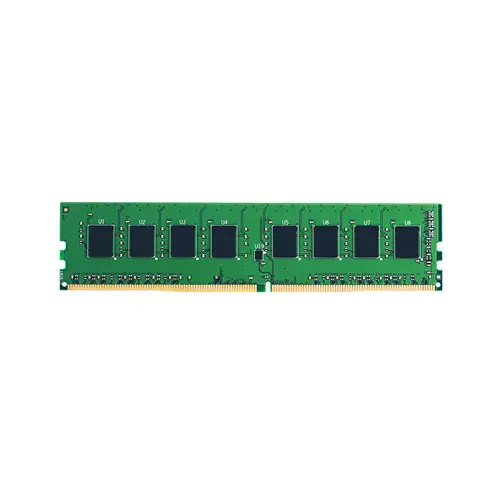
Based on its RDIMM form factor, Registered signal type, and ECC support, the Samsung M393A4K40BB0-CRC is unmistakably server-grade memory engineered for mission-critical enterprise environments. Its four key characteristics directly address the pain points of data centers. First, the integrated ECC (Error-Correcting Code) is your silent guardian against single-bit soft errors caused by cosmic radiation, which silently corrupt data in long-running virtualization clusters; with ECC, a flipped bit inside a virtual machine’s memory state is detected and corrected on the fly, preventing unpredictable application crashes or silent data corruption that would otherwise undermine an entire hypervisor’s stability. Second, the Registered (buffered) architecture stabilizes communication between the CPU and memory when populating all 24 DIMM slots in a 2U server—without it, the electrical load would cause signal degradation and boot failures, but with it, your massive 32GB capacity per stick scales reliably to hundreds of gigabytes for dense virtualized workloads. Third, the dual-rank configuration of x4 DRAM chips unlocks interleaving, meaning the memory controller can issue concurrent commands to two internal ranks, which substantially accelerates the random-access performance critical for in-memory databases like SAP HANA or Redis where microseconds of latency directly impact transaction throughput. Finally, the 1.2V low-voltage DDR4 design dramatically reduces power draw across a fleet of hundreds of nodes, curbing thermal stress and operational costs in a 24/7 data center. Together, these features mean your virtualized infrastructure and memory-hungry analytics platforms run not just faster, but with the absolute integrity, density, and energy efficiency that revenue-critical services demand.
General Virtualization
For dense VM consolidation, deploy this 32GB RDIMM across all available channels to maximize capacity per socket. Aim for 256GB–512GB per host using eight to sixteen modules in a balanced population, which satisfies moderate overcommit ratios without memory ballooning latency.
In-Memory Database
Large memory footprints are critical; configure six or twelve identical 32GB DIMMs per CPU to reach 192GB–384GB of low-latency ECC RAM. Populate all channels symmetrically to sustain high throughput under Redis or SAP HANA, and avoid mixing ranks that could throttle frequency.
High Performance Computing
Bandwidth-sensitive workloads demand full channel utilization, so install one DIMM per channel (e.g., eight modules for 256GB on a dual-socket system). Dual-rank x4 devices like this module deliver strong stream performance, and keeping the configuration uniform at 1 DIMM per channel preserves the 2400 MT/s speed without downclocking.
Rigorously tested server memory. Compatible with Dell PowerEdge R740, HPE ProLiant DL380 Gen10, Lenovo ThinkSystem SR650.
Q: Can I mix this M393A4K40BB0-CRC with other memory modules of different brands or speeds?
A: Mixing is not recommended for server environments. Mismatched modules may cause instability or speed reduction to the lowest common denominator. For mission-critical reliability, use identical Samsung DDR4-2400 RDIMMs.
Q: Is this memory compatible with my server platform, such as Intel Xeon Scalable or AMD EPYC?
A: This DDR4-2400 ECC Registered RDIMM is widely compatible with Intel Xeon Scalable and AMD EPYC platforms. Always verify your server motherboard's QVL to ensure full compatibility with this 288-pin dual-rank module.
Q: What is the recommended DIMM population order for optimal performance?
A: Populate identical DIMMs per channel, balancing across all memory channels. For dual-processor servers, install equal capacity in symmetric slots. Refer to your system’s service manual for the exact slot numbering to maximize interleaving.
Q: Does this module support overclocking or XMP profiles?
A: No. Enterprise server memory like this 1.2V DDR4-2400 RDIMM is engineered for maximum stability and data integrity. Overclocking and XMP are not supported, as they compromise ECC and registered signal standards.
Q: What warranty and typical failure rate can I expect for this Samsung server memory?
A: It includes a 1-year warranty. As a genuine Samsung enterprise module, the annualized failure rate (AFR) is extremely low, typically under 0.4%, ensuring top-tier reliability for 24/7 data center operations.