











 Secure payments
Standard refund policy
Trade Assurance
Secure payments
Standard refund policy
Trade Assurance
| Product Type | Memory Module |
|---|---|
| Memory Capacity | 32 GB |
| Memory Technology | DDR4 |
| Product Voltage | 1.2 V |
| RAM Speed | 2666 MHz |
| RAM Standard | DDR4-2666/PC4-21300 |
| Error Identifying | ECC |
| Signal Type | Registered |
| Column Access Strobe (CAS) | CL19 |
| Rank | Dual Rank x4 |
| Quantity of Pins | 288-pin |
| RAM Genre | RDIMM |
This RDIMM is purpose-built for enterprise servers and workstations, delivering critical data integrity through registered signal buffering and ECC protection which makes it the definitive choice for memory-intensive virtualization, in-memory databases, and mission-critical workloads. The dual-rank x4 organization paired with a 2666 MT/s transfer rate and CL19 latency provides a balanced combination of capacity interleaving and efficient bandwidth, ensuring reliable performance across heavily loaded multi-channel platforms.
1. The high-density module capacity allows servers to pack more active virtual machines per host, directly boosting consolidation ratios while maintaining smooth application performance under heavy multi-tenancy.
2. On-the-fly ECC correction eliminates silent data corruption, ensuring transactional databases and long-running analytic jobs deliver accurate results without downtime.
3. Registered buffering stabilizes signal integrity across fully loaded memory channels, enabling predictable performance in large-scale virtualization clusters as RAM scales.
4. Dual Rank x4 architecture interleaves bank accesses to keep memory channels saturated, delivering consistent bandwidth for concurrent enterprise workloads like in-memory caching.
5. The fast DDR4 transfer rate supplies the sustained throughput needed for real-time streaming analytics and high-frequency OLTP, preventing I/O stalls under peak loads.
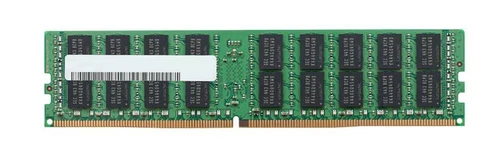
When you are running a virtualized cluster hosting dozens of VMs, a single uncorrected memory error can cascade into silent data corruption across your entire tenant workload. The Samsung M393A4K40CB2-CTD6Q is a 32 GB DDR4-2666 Registered DIMM built with ECC, and that changes the equation from risk to resilience. ECC detects and corrects single-bit flips in real time, which directly protects in-memory database instances like SAP HANA or Redis from transactional inconsistencies. Meanwhile, the Registered signal buffer stabilizes the command and address lines, allowing a server to support fully populated 24‑slot configurations without signal degradation. In high‑density hypervisor environments, that means you can scale RAM to terabytes without random reboot headaches. This module’s dual‑rank x4 organization further unlocks interleaving gains: the memory controller can access two internal rank groups concurrently, measurably lifting bandwidth for analytics queries that scan large in‑memory tables. Forty‑plus virtual machines per node, a live financial trading cache, or a dense container platform—none of them tolerate silent faults or mid‑day crashes. Here, 32 GB ECC registered capacity, dual‑rank parallelism, and 1.2 V efficiency converge to give IT architects the stability and throughput their critical services demand.
General Virtualization
For a typical hypervisor hosting mixed VMs, populate the server with at least eight of these 32GB RDIMMs to achieve 256GB total. This dual-rank x4 configuration balances capacity and memory bandwidth, avoiding bottlenecks during live migration and resource overcommitment. Distribute modules evenly across all memory channels to maximize interleaving and sustain performance as VM density increases.
In-Memory Database
In-memory databases like Redis or SAP HANA demand low latency and high reliability. Deploy twelve or more modules per socket to reach 384GB+ while leveraging the ECC and registered signals for data integrity. Configure all channels identically with these CL19 RDIMMs to maintain consistent access times, and keep spare DIMM slots free for future scaling without downtime.
High-Performance Computing (HPC)
HPC clusters running MPI workloads require maximum memory bandwidth. Install one 32GB DIMM per channel across all available channels—typically eight or twelve modules per node—to saturate the DDR4-2666 interface. The dual-rank x4 organization provides an optimal rank-per-channel ratio, reducing contention in parallel file system buffers and accelerating iterative solver performance under heavy floating-point loads.
Server validated: rigorously tested, compatible with Dell PowerEdge R740/R640, HPE DL380 Gen10, Lenovo SR650.
Q: Can I mix this M393A4K40CB2-CTD6Q with other memory modules of different brands or speeds?
A: Mixing RDIMMs of different brands or speeds is not recommended. It can force the memory controller to lower frequencies and disable essential ECC functions, risking stability and data integrity in server environments.
Q: Is this memory compatible with my server system?
A: This DDR4-2666 ECC registered DIMM is compatible with platforms supporting the standard, such as Intel Xeon Scalable and AMD EPYC 7000/7002/7003 series. Always verify your motherboard's qualified vendor list.
Q: What is the recommended DIMM population order for optimal performance?
A: Populate identical DIMMs in sets of one, two, four, or eight per channel, following your server board's slot numbering guide. Balanced configuration across memory channels ensures maximum bandwidth and interleaving.
Q: Does this module support overclocking or XMP profiles?
A: No. Enterprise-class registered memory is designed for reliability and compliance with JEDEC timings at 1.2V. Overclocking or XMP profiles are not supported and would compromise error correction and system stability.
Q: What warranty and typical failure rate can I expect?
A: This module includes a one-year warranty. It is built to rigorous server-grade standards with very low annualized failure rates. For exact AFR data, refer to Samsung’s official reliability documentation.