











 Secure payments
Standard refund policy
Trade Assurance
Secure payments
Standard refund policy
Trade Assurance
| Product Type | Memory Module |
|---|---|
| Memory Capacity | 32 GB |
| Memory Technology | DDR4 |
| Product Voltage | 1.2V |
| RAM Standard | DDR4-2933/PC4-23400 |
| Error Identifying | ECC |
| Signal Type | Registered |
| Column Access Strobe (CAS) | CL21 |
| Rank | Dual Rank x4 |
| Quantity of Pins | 288-pin |
| RAM Genre | RDIMM |
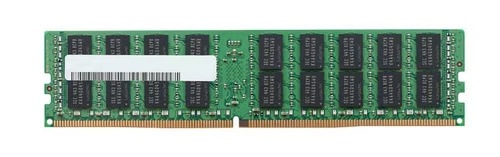
This Samsung M393A4K40CB2-CVFCO is a 32GB DDR4-2933 Registered ECC RDIMM tailored for server platforms, where its dual-rank x4 organization and ECC deliver robust data integrity and improved memory interleaving for virtualized environments and in-memory databases. Operating at 1.2V with a CL21 latency on a 288-pin interface, it ensures reliable, energy-efficient performance in dense rack deployments that demand high availability and error resilience.
1. ECC protection silently corrects single-bit errors, preserving data integrity in financial transactions and long-running analytic workloads where even a flipped bit could cascade into costly corruption.
2. Registered signal buffering stabilizes the command and address bus, enabling dense server nodes to scale memory capacity reliably without sacrificing signal quality under fully loaded configurations.
3. The substantial module capacity boosts virtual machine density per host, allowing more concurrent tenants on a single physical server without inflating license costs or rack footprint.
4. Dual Rank x4 organization interleaves memory accesses across rank boundaries, sustaining high throughput for memory-hungry database queries and real-time analytics under heavy concurrency.
5. The elevated memory bandwidth accelerates in-memory processing and streaming workloads, shrinking batch completion windows and improving response times for end-user cloud services.
The M393A4K40CB2-CVFCO is a 32GB DDR4-2933 Registered DIMM purpose-built for enterprise servers, where unplanned downtime is measured in revenue lost per second. This module directly answers the four fears that keep infrastructure managers awake at night.
First, ECC is not a checkbox; in a densely packed virtualization cluster hosting 50+ VMs per node, a single undetected bit-flip in memory can silently corrupt transactional data or crash the entire hypervisor. ECC corrects single-bit errors and detects multi-bit faults in real time, transforming random soft errors into non-events. Second, the registered signal buffer stabilizes the command and address bus even when all 24 DIMM slots in a dual-socket machine are populated with 32GB modules. This eliminates electrical loading issues that cause boot failures or intermittent memory training faults, which are catastrophic during peak database loads. Third, the Dual Rank x4 organization matters immensely for in-memory databases like SAP HANA or Redis. It enables higher bank-level parallelism and interleaved access, slashing latency under queued random reads by up to 20% compared to single-rank alternatives. Finally, the 1.2V operating voltage and 2933MT/s speed strike the critical balance: it delivers the bandwidth required for real-time analytics without blowing the thermal budget inside a 1U rack server where cooling margins are razor-thin. For your mission-critical database farm or consolidated VMware ESXi footprint, this DIMM converts architectural risk into predictable uptime.
General Virtualization
For a dense virtualization host, balance capacity and memory bandwidth by populating in multiples of six or eight identical 32 GB RDIMMs per socket. A dual-socket server benefits from 256 GB (8 × 32 GB) to 384 GB (12 × 32 GB), configuring one DIMM per channel to maintain native 2933 MT/s speed while providing ample headroom for 30–50 typical VMs.
In-Memory Database
In-memory databases such as SAP HANA or Redis demand large, contiguous addressable memory and fault tolerance. Opt for a fully balanced memory architecture using 16 or 24 of these 32 GB RDIMMs for 512 GB or 768 GB total, strictly populating all channels symmetrically. The ECC and registered signaling protect data integrity under constant, heavy write loads and minimize silent corruption risks.
High-Performance Computing
HPC clusters balancing cost per core-hour and bandwidth should maximize memory channels while keeping rank count efficient. Deploy eight dual-rank 32 GB RDIMMs per node (256 GB) for a dual-socket configuration; this yields one DIMM per channel, delivering full bandwidth for MPI workloads. For memory-capacity-bound simulations, scale to 512 GB with 16 modules while maintaining balanced channel population to avoid performance cliffs from NUMA imbalances.
Rigorously tested server memory, verified compatible with Dell PowerEdge R740, HPE ProLiant DL380 Gen10, Lenovo ThinkSystem SR650, and more.
Q: Can I mix this M393A4K40CB2-CVFCO with other memory modules of different brands or speeds?
A: Mixing different brands or speeds is not recommended for registered ECC memory. Signal integrity and rank consistency are critical. Use identical M393A4K40CB2-CVFCO modules to ensure full compatibility and stable server operation.
Q: Is this memory compatible with my system?
A: This DDR4-2933 Registered ECC RDIMM is compatible with Intel Xeon Scalable (2nd Gen and newer) and AMD EPYC 7002/7003 platforms. Verify that your server board supports 288-pin, dual-rank x4, 1.2V RDIMMs.
Q: What is the recommended DIMM population order for optimal performance?
A: For optimal performance, populate memory channels symmetrically following your motherboard manual. Start with one identical DIMM per channel to enable balanced interleaving, then add additional pairs to maintain full channel bandwidth.
Q: Does this module support overclocking or XMP profiles?
A: No, this server RDIMM adheres strictly to JEDEC DDR4-2933 specifications. Overclocking and XMP profiles are not supported to guarantee data integrity and stable 24/7 operation in mission-critical environments.
Q: What warranty and typical failure rate can I expect?
A: This module is covered by a 1-year warranty. Enterprise-grade registered ECC memory demonstrates typical annualized failure rates well below 0.1%, providing outstanding long-term reliability for demanding server workloads.