











 Secure payments
Standard refund policy
Trade Assurance
Secure payments
Standard refund policy
Trade Assurance
| Product Type | Memory Module |
|---|---|
| Memory Capacity | 32 GB |
| Memory Technology | DDR4 |
| Product Voltage | 1.2 V |
| RAM Speed | 2666 MHz |
| RAM Standard | DDR4-2666/PC4-21300 |
| Error Identifying | ECC |
| Signal Type | Registered |
| Column Access Strobe (CAS) | CL19 |
| Rank | Dual Rank x4 |
| Quantity of Pins | 288-pin |
| RAM Genre | RDIMM |
Designed for enterprise servers with its Registered ECC architecture, this 32GB DDR4-2666 RDIMM ensures data integrity in virtualized environments and memory-intensive databases. The dual-rank x4 configuration optimizes interleaving for higher bandwidth, while the CL19 timing and 1.2V low-voltage operation deliver stable, energy-efficient 24/7 data center performance.
1. ECC error correction detects and corrects single-bit data errors, safeguarding long-running enterprise workloads and financial databases from silent data corruption.
2. Registered signal buffering enables stable operation across multiple DIMMs per channel, essential for achieving maximum memory footprint in large-scale server deployments without signal degradation.
3. 32GB capacity per module doubles the memory density over standard 16GB sticks, allowing IT administrators to provision more virtual machines per host while preserving headroom for memory-intensive services.
4. Dual Rank x4 organization leverages rank interleaving to keep the 72-bit memory bus fully utilized, delivering the sustained throughput that virtualized and containerized applications demand under heavy load.
5. 2666 MT/s transfer rate balances bandwidth and power efficiency, supplying modern server CPUs with enough data per cycle to handle concurrent analytics queries without unnecessary thermal overhead.
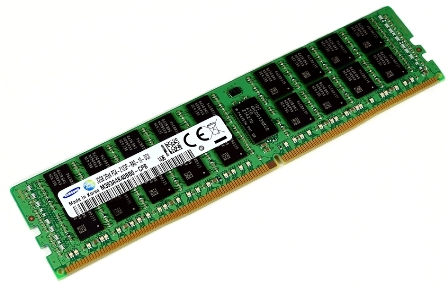
The Samsung M393A4K40DB2-CTD is a server-grade DDR4 RDIMM, purpose-built for mission-critical enterprise environments where failure is not an option. Its four defining characteristics directly address the real pain points of data center operators. First, ECC error correction continuously detects and corrects single-bit memory errors caused by background radiation, preventing silent data corruption that could crash a virtualized cluster or poison financial transactions. Second, the registered signal buffer stabilizes the electrical load on the memory controller, allowing your server to populate all 24 DIMM slots without sacrificing signal integrity—vital when scaling a VMware farm from a handful of VMs to hundreds. Third, the dual-rank x4 organization interleaves memory accesses across two internal ranks, significantly boosting effective bandwidth for latency-sensitive in-memory databases like SAP HANA or Redis. Finally, the generous 32GB capacity per stick enables dense memory configurations, letting you provision massive virtual machines or run large-scale database joins entirely in RAM, slashing storage I/O wait times and delivering consistent low-latency responses under heavy consolidation workloads.
General Virtualization
For a typical hypervisor hosting multiple VMs, populate the server with at least four to eight of these 32GB RDIMMs to achieve 128–256 GB of total capacity. Distribute modules evenly across memory channels to maximize bandwidth, and leave headroom for future scaling. Registered ECC memory ensures stability and data integrity under sustained multi-tenant workloads.
In-Memory Database
In-memory databases like Redis or SAP HANA demand both capacity and low latency. A six- or eight-DIMM configuration yielding 192–256 GB fits moderate datasets, while larger instances should fill all available channels for maximum bandwidth. The ECC and registered design protect against bit errors during high-frequency transactions, making this RDIMM ideal for financial or real-time analytics platforms.
High-Performance Computing (HPC)
HPC clusters benefit from fully populating memory channels to avoid bottlenecks in large-scale simulations or parallel calculations. Start with one 32GB DIMM per channel (e.g., eight modules on a dual-socket board) for balanced throughput. The dual-rank x4 organization and CL19 latency deliver consistent performance under compute-intensive, sustained loads, and registered ECC safeguards long-running jobs against silent data corruption.
Rigorously tested, this server DDR4 RDIMM is compatible with Dell PowerEdge R740, HPE ProLiant DL380 Gen10, Lenovo ThinkSystem SR650.
Q: Can I mix this M393A4K40DB2-CTD with other memory modules of different brands or speeds?
A: Mixing RDIMMs with different brands or speeds is strongly discouraged in servers. It often causes POST failures or stability issues due to mismatched timings and ranks. For reliable operation, use identical modules.
Q: Is this memory compatible with my Intel Xeon Scalable or AMD EPYC server platform?
A: This DDR4-2666 Registered ECC DIMM is validated for Intel Xeon Scalable (1st/2nd Gen) and AMD EPYC 7001/7002 series platforms. Please verify your specific motherboard’s memory QVL to ensure full compatibility and supported configurations.
Q: What is the recommended DIMM population order for optimal performance with this module?
A: For dual-socket servers, populate identical DIMMs per channel starting with channels farthest from the CPU. A balanced configuration across all memory channels ensures maximum bandwidth and avoids NUMA performance penalties.
Q: Does this Samsung server memory module support overclocking or XMP profiles?
A: No. This is a JEDEC-compliant Registered ECC module operating at a fixed 1.2V and 2666 MT/s. Server memory prioritizes data integrity and stability over performance tuning, so overclocking and XMP are not supported.
Q: What warranty and typical failure rate can I expect for this RDIMM?
A: This M393A4K40DB2-CTD module comes with a 1-year warranty. With robust Samsung B-die and ECC, the annualized failure rate is typically under 0.5% in controlled data center environments, ensuring high long-term reliability.