











 Secure payments
Standard refund policy
Trade Assurance
Secure payments
Standard refund policy
Trade Assurance
| Product Type | Memory Module |
|---|---|
| Memory Capacity | 32 GB |
| Memory Technology | DDR4 |
| Product Voltage | 1.2 V |
| RAM Speed | 2933 MHz |
| RAM Standard | DDR4-2933/PC4-23400 |
| Error Identifying | ECC |
| Signal Type | Registered |
| Column Access Strobe (CAS) | CL21 |
| Rank | Dual Rank x4 |
| Quantity of Pins | 288-pin |
| RAM Genre | RDIMM |
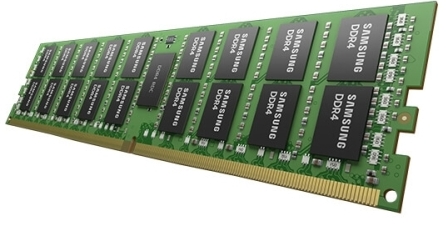
This 32GB DDR4-2933 Registered ECC RDIMM with a dual-rank x4 configuration is engineered for enterprise servers and virtualization platforms demanding maximum data integrity and memory density. Its registered buffering stabilizes heavy signal loads across densely populated DIMM slots while integrated ECC corrects single-bit errors in real time, making it ideal for in-memory databases and large-scale virtual machine deployments.
1. ECC protection automatically corrects single-bit errors, preserving data integrity for transactional databases and financial workloads.
2. Registered signal buffering stabilizes command and address lines in fully-populated servers, enabling rock-solid uptime for mission-critical applications.
3. A 32GB module density boosts total system memory headroom, allowing more virtual machines per physical host without sacrificing performance.
4. Dual-rank x4 organization interleaves memory accesses across two ranks, sustaining peak bandwidth even under mixed read/write workloads typical in virtualized clusters.
5. 2933 MT/s throughput accelerates in-memory analytics and caching layers, reducing query latency for business intelligence dashboards.
The M393A4K40DB2-CVF is an RDIMM engineered specifically for server environments, and its four defining characteristics directly address the critical demands of enterprise data centers. First, the integrated ECC technology detects and corrects single-bit memory errors that can occur from background radiation or cosmic particles. In a virtualized cluster hosting dozens of financial transaction systems, such an uncorrected error would silently corrupt a virtual machine and lead to cascading transactional failure; ECC ensures data integrity remains absolute. Second, the Registered (buffered) signal architecture stabilizes communication between the CPU and memory modules when you fully populate all 24 DIMM slots for maximum capacity. Without a register to redrive signals, electrical loading would cause signal degradation, random crashes, and unsustainable downtime—a disaster during peak-hour database queries. Third, the dual-rank x4 organization exploits rank interleaving to keep the memory controller fed with data while one rank is refreshed, effectively boosting bandwidth without overclocking. This is crucial for an in-memory database like Redis that must sustain hundreds of thousands of low-latency operations per second while serving multiple analytics dashboards, preventing bottlenecks during read surges. Finally, operating at a standard 1.2 V and DDR4-2933 speed, the module delivers the performance-per-watt balance that hyperscale deployments require—lower power means less heat stress across the entire rack, directly reducing cooling costs and extending the service life of your 288-pin RDIMM population. Together, these features translate into uncompromised stability, predictable performance, and a rock-solid foundation for business-critical workloads where every bit of data and every millisecond counts.
Based on the ECC registered signal, 288-pin RDIMM form factor, and Dual Rank x4 design, this 32GB DDR4-2933 module is a server memory DIMM. Optimal configurations per workload:
General Virtualization
Populate all memory channels uniformly to maximize memory bandwidth and capacity. A balanced starting point is one 32GB DIMM per channel (e.g., 12 DIMMs for 384GB on a dual-socket server); for heavier consolidation, use two DIMMs per channel (24 DIMMs for 768GB).
In-Memory Database
Maximize capacity by installing two DIMMs per channel across all sockets, reaching 768GB or more per node. The Dual Rank x4 architecture improves bank-level parallelism, which reduces latency; always use identical part numbers to guarantee stability and enable memory mirroring or sparing.
High-Performance Computing (HPC)
Prioritize speed over maximum density: install one DIMM per channel to sustain 2933 MT/s without frequency drops. The Dual Rank x4 design delivers superior bandwidth; a common node setup uses 12 of these 32GB RDIMMs for 384GB while fully saturating all memory channels.
Rigorously tested and validated for Dell PowerEdge R740, HPE ProLiant DL380 Gen10, Lenovo ThinkSystem SR650, and similar servers.
Q: Can I mix this M393A4K40DB2-CVF with other memory modules of different brands or speeds?
A: Mixing is not recommended. This 32GB DDR4-2933 registered ECC RDIMM requires identical modules for validated stability and performance in server platforms. Mixed brands, speeds, or ranks may cause POST failures or signal integrity issues.
Q: Is this memory compatible with my system?
A: Compatibility requires a server board with DDR4 RDIMM support and a compatible Intel Xeon Scalable or AMD EPYC CPU. Verify that your system's qualified vendor list includes this 2933MT/s, 1.2V, dual-rank x4 module; check chipset and BIOS revision.
Q: What is the recommended DIMM population order for optimal performance?
A: Populate DIMMs per your server's manual, typically filling the farthest slot from the CPU per channel first. This balances memory channels and interleaving, maximizing bandwidth with this 2Rx4 registered module.
Q: Does this module support overclocking or XMP profiles?
A: No. This is a JEDEC-compliant enterprise RDIMM running at fixed 2933MT/s with CL21. It does not support overclocking or Intel XMP profiles, ensuring maximum reliability for mission-critical 24x7 workloads.
Q: What warranty and typical failure rate can I expect?
A: This module includes a one-year warranty. As a rigorously tested RDIMM built with Samsung DRAM, its annualized failure rate is typically below 0.5% under specified server operating conditions.