











 Secure payments
Standard refund policy
Trade Assurance
Secure payments
Standard refund policy
Trade Assurance
| Product Type | Memory Module |
|---|---|
| Compliance Standards | |
| Memory Capacity | 32 GB |
| Memory Technology | DDR4 |
| Product Voltage | 1.2 V |
| RAM Speed | 3200 MHz |
| RAM Standard | DDR4-3200/PC4-25600 |
| Error Identifying | ECC |
| Signal Type | Registered |
| Column Access Strobe (CAS) | CL22 |
| Rank | Dual Rank x4 |
| Quantity of Pins | 288-pin |
| RAM Genre | RDIMM |
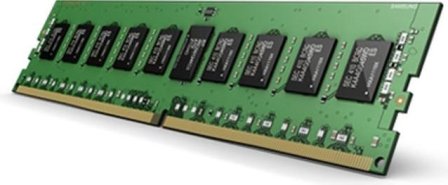
Designed for server-class platforms, this Samsung 32GB DDR4-3200 RDIMM (M393A4K40DB3-CWECO) leverages a registered signal type and ECC to ensure data integrity in memory-intensive workloads such as virtualization and in-memory databases. Its dual-rank x4 organization enhances memory bank interleaving for improved bandwidth efficiency, while the CL22 latency and 1.2V operation deliver a stable, power-efficient foundation for enterprise deployments.
1. ECC protection detects and corrects single-bit memory errors in real time, preserving data integrity for mission-critical databases and preventing silent corruption in long-running server workloads.
2. Registered signal buffering stabilizes high-density memory configurations by reducing electrical load on the memory controller, allowing data centers to scale DRAM capacity without compromising system uptime.
3. With a sizable 32 GB footprint, each module supports dense virtual machine consolidation, letting IT teams run more simultaneous workloads per physical host without resorting to expensive storage swap.
4. 3200 MT/s throughput elevates memory bandwidth, accelerating in-memory analytics and high-frequency trading applications where every microsecond of data access latency carries financial impact.
5. Dual Rank x4 organization interleaves internal memory banks to maximize channel utilization, ensuring consistent low-latency performance under the heavy, randomized access patterns typical of multi-tenant cloud services.
The Samsung M393A4K40DB3-CWECO is a server-class Registered ECC DDR4 module purpose-built for enterprise workloads. Its ECC capability means every bit is policed—in a virtualized cluster, a single uncorrected error could corrupt a hypervisor’s memory state and bring down dozens of VMs; ECC prevents this silent failure. The Registered buffer handles staggering electrical loads when all 24 slots of a dual-socket server are filled, giving you stable 32GB capacity per slot without signal compromise, enabling multi-terabyte memory pools. The dual-rank x4 organization enables rank interleaving for faster simultaneous reads and writes—vital when multiple VMs or an in-memory database like Redis hammer the memory bus. Finally, 3200MT/s speed with CL22 latency at 1.2V delivers high bandwidth and energy efficiency, cutting power costs in colocation environments. For your database transactions or virtual desktop infrastructure, these characteristics translate directly into data integrity, predictable low latency, and maximum consolidation density.
General Virtualization
For general virtualization, install one 32GB RDIMM in each memory channel of a dual‑socket server (eight channels per CPU), achieving 512GB total. This balanced 1‑DIMM‑per‑channel (1DPC) population sustains full 3200 MT/s speed and supplies sufficient capacity for high VM density. Symmetric, identical module placement across sockets ensures optimal NUMA behavior and reliable ECC operation.
In‑Memory Database
Maximize capacity for in‑memory databases by filling all available DIMM slots—24 modules in a typical two‑socket platform deliver 768GB. Running at 2 DIMMs per channel may reduce the speed to 2933 or 2666 MT/s, but the capacity gain allows entire datasets to reside in memory. Use identical 32GB Dual‑Rank x4 RDIMMs to preserve signal integrity and ECC coverage.
High Performance Computing
For bandwidth‑intensive HPC workloads, populate every memory channel with a single 32GB RDIMM (1DPC) to maintain the full 3200 MT/s rate. A dual‑socket node with 8 channels per socket yields 512GB of low‑latency, high‑bandwidth memory. This avoids the throughput penalty of 2DPC and fully exploits the memory controller’s potential for parallel simulation codes.
Validated server RAM, rigorously tested, compatible with Dell R750, HPE DL380 Gen10, Lenovo SR650 V2, Supermicro X12.
Q: Can I mix this M393A4K40DB3-CWECO with other memory modules of different brands or speeds?
A: Mixing different brands or speeds of RDIMMs is not recommended in servers. It often causes stability issues, POST failures, or unexpected performance drops. Use identical part numbers across all channels to ensure validated co-operation.
Q: Is this memory compatible with my system?
A: This module is compatible with servers using Intel Xeon Scalable or AMD EPYC platforms that support DDR4-3200 ECC Registered DIMMs. Always verify your motherboard or system vendor’s memory QVL to confirm full compatibility.
Q: What is the recommended DIMM population order for optimal performance?
A: Populate identical DIMMs per channel, starting with the farthest slot from the CPU. Balance memory across all memory channels and follow the server motherboard’s population guide to maximize bandwidth and avoid performance bottlenecks.
Q: Does this module support overclocking or XMP profiles?
A: No. This is a JEDEC-compliant ECC Registered server memory module. It operates at fixed timings and voltage for stability and data integrity, not supporting XMP or overclocking features common in consumer desktop memory.
Q: What warranty and typical failure rate can I expect?
A: This module is backed by a 1-year limited warranty. Built with enterprise-grade components and rigorous testing, its annualized failure rate is extremely low, typically below 0.5% in properly cooled and maintained server environments.