











 Secure payments
Standard refund policy
Trade Assurance
Secure payments
Standard refund policy
Trade Assurance
| Product Type | Memory Module |
|---|---|
| Compliance Standards | EU RoHS,FCC |
| Memory Capacity | 4 GB |
| Memory Technology | DDR4 |
| Product Voltage | 1.2 V |
| RAM Speed | 2133 MHz |
| RAM Standard | DDR4-2133/PC4-17000 |
| Error Identifying | ECC |
| Signal Type | Registered |
| Column Access Strobe (CAS) | CL15 |
| Rank | Single Rank x8 |
| Quantity of Pins | 288-pin |
| RAM Genre | RDIMM |
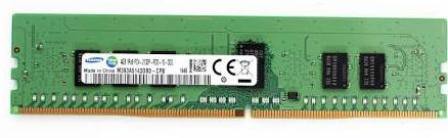
This RDIMM is engineered for server platforms, employing registered signal buffering and ECC to ensure data integrity in virtualization, memory-resident databases, and other mission-critical workloads where even single-bit errors are unacceptable. Its single-rank x8 organization with a CL15 latency minimizes electrical loading on the memory bus, enabling stable command rates and lower thermal stress in dense rack servers at the standard 1.2 V operating voltage.
1. ECC protection silently detects and corrects single-bit errors in real time, preserving data integrity for financial transactions or virtualized databases that cannot tolerate any corruption.
2. Registered buffering decouples the command and address bus from the DRAM load, allowing fully populated servers to maintain signal clarity across dozens of modules without compromising stability.
3. A 4 GB capacity fits cost-optimized management nodes, lightweight container hosts, or dedicated appliance roles where footprint and budget matter more than raw memory density.
4. The 2133 MT/s base frequency provides predictable, consistent throughput for entry-level enterprise applications without exceeding typical thermal limits of dense rack deployments.
5. Running at 1.2 volts aligns with the DDR4 low-power envelope, trimming total server electricity consumption and lowering cooling overhead in always-on data center environments.
The M393A5143DB0-CPB is a Registered DDR4-2133 RDIMM, purpose-built for the relentless demands of enterprise servers. Its four defining characteristics directly address the real-world pain points of data center operators. First, Error-Correcting Code (ECC) functions as an invisible safeguard against single-bit memory errors, which cosmic radiation or electrical noise can cause. In a financial trading database or an in-memory analytics platform like SAP HANA, an undetected bit flip could corrupt a transaction or skew a critical report; ECC automatically corrects these errors, protecting data integrity at all times. Second, the Registered (buffered) signal architecture stabilizes the command and address bus, allowing a server to reliably populate all DIMM slots per channel without signal degradation. For a virtualization cluster running dozens of VMs on VMware or Hyper-V, this means you can scale memory capacity densities for more virtual machines per host, eliminating costly premature hardware refreshes. Third, the Single Rank x8 configuration strikes a balance between low latency and bandwidth, delivering consistent CL15 performance under the heavy, concurrent access patterns of multi-socket database servers. Finally, the 1.2V DDR4 standard dramatically reduces power consumption and active cooling requirements compared to previous generations. In a rack full of web servers operating 24/7, this cumulative energy efficiency directly lowers your total cost of ownership, turning a memory upgrade into a long-term operational savings strategy.
General Virtualization
For virtualized environments, populate all available memory channels with identical 4 GB RDIMMs to maximize bandwidth and reduce latency. A balanced configuration such as 8 modules per server (32 GB total) suits light to moderate VM densities, but scale up by deploying additional servers for larger workloads.
In-Memory Database
In-memory databases demand low latency and absolute data integrity, making ECC Registered DIMMs essential. Given the modest 4 GB per module, aim for high module counts—12 or more per socket—to reach 48–128 GB while keeping channels fully populated. Use identical single-rank x8 DIMMs to avoid performance penalties from mixed ranks.
High-Performance Computing (HPC)
HPC workloads require wide memory bandwidth, so install one DIMM per channel across all channels to enable full memory interleaving. Although 4 GB modules are small, configuring 8 or 16 modules provides 32–64 GB of ECC-protected capacity. For maximum throughput, maintain uniform single-rank modules and avoid populating only a subset of channels.
Rigorously tested ECC RDIMM for servers—compatible with Dell PowerEdge R750, HPE DL380 Gen10, Lenovo SR650.
Q: Can I mix this M393A5143DB0-CPB with other memory modules of different brands or speeds?
A: Mixing with modules of different brands or speeds is not recommended in server environments. It can cause signal integrity issues and instability. Use identical RDIMMs with the same part number and revision to ensure reliable operation.
Q: Is this memory compatible with my system?
A: This DDR4-2133 ECC Registered RDIMM is compatible with platforms using Intel Xeon E5-2600 v3/v4 or AMD EPYC 7001 series processors and C610 chipset. Always consult your server vendor's memory QVL to confirm support.
Q: What is the recommended DIMM population order for optimal performance?
A: Populate identical DIMMs in matched sets per channel, starting with slots farthest from the CPU. Follow your motherboard's specific guidelines—typically populate the white or blue connectors first to balance memory channels and maximize throughput.
Q: Does this module support overclocking or XMP profiles?
A: No. This is a JEDEC-compliant DDR4-2133 Registered ECC module designed for server environments. It does not support overclocking or XMP profiles, prioritizing signal stability and data integrity over frequency flexibility.
Q: What warranty and typical failure rate can I expect?
A: This Samsung module is covered by a 1-year warranty. Enterprise-grade Registered ECC DIMMs exhibit a very low annualized failure rate (AFR), typically below 0.5%, ensuring long-term mission-critical reliability under 24/7 operation.