











 Secure payments
Standard refund policy
Trade Assurance
Secure payments
Standard refund policy
Trade Assurance
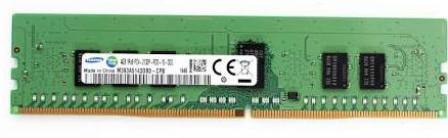
| Model | M393A5143DB0-CPB20 |
|---|---|
| Product Type | Memory Module |
| Compliance Standards | EU RoHS,FCC |
| Memory Capacity | 4 GB |
| Memory Technology | DDR4 |
| Product Voltage | 1.2V |
| RAM Speed | 2133MHz |
| RAM Standard | DDR4-2133/PC4-17000 |
| Error Identifying | ECC |
| Signal Type | Registered |
| Column Access Strobe (CAS) | CL15 |
| Rank | Single Rank x8 |
| Quantity of Pins | 288-pin |
| RAM Genre | RDIMM |
Engineered for enterprise servers, this Samsung M393A5143DB0-CPB20 4GB DDR4-2133 RDIMM leverages Registered ECC technology to ensure data integrity in virtualization and in-memory database workloads. Its single-rank x8 configuration and CL15 latency deliver stable signal integrity on dense 288-pin platforms while keeping power low at 1.2V.
1. Registered signal type strengthens signal integrity, enabling densely populated server motherboards to maintain error-free operation across continuously running virtualized clusters.
2. ECC error correction automatically detects and resolves single-bit flips, shielding in-memory databases from silent data corruption that could compromise financial integrity.
3. DDR4 technology raises energy-efficient bandwidth, allowing containerized microservices to scale seamlessly under the power and thermal limits of multi-node data centers.
4. A sustained throughput of seventeen gigabytes per second ensures consistent sub-millisecond response for hot data in content delivery caching layers.
5. Single Rank x8 layout minimizes electrical load per channel, making it practical to fully populate DIMM slots and maximize memory headroom for dense virtual machine consolidation.
When powering a virtualization cluster or an in-memory database, your server’s memory must deliver absolute stability and data integrity. The Samsung M393A5143DB0-CPB20 RDIMM is engineered precisely for these demands. Its ECC technology actively detects and corrects single-bit errors, preventing silent data corruption that could crash virtual machines or compromise financial transactions in a Redis or SAP HANA node—this translates directly into uninterrupted uptime for your critical services. The Registered signal buffer decouples the memory controller from the DRAM loads, enabling you to populate multiple DIMMs per channel without sacrificing signal quality, which is vital when scaling out a hypervisor host to support dozens of VMs. Built as a Single Rank x8 module, it minimizes electrical loading and cross-rank contention, ensuring consistent low latency and high throughput under the sustained pressure of real-time analytics. Additionally, the 1.2 V DDR4 design reduces power consumption in dense rack deployments, lowering your cooling burden and operating cost. For your virtualized workloads and in-memory data processing, this RDIMM turns unseen reliability into a tangible business advantage.
Capacity Planning for Samsung M393A5143DB0-CPB20
This registered ECC DDR4-2133 module is designed for server environments where data integrity and uptime are paramount. Given its 4GB capacity per stick, plan channel population to balance density and cost.
General Virtualization
Populate at least one DIMM per memory channel to maximize bandwidth for hypervisor overhead and guest VMs. In 2-socket servers, using eight modules (32 GB total) delivers a cost‑effective foundation for light to medium consolidation, while moving to 16×4 GB (64 GB) provides headroom for denser VM fleets without introducing large‑capacity‑module premiums.
In-Memory Database
Prioritize fully balanced memory configurations across all processor channels—six or eight identical modules—to achieve the lowest latency and highest throughput. For datasets that exceed 32 GB, consider deploying 16 modules (64 GB) across two processors, but note that 4 GB RDIMMs may become a density limitation; scale out with additional nodes if total capacity requirements surpass practical DIMM slot counts.
High-Performance Computing
Enable all memory controllers with uniform DIMM counts (e.g., 12×4 GB on a single‑socket 6‑channel platform) to saturate total bandwidth. For MPI or OpenMP workloads, avoid mixing ranks within a channel; the single‑rank x8 design of this module minimizes power draw per DIMM and ensures stable operation at the rated 2133 MT/s, allowing dense compute nodes where memory bandwidth per core is the design target.
Verified for Dell PowerEdge R730/R740, HPE ProLiant DL380 Gen9, Lenovo ThinkSystem SR650. Rigorously tested server memory.
Q: Can I mix this M393A5143DB0-CPB20 with other memory modules of different brands or speeds?
A: Mixing RDIMMs of different brands or speeds is not recommended. It may cause instability and prevent the memory from running at the rated speed. For server reliability, always install identical modules with matching specifications.
Q: Is this memory compatible with my Intel or AMD server platform?
A: This DDR4-2133 ECC Registered DIMM is compatible with platforms supporting 288-pin RDIMMs, such as Intel Xeon E5-2600 v3/v4 or select AMD EPYC series. Please verify your motherboard's qualified vendor list for confirmation.
Q: What is the recommended DIMM population order for optimal performance?
A: Follow the server motherboard manual for balanced memory configuration. Typically, populate identical DIMMs per channel starting with the slots farthest from the CPU to ensure proper interleaving and full ECC functionality.
Q: Does this module support overclocking or XMP profiles?
A: This is a server-grade Registered ECC module operating strictly at JEDEC standard DDR4-2133. It does not support overclocking or XMP profiles, as stability and data integrity are prioritized over variable speeds.
Q: What warranty and typical failure rate can I expect?
A: This module is backed by a one-year warranty. Built with rigorous testing and ECC technology, it delivers enterprise-level reliability with a very low annualized failure rate under normal operating conditions.