











 Secure payments
Standard refund policy
Trade Assurance
Secure payments
Standard refund policy
Trade Assurance
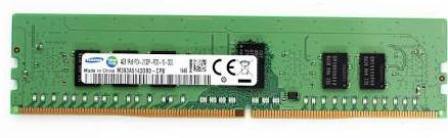
| Model | M393A5143DB0-CPB2Q |
|---|---|
| Product Type | Memory Module |
| Compliance Standards | EU RoHS,FCC |
| Memory Capacity | 4 GB |
| Memory Technology | DDR4 |
| Product Voltage | 1.2V |
| RAM Speed | 2133MHz |
| RAM Standard | DDR4-2133/PC4-17000 |
| Error Identifying | ECC |
| Signal Type | Registered |
| Column Access Strobe (CAS) | CL15 |
| Rank | Single Rank x8 |
| Quantity of Pins | 288-pin |
| RAM Genre | RDIMM |
DDR4-2133 Registered ECC RDIMM with a single-rank x4/x8 organization and CL15 latency is tailored for entry-level server platforms, delivering reliable performance for virtualization, lightweight in-memory databases, and general data-center workloads where data integrity is paramount. Its registered signal buffering and ECC error correction provide enhanced signal integrity and protection against single-bit errors, enabling stable multi-DIMM deployment in 288-pin servers while operating at an energy-efficient 1.2 V.
1. ECC protection eliminates silent data corruption, safeguarding transactional integrity and enabling financial or healthcare workloads to run uninterrupted on mission-critical servers.
2. Registered buffering stabilizes command and address lines across densely populated memory channels, ensuring reliable operation even when all DIMM slots are fully utilized in virtualized infrastructure.
3. DDR4-2133 transfers data at over 17 GB/s, delivering the consistent throughput needed for multiple concurrent virtual machines and moderate in-memory database instances without bottlenecks.
4. Single Rank x8 construction reduces electrical loading per module, allowing system builders to populate more channels at higher capacities while maintaining signal clarity and uptime.
5. Operating at just 1.2 volts, this module helps drive down total cost of ownership by cutting per-node power draw and cooling requirements inside large-scale data center deployments.
The Samsung M393A5143DB0-CPB2Q RDIMM delivers four enterprise-critical features: ECC error correction, registered buffering, a single-rank x8 layout, and efficient 1.2V operation. In a heavily consolidated virtualization cluster, ECC silently corrects single-bit errors triggered by background radiation, preventing corrupted data from crashing guest VMs or causing unexplained application faults—this translates directly into avoided downtime and solid SLA compliance. Registered buffering stabilizes command and address signals so you can fully populate all memory channels, reaching the multi-terabyte capacity needed to run dozens of memory-hungry VMs simultaneously without signal degradation. For an in-memory database like Redis or SAP HANA, the single-rank x8 design preserves clean signal integrity and tight CL15 timing, yielding consistently low query latency even with multiple DIMMs installed; combined with ECC, it guarantees every cache read is bit-accurate, safeguarding transactional integrity. Meanwhile, 1.2V operation reduces power draw in dense racks, lowering your cooling burden. Together, these characteristics give you uncompromising reliability, linear scalability, and predictable performance that keep mission-critical workloads running smoothly around the clock.
General Virtualization
For a typical hypervisor hosting multiple VMs, memory capacity and stability are paramount. Given these are 4GB RDIMMs, populate at least eight modules (32GB total) per socket to achieve balanced memory interleaving. Use identical sticks across all populated channels to maintain ECC integrity and avoid performance penalties on DDR4-2133 platforms.
In-Memory Database
In-memory databases demand the lowest possible latency and maximum capacity. Although these single-rank 4GB DIMMs are small, deploying them in all available slots (e.g., 24 modules for 96GB) on a dual-socket server can provide a cost-effective, low-latency pool. Ensure all channels are fully populated to leverage rank interleaving, but be aware that speed is capped at 2133MHz, limiting throughput for massive datasets.
High-Performance Computing (HPC)
HPC workloads benefit from high memory bandwidth and reliable ECC. Configure the server with one DIMM per channel (1DPC) using these 4GB registered sticks to achieve the supported 2133MHz speed without downclocking. This yields a modest 32GB across eight channels, suitable for light simulation or compute nodes where capacity takes a back seat to deterministic, error-free execution.
Rigorously tested server memory, compatible with Dell PowerEdge R740, HPE ProLiant DL380 Gen10, Lenovo ThinkSystem SR650.
Q: Can I mix this M393A5143DB0-CPB2Q with other memory modules of different brands or speeds?
A: Mixing Registered DIMMs of different brands or speeds is strongly discouraged. It often leads to POST failures and system instability. For reliable server operation, always use identical modules per channel.
Q: Is this memory compatible with my Intel Xeon or AMD EPYC server?
A: This DDR4-2133 RDIMM is designed for platforms using Intel Xeon E5-2600 v3/v4 or AMD EPYC 7001/7002 series with C612 or equivalent chipsets. Please consult your server's qualified vendor list for confirmed compatibility.
Q: What is the recommended DIMM population order for optimal performance?
A: For optimal performance, populate DIMMs starting with the slots farthest from the CPU in each memory channel. Balance the same quantity and type of DIMMs across all channels to ensure maximum memory bandwidth.
Q: Does this module support overclocking or XMP profiles?
A: No. This is a server-grade Registered DIMM operating strictly at JEDEC standard DDR4-2133. Overclocking and XMP profiles are not supported to maintain the rock-solid stability required for enterprise environments.
Q: What warranty and typical failure rate can I expect?
A: This module includes a one-year warranty. Its typical Annualized Failure Rate (AFR) is below 0.5% under normal server operating conditions, reflecting Samsung's high reliability and stringent quality testing standards.