











 Secure payments
Standard refund policy
Trade Assurance
Secure payments
Standard refund policy
Trade Assurance
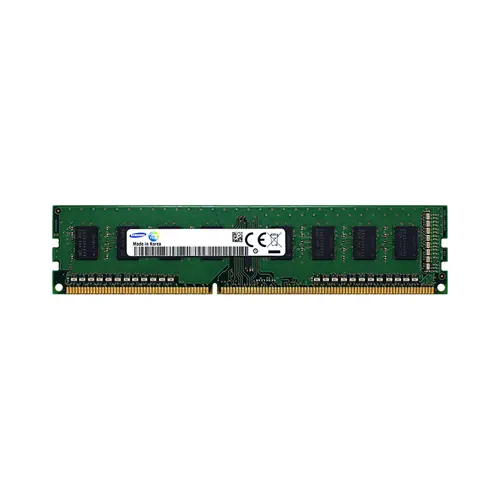
| Model | M393B1G70BH0-CK008 |
|---|---|
| Product Type | Memory Module |
| Compliance Standards | EU RoHS,FCC |
| Memory Capacity | 8 GB |
| Memory Technology | DDR3 |
| Product Voltage | 1.5V |
| RAM Speed | 1600MHz |
| RAM Standard | DDR3-1600/PC3-12800 |
| Error Identifying | ECC |
| Signal Type | Registered |
| Column Access Strobe (CAS) | CL11 |
| Rank | Single Rank x4 |
| Quantity of Pins | 240-pin |
| RAM Genre | RDIMM |
This DDR3-1600 RDIMM is engineered for legacy server platforms requiring robust data integrity in virtualized environments and memory-intensive database applications. Its registered signal architecture with ECC and single-rank x4 organization ensures stable multi-DIMM operation and reliable error correction at a CL11 latency, making it a cost-effective refresh for aging enterprise infrastructure.
1. ECC protection silently corrects single-bit memory errors, safeguarding data integrity for 24/7 transactional databases and financial processing.
2. Registered clocking buffers command and address signals, stabilizing large-capacity memory arrays to maintain uptime in multi-socket server deployments.
3. RDIMM architecture increases per-channel memory scalability, allowing dense virtualization hosts to allocate more RAM per virtual machine without sacrificing reliability.
4. The 8GB module density balances capacity and cost, enabling cloud operators to provision sufficient memory for containerized microservices across fleet-wide node configurations.
5. 1600 MT/s data rate sustains predictable throughput for in-memory caching layers, accelerating real-time analytics queries under heavy concurrent user loads.
The Samsung M393B1G70BH0-CK008 is a DDR3 Registered DIMM purpose-built for enterprise servers where data integrity and relentless uptime are non-negotiable. In a dense virtualization cluster running dozens of VMware or Hyper-V guests, the Registered signal buffer is transformative—it offloads the memory controller, allowing you to fully populate all 24 DIMM slots without signal degradation, keeping every virtual machine stable even under heavy overcommit. Behind that stability, ECC error correction silently scans each data bit, detecting and correcting single-bit flips caused by background radiation before they can corrupt a financial transaction or crash a critical database host. For memory-hungry in-memory databases like SAP HANA or large Redis instances, the single-rank x4 organization strikes an ideal balance, delivering high sustained bandwidth at its 1600MHz speed with CL11 latency, so complex queries return results faster while ECC scrubs safeguard precision. This means fewer unplanned outages, zero silent data corruption, and the confidence that your entire rack of virtualized workloads runs on a foundation engineered for 24/7 availability. When seconds of downtime translate to lost revenue, this memory’s combination of buffered reliability, error-free operation, and optimized throughput becomes your least expensive insurance policy.
Based on the specifications — DDR3-1600, ECC, Registered, 240-pin RDIMM — this is server memory. The 8 GB capacity per module and 1.5 V operating voltage make it suitable for enterprise platforms that require data integrity and sustained stability. Below are capacity planning recommendations for three typical server workload scenarios.
General Virtualization
Virtualized hosts thrive on core count and memory headroom. Start with at least 8 modules (64 GB) per dual-socket server to comfortably host 10–15 light VMs. Populate all identical channels symmetrically — for example, one RDIMM per channel across two processors — to maintain balanced memory interleaving and consistent NUMA performance.
In-Memory Database
Low-latency datasets demand high capacity and wide parallelism. Configure with 16 modules (128 GB) as a baseline, using dual-rank configurations where possible to improve bank-level parallelism. For larger working sets, scale to 24 modules across all channels, ensuring the dataset fits entirely in RAM to avoid swap-induced latency spikes.
High Performance Computing (HPC)
HPC jobs favor bandwidth over sheer capacity per node. Populate one RDIMM per channel on all available channels — typically 8 or 16 modules per node — to maximize memory bandwidth. Keep capacity sufficient so that per-core working sets (often 2–4 GB per core) stay resident, and avoid mixing different ranks per channel to preserve uniform access timings.
Rigorously tested, compatible with Dell PowerEdge R720, HP ProLiant DL380p Gen8, and more.
Q: Can I mix this M393B1G70BH0-CK008 with other memory modules of different brands or speeds?
A: Mixing is not recommended for server environments. Registered ECC DDR3 modules require identical specifications to ensure signal integrity and system stability. Mixed brands or speeds may cause POST failures or memory errors.
Q: Is this memory compatible with my system?
A: This 8GB DDR3-1600 ECC Registered RDIMM is designed for Intel Xeon E5/E5v2 or AMD Opteron 6300 series platforms. Please verify your server board's QVL list for official support.
Q: What is the recommended DIMM population order for optimal performance?
A: Populate identical DIMMs per channel in descending slot order, typically filling blue slots first. Follow your server board manual to balance memory channels and maximize bandwidth. Symmetric population ensures best performance.
Q: Does this module support overclocking or XMP profiles?
A: No. This server-grade RDIMM strictly follows JEDEC DDR3-1600 (PC3-12800) standards with timings of CL11. Overclocking and XMP are not supported, as they compromise data integrity in enterprise environments.
Q: What warranty and typical failure rate can I expect?
A: This module carries a one-year warranty. It meets enterprise-class reliability standards with an MTBF exceeding 2 million hours under normal operating conditions, yielding a very low annualized failure rate.