











 Secure payments
Standard refund policy
Trade Assurance
Secure payments
Standard refund policy
Trade Assurance
| Model | M393B1G70DJ1-CF8 |
|---|---|
| Product Type | Memory Module |
| Compliance Standards | CE,WEEE,RoHS |
| Memory Capacity | 8 GB |
| Memory Technology | DDR3 |
| Product Voltage | 1.5V |
| RAM Speed | 1066MHz |
| RAM Standard | DDR3-1066/PC3-8500 |
| Error Identifying | ECC |
| Signal Type | Registered |
| Column Access Strobe (CAS) | CL7 |
| Rank | Quad Rank x4 |
| Quantity of Pins | 240-pin |
| RAM Genre | RDIMM |
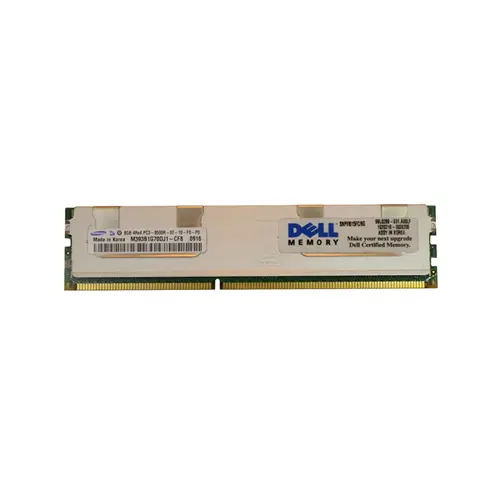
This Samsung M393B1G70DJ1-CF8 is an 8GB DDR3-1066 registered ECC RDIMM, purpose-built for legacy server platforms where data integrity and stability under continuous load are non-negotiable, such as virtualization hosts or small-scale in-memory databases. Its quad-rank x4 organization enables higher capacity per channel in 2DPC configurations, while Registered signal type and CL7 latency deliver consistent electrical loading and reliable timing margins for aging yet mission-critical enterprise systems.
1. On-the-fly error correction safeguards data integrity, preventing silent corruption in long-running enterprise databases and hypervisor environments.
2. Buffered signal path enhances electrical stability, enabling fully populated memory slots for maximum capacity without sacrificing uptime.
3. Quad Rank x4 topology packs more memory devices per rank, multiplying capacity density per channel for heavy consolidation of virtualized workloads.
4. Sufficient base capacity per stick allows cost-effective scaling of total system memory to handle growing concurrent user sessions.
5. Tight column access timing reduces memory fetch latency, giving transactional and real-time processing a measurable performance boost.
The Samsung M393B1G70DJ1-CF8 is a Registered DDR3 memory module purpose-built for servers, where its four core attributes directly resolve critical data center pain points. First, ECC protection silently corrects single-bit errors the moment they occur. In a virtualized cluster running dozens of VMware or Hyper‑V guests, a single uncorrected flip can cascade into corrupted transactions and unplanned downtime; ECC transforms that risk into continuous uptime. Second, the Registered buffer re‑drives command and address signals, letting you fully populate channels with multiple Quad Rank DIMMs without signal degradation or boot failures—a prerequisite for dense, memory‑heavy virtualization nodes. Third, the Quad Rank x4 organization elevates capacity and enables rank interleaving, significantly boosting throughput for in‑memory databases like SAP HANA or Redis. Under heavy analytical queries, this translates directly into faster insights and more simultaneous users. Fourth, the CL7 latency minimizes column access delays, shaving microseconds off every read—critical in latency‑sensitive financial trading platforms where reaction speed defines profit. Built at a standard 1.5V, the module balances power efficiency with 1066MHz stability. For IT managers, these characteristics mean maximized hardware ROI, predictable performance under consolidation workloads, and a resilient foundation for business‑critical applications.
Memory Type Identification
The M393B1G70DJ1-CF8 is a server-grade DDR3 Registered ECC memory module (RDIMM). Its 240-pin form factor, ECC error correction, registered signaling, and quad-rank x4 design confirm it belongs exclusively in servers and workstations—not desktops or laptops.
Capacity Planning Guide
These 8GB DDR3-1066 quad-rank RDIMMs demand careful population to balance capacity, rank loading, and channel bandwidth. All guidance assumes a multi-channel server platform with symmetric memory architecture.
General Virtualization
Populate all memory channels identically with at least one DIMM per channel to guarantee full bandwidth. For consolidating a moderate number of virtual machines, four to eight modules (32–64 GB) offer solid density while keeping rank count manageable. Always use identical part numbers; mixing different ranks or vendors risks stability in virtualized environments.
In-Memory Database
Maximize capacity aggressively, even at the expense of slight frequency reductions. Fill every available slot with these quad-rank DIMMs to reach 128 GB or more on a dual-socket server. Expect a step down to 800 MHz when populating three quad-rank modules per channel, but for large in-memory datasets, raw capacity is far more critical than peak clock speed.
High-Performance Computing (HPC)
Favor memory bandwidth over maximum capacity. Install exactly one quad-rank DIMM per channel to retain the full 1066 MHz speed and avoid rank-induced downclocking. On a dual-socket system with eight or more channels, this configuration delivers optimum throughput for bandwidth-sensitive parallel workloads while still providing sufficient capacity per node.
Rigorously tested server RAM, compatible with Dell PowerEdge R710, R720, HP DL380 G7, and more.
Q: Can I mix this M393B1G70DJ1-CF8 with other memory modules of different brands or speeds?
A: Mixing is strongly discouraged, especially with Quad Rank Registered DIMMs. Different speeds or ranks can cause signal integrity issues and system instability. For server environments, install identical modules to ensure validated performance and uptime.
Q: Is this memory compatible with my system?
A: This DDR3-1066 Registered ECC RDIMM is designed for server platforms using Intel Xeon 5500/5600 series or AMD Opteron 6100 series. Verify your motherboard’s Qualified Vendor List (QVL) to confirm support for Quad Rank x4 modules.
Q: What is the recommended DIMM population order for optimal performance?
A: Follow your server motherboard’s manual. Typically, populate the farthest slot of each memory channel first. With Quad Rank modules, avoid mixing ranks per channel and expect possible speed reduction if all channels are fully populated.
Q: Does this module support overclocking or XMP profiles?
A: No. This is a server-grade Registered DIMM built for reliability. It operates strictly at JEDEC standard DDR3-1066 CL7; overclocking or XMP is not supported and would compromise data integrity in enterprise environments.
Q: What warranty and typical failure rate can I expect?
A: We provide a one-year warranty. As an enterprise memory module, it features a very low annualized failure rate (AFR), typically below 0.5%, ensuring mission-critical stability.