











 Secure payments
Standard refund policy
Trade Assurance
Secure payments
Standard refund policy
Trade Assurance
| Model | M393B1G73BH0-CK0 |
|---|---|
| Product Type | Memory Module |
| Compliance Standards | EU RoHS,FCC |
| Memory Capacity | 8 GB |
| Memory Technology | DDR3 |
| Product Voltage | 1.5V |
| RAM Speed | 1600MHz |
| RAM Standard | DDR3-1600/PC3-12800 |
| Error Identifying | ECC |
| Signal Type | Registered |
| Column Access Strobe (CAS) | CL11 |
| Rank | Dual Rank x8 |
| Quantity of Pins | 240-pin |
| RAM Genre | RDIMM |
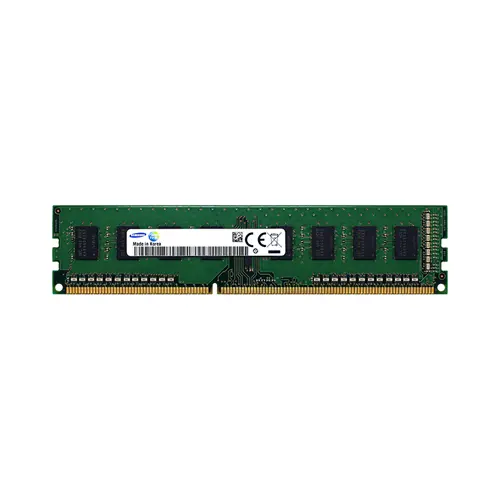
This Samsung M393B1G73BH0-CK0 is a server-grade DDR3 RDIMM with ECC and registered signaling, purpose-built for virtualization clusters, in-memory databases, and enterprise workloads where data integrity and 24/7 stability are non-negotiable. Its dual-rank x8 organization at 1600MHz with CL11 latency optimizes bank-level parallelism for consistent throughput, while the registered buffer ensures clean command/address signals across fully populated 240-pin platforms.
1. ECC error correction silently detects and fixes single-bit memory errors, preserving transaction integrity in financial databases and mission-critical enterprise applications.
2. Registered signal buffering stabilizes high-capacity memory configurations, allowing dense server farms to pack more DIMMs per channel without signal degradation.
3. Eight-gigabyte module capacity strikes a balance for lightweight virtualized environments, hosting multiple small VMs or containers while keeping cost per gigabyte low.
4. 1600 MHz clock speed delivers 12.8 GB/s peak bandwidth per channel, sustaining smooth throughput for concurrent web servers and content delivery workloads.
5. Dual Rank x8 organization interleaves accesses across two internal ranks, boosting effective memory bandwidth and reducing latency spikes under heavy virtualization consolidation.
In a data center where every millisecond of downtime translates directly into lost revenue, the Samsung M393B1G73BH0-CK0 RDIMM is engineered to eliminate the compromises that threaten server reliability. This 8GB DDR3-1600 Registered ECC module directly confronts three critical pain points faced by IT infrastructure teams. When you run a dense virtualization cluster hosting dozens of VMs on a single host, the registered buffer stabilizes signal integrity across heavily populated memory channels, preventing the sporadic crashes that wake you at 3 a.m. and allow you to confidently scale memory capacity without destabilizing the entire node. Meanwhile, ECC protection silently corrects single-bit errors caused by cosmic radiation or electrical noise—an absolute necessity for in-memory databases like SAP HANA or Redis, where a flipped bit can corrupt a financial transaction or distort real-time analytics without any warning. The dual-rank x8 organization further boosts throughput by enabling interleaved access, so your database server can sustain elevated IOPS under peak query loads without choking on contention. For virtualization and mission-critical database workloads, this module does not just store data—it safeguards your operational continuity and data integrity in ways that non-ECC unbuffered memory fundamentally cannot.
General Virtualization
For general virtualization hosts, deploy six to eight of these 8GB RDIMMs per CPU to achieve 48–64GB, balancing density and cost. Populate identical modules across all memory channels to maintain balanced NUMA access and maximize VM density without overcommitting RAM.
In-Memory Database
In-memory databases demand large, reliable capacity; install at least twelve modules (96GB) by filling all DIMM slots on a dual-socket board. Use ranked DIMMs with ECC to sustain data integrity under continuous high-throughput writes, and configure memory interleaving for lower latency.
HPC
For HPC clusters, populate four or six modules per node (32–48GB) to match per-core memory bandwidth requirements. Strictly follow the platform’s population order to enable quad-channel mode, and validate ECC scrubbing settings to prevent silent data corruption during long-running parallel jobs.
Rigorously tested server memory, compatible with Dell PowerEdge R720, HP ProLiant DL380p Gen8, IBM System x3650 M4.
Q: Can I mix this M393B1G73BH0-CK0 with other memory modules of different brands or speeds?
A: Not recommended. Mixing ECC Registered DIMMs with different specifications often leads to system instability or uncorrectable ECC errors. For server reliability, always install identical part numbers.
Q: Is this memory compatible with my system?
A: This DDR3-1600 ECC Registered RDIMM is designed for servers. It typically supports Intel Xeon E5-2400/2600 v1/v2 and AMD Opteron 6300 series platforms. Please verify against your motherboard's QVL list.
Q: What is the recommended DIMM population order for optimal performance?
A: Install identical DIMMs in the furthest slot of each memory channel from the CPU first. Balance capacity across all available memory channels to ensure maximum bandwidth and uniform memory access.
Q: Does this module support overclocking or XMP profiles?
A: No. As a server-grade ECC Registered DIMM, it runs at JEDEC standard DDR3-1600 with no overclocking or XMP support, prioritizing 24/7 data integrity and operational stability over speed.
Q: What warranty and typical failure rate can I expect?
A: This module includes a 1-year warranty. Enterprise-class DDR3 ECC memory exhibits an extremely low annualized failure rate, typically below 0.1% under specified server operating conditions.