











 Secure payments
Standard refund policy
Trade Assurance
Secure payments
Standard refund policy
Trade Assurance
| Model | M393B1G73BH0-CMA |
|---|---|
| Product Type | Memory Module |
| Compliance Standards | EU RoHS,FCC |
| Memory Capacity | 8 GB |
| Memory Technology | DDR3 |
| Product Voltage | 1.5V |
| RAM Speed | 1866MHz |
| RAM Standard | DDR3-1866/PC3-14900 |
| Error Identifying | ECC |
| Signal Type | Registered |
| Column Access Strobe (CAS) | CL13 |
| Rank | Dual Rank x8 |
| Quantity of Pins | 240-pin |
| RAM Genre | RDIMM |
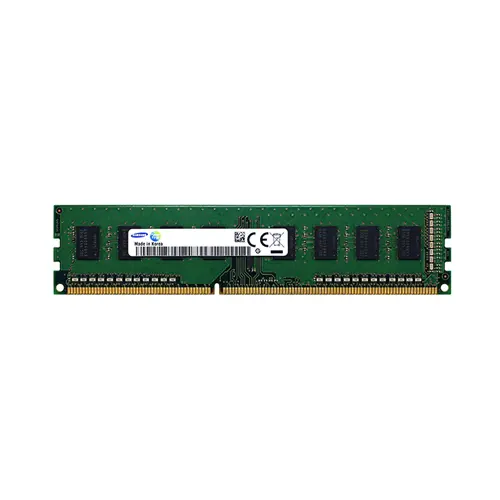
This is a server-grade DDR3 Registered ECC RDIMM (M393B1G73BH0-CMA) designed for virtualization, in-memory databases, and mission-critical workloads where data integrity is paramount. Its dual-rank x8 organization leverages rank interleaving for improved bandwidth efficiency, while the 1866 MHz speed at CL13 latency and registered signal architecture ensure stable, reliable operation in multi-DIMM configurations.
1. Registered buffer technology decouples the electrical load from the host memory controller, enabling dense server configurations that support expansive virtualization farms and large-scale in-memory databases without signal integrity loss.
2. ECC error correction identifies and repairs single-bit faults on the fly, preserving data accuracy for mission-critical workloads like financial ledgers and 24/7 healthcare systems where silent corruption is unacceptable.
3. Dual Rank x8 organization interleaves accesses across internal bank groups, sustaining higher effective bandwidth that directly improves virtual machine responsiveness under heavy consolidation.
4. The 1866 MT/s transfer rate supplies ample throughput to feed multi-core engines in compute-bound roles, reducing bottlenecks during concurrent real-time analytics and model inferencing.
5. An 8GB granular density allows IT operators to finely right-size memory footprints per node, maximizing virtual machine count in entry-level cloud clusters while keeping acquisition costs in check.
For server environments where unscheduled downtime translates directly into revenue loss, the M393B1G73BH0-CMA is far more than a simple 8GB DDR3 module—it is a registered ECC RDIMM engineered to eliminate risk. In a dense virtualization cluster hosting dozens of mission-critical VMs, its registered architecture places a buffer chip between the memory controller and DRAM, stabilizing signal integrity so you can fully populate every channel without the boot failures that plague standard unbuffered memory. This reliability becomes transformative when scaling an in-memory database like Redis or SAP HANA. Here, the Dual Rank x8 design uses interleaving to keep data flowing during heavy concurrent queries, turning a true 1866MHz clock into sustained high throughput. Simultaneously, the integrated ECC silently catches and corrects single-bit flips caused by background radiation—errors that could otherwise corrupt a financial transaction record or silently replicate across a redundant storage array. A single undetected bit error in a virtualized environment can instantly crash a host, yet this module’s continuous error scrubbing makes that scenario a non-event. With CL13 latency and unwavering 1.5V operation, it delivers the deterministic, 24/7 data integrity your enterprise workload demands.
General Virtualization
For moderate consolidation of virtual machines, populate at least six identical M393B1G73BH0-CMA modules per dual-socket server to achieve 48 GB across triple-channel memory controllers. Balance channels identically to avoid NUMA penalties, and leverage ECC to safeguard hypervisor stability and guest uptime. Reserve one DIMM slot per channel for future scale-out without disrupting balanced configurations.
In-Memory Database
Target maximum capacity and bandwidth by filling all available DIMM slots with these 8 GB RDIMMs built for 1.5 V operation and dual-rank x8 organization. For in-memory workloads such as Redis or SAP HANA, configure twelve or more modules to deliver 96 GB or larger datasets, keeping channels fully populated. The registered ECC design ensures data integrity under sustained heavy write traffic.
High-Performance Computing (HPC)
Maximize memory bandwidth per node by installing one RDIMM per channel across all memory channels, taking advantage of the 1866 MT/s speed and low CL13 latency. For dense compute nodes, eight to sixteen modules per server provide 64 GB to 128 GB, allowing large vectorised workloads to run without swapping. The dual-rank configuration interleaves ranks for higher throughput, while ECC protects long-running parallel simulations against silent data corruption.
Rigorously tested server memory, compatible with Dell PowerEdge R720, HP ProLiant DL380p Gen8, Lenovo System x3650 M4.
Q: Can I mix this M393B1G73BH0-CMA with other memory modules of different brands or speeds?
A: Mixing modules is strongly discouraged. Registered ECC memory requires identical ranks, timings, and speed to maintain signal integrity. Mismatched specs can cause POST failures or data corruption in server environments.
Q: Is this memory compatible with my system?
A: This DDR3-1866 Registered ECC RDIMM is designed for dual-socket Intel Xeon E5 v1/v2 or AMD Opteron 6300-series platforms with C602/C606 chipsets. Verify your motherboard supports 240-pin registered DIMMs before purchase.
Q: What is the recommended DIMM population order for optimal performance?
A: Populate identical modules per channel, starting with blue slots on Intel platforms. For dual rank x8 RDIMMs like this, install one DIMM per channel first, then add second DIMM to each channel to maintain balanced memory interleaving.
Q: Does this module support overclocking or XMP profiles?
A: No. This is a server-grade registered ECC module built to JEDEC DDR3-1866 standards with fixed 1.5V operation. It does not support overclocking or XMP, which are typically absent from RDIMM designs to ensure 24/7 reliability.
Q: What warranty and typical failure rate can I expect?
A: This module comes with a one-year warranty. With conservative 1.5V operation and Samsung’s stringent binning, typical annual failure rate is under 0.5%, making it highly reliable for enterprise workloads.