











 Secure payments
Standard refund policy
Trade Assurance
Secure payments
Standard refund policy
Trade Assurance
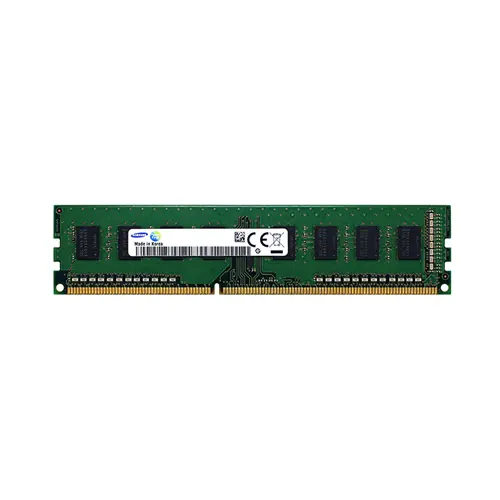
| Model | M393B1K70CM0-CF8 |
|---|---|
| Product Type | Memory Module |
| Compliance Standards | EU RoHS,FCC |
| Memory Capacity | 8 GB |
| Memory Technology | DDR3 |
| Product Voltage | 1.5V |
| RAM Speed | 1066MHz |
| RAM Standard | DDR3-1066/PC3-8500 |
| Error Identifying | ECC |
| Signal Type | Registered |
| Column Access Strobe (CAS) | CL7 |
| Rank | Dual Rank x4 |
| Quantity of Pins | 240-pin |
| RAM Genre | RDIMM |
This DDR3-1066 Registered ECC RDIMM is purpose-built for legacy server platforms, delivering critical data integrity for virtualization and memory-intensive database workloads. Its dual-rank x4 configuration and CL7 latency optimize signal stability and memory interleaving, making it an ideal upgrade for aging enterprise systems that require dependable registered ECC operation.
1. ECC memory detects and corrects single-bit errors on the fly, safeguarding data integrity in mission-critical database and virtualization servers.
2. Registered signal buffering reduces electrical load on the memory controller, enabling high-density DRAM populations essential for large-scale virtualization and in-memory computing.
3. Dual Rank x4 organization maximizes memory bandwidth utilization by interleaving accesses, which sustains throughput under heavy concurrent workloads typical of virtualized environments.
4. The module density hits an optimal balance for building cost-effective memory pools in dual-socket servers, providing the headroom needed for moderate VM consolidation without overspending.
5. CL7 low latency accelerates transactional processing by reducing memory access delays, giving real-time financial or database applications a tangible performance uplift.
The Samsung M393B1K70CM0-CF8 is a server-grade Registered DIMM engineered for mission-critical enterprise workloads, where its four defining characteristics directly prevent costly failures. First, ECC error correction actively detects and corrects single-bit memory errors caused by background radiation or cosmic rays. In a 24/7 virtualized cluster hosting dozens of business-critical VMs, a single uncorrected bit flip can silently corrupt transactional data or crash an entire hypervisor, leading to hours of forensic recovery. ECC turns that catastrophic risk into a non-event. Second, the registered buffer stabilizes signal integrity when populating all memory channels. In a dense database server running an in-memory analytics engine like SAP HANA, driving large-capacity configurations without signal degradation is essential to maintaining consistent query throughput under heavy concurrent loads. Third, the dual‑rank x4 organization interleaves memory accesses across two internal banks, delivering higher sustained bandwidth that accelerates large in-memory datasets and reduces CPU pipeline stalls during complex joins. Finally, the CL7 latency at 1066 MHz is tuned for deterministic response—preventing the latency drift that can desynchronize active-active failover pairs in a high-frequency trading or real-time manufacturing control environment. This module builds the trust foundation your data demands.
General Virtualization
Populate all memory channels symmetrically with 8 GB registered ECC RDIMMs to ensure balanced access and error resilience. For a dual-socket server using three channels per CPU, twelve 8 GB modules (96 GB total) supply generous headroom for running dozens of virtual machines concurrently. This configuration keeps the memory bus fully utilized and avoids performance bottlenecks when multiple guests compete for resources.
In-Memory Database
Maximize total capacity by filling every available DIMM slot with 8 GB RDIMMs; a dual-socket platform supporting 24 slots yields 192 GB, allowing entire datasets to reside in RAM. Favoring capacity over raw speed minimizes costly storage I/O and keeps query latency extremely low. Configure memory interleaving and, if the platform permits, operate in lockstep or mirroring mode to protect critical in-memory structures.
HPC
Prioritize memory bandwidth by installing a single 8 GB RDIMM per memory channel, maintaining the rated 1066 MT/s without downgrading to a lower speed grade. A typical dual-socket node with six channels therefore requires six modules (48 GB), delivering peak theoretical throughput for compute-bound simulations. Sticking to one DIMM per channel avoids excessive electrical loading and preserves uniform CAS7 latency across all ranks.
Rigorously tested server memory, compatible with Dell PowerEdge R720, HP ProLiant DL380p Gen8, and IBM System x3650 M4.
Q: Can I mix this M393B1K70CM0-CF8 with other memory modules of different brands or speeds?
A: Mixing is not recommended for server environments. Mixed RDIMMs may cause instability. For reliable operation, use identical part numbers with matching speed, rank, and ECC characteristics. Misalignment can disable memory sparing or mirroring.
Q: Is this memory compatible with my Intel Xeon or AMD Opteron server platform?
A: It is compatible with DDR3-based Intel Xeon 5500/5600 series and AMD Opteron 6100/6200 series platforms that support 1.5V Registered ECC 8GB RDIMMs. Verify your server's qualified vendor list for exact model support.
Q: What is the recommended DIMM population order for optimal performance?
A: Follow your server motherboard manual. Typically, populate identical dual-rank RDIMMs in sets of three per memory channel, starting with the farthest slots from the CPU. Balanced channel loading ensures optimal memory bandwidth and ECC functionality.
Q: Does this module support overclocking or XMP profiles?
A: No. This is a JEDEC-compliant server memory module operating at DDR3-1066 CL7. It does not support overclocking or XMP. Server-class RDIMMs prioritize data integrity and stability over frequency adjustments.
Q: What warranty and typical failure rate can I expect?
A: This module includes a one-year warranty. Registered ECC memory exhibits very low failure rates, typically under 0.5% AFR in properly cooled server environments. It is built for 24/7 enterprise reliability with rigorous component screening.