











 Secure payments
Standard refund policy
Trade Assurance
Secure payments
Standard refund policy
Trade Assurance
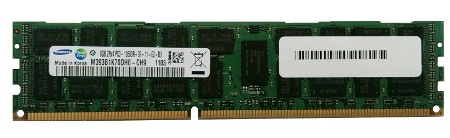
| Model | M393B1K70DH0-CH9Q8 |
|---|---|
| Product Type | Memory Module |
| Compliance Standards | EU RoHS,FCC |
| Memory Capacity | 8 GB |
| Memory Technology | DDR3 |
| Product Voltage | 1.5V |
| RAM Speed | 1333MHz |
| RAM Standard | DDR3-1333/PC3-10600 |
| Error Identifying | ECC |
| Signal Type | Registered |
| Column Access Strobe (CAS) | CL9 |
| Rank | Dual Rank x4 |
| Quantity of Pins | 240-pin |
| RAM Genre | RDIMM |
This M393B1K70DH0-CH9Q8 is a DDR3-1333 registered ECC RDIMM designed for legacy server platforms, making it ideally suited for virtualization hosts and memory-resident databases where data integrity is critical. Its dual-rank x4 organization with registered signaling ensures stable command/address loading in multi-DIMM configurations, while ECC actively corrects single-bit errors to prevent silent data corruption in sustained enterprise workloads.
1. ECC protection automatically corrects single-bit memory errors, safeguarding data integrity for transactional databases and financial processing running around the clock.
2. Registered signal buffering decouples the memory controller from direct electrical loading, allowing populated multi-slot servers to scale capacity without sacrificing signal stability.
3. Dual Rank x4 organization keeps the data bus efficiently pipelined, delivering sustained bandwidth that prevents stutter under heavy virtualization and concurrent enterprise workloads.
4. The 8GB capacity provides enough headroom per module to consolidate a meaningful number of VMs or containers, reducing the risk of hypervisor swapping in moderate-density deployments.
5. DDR3-1333 bandwidth supplies a balanced throughput ideal for legacy server fleets, maintaining steady application responsiveness in file serving and lightweight database roles.
Designed for enterprise servers, the M393B1K70DH0-CH9Q8 is an 8GB DDR3-1333 Registered ECC DIMM purpose-built to eliminate the risks that keep IT managers awake at night. In a dense virtualization cluster running dozens of VMs per node, ECC is your first line of defense—it silently detects and corrects single-bit memory errors caused by background radiation, preventing the kind of silent data corruption that cascades into hypervisor crashes or irrecoverable database inconsistencies. The registered buffer re-drives command and address signals, so you can fully populate all 12 or 24 DIMM slots per server without signal degradation. For you, that means scaling memory capacity for growing virtual machines and container fleets while maintaining bank-level stability. Its dual-rank x4 organization interleaves accesses across internal die groups, directly boosting throughput for in-memory databases like SAP HANA or Redis where every microsecond of latency impacts real-time transactions. In cost-sensitive legacy server upgrades or scale-out analytics farms, this module delivers uncompromising data integrity and reliable 10.6 GB/s bandwidth—because in the data center, memory errors aren’t just glitches, they’re revenue at risk.
General Virtualization
For a DDR3 Registered ECC RDIMM like the M393B1K70DH0-CH9Q8, populate in balanced sets across memory channels to maximize throughput. Start with 6 or 8 identical 8 GB modules per dual-socket server, yielding 48–64 GB, sufficient for dozens of light VMs. Distribute DIMMs evenly per CPU socket and leave spare slots for future scale-out.
In-Memory Database
In-memory workloads demand both capacity and reliability, making ECC crucial. Deploy 12–16 modules fully populating all channels on a two-socket board to reach 96–128 GB, keeping the entire dataset in RAM. Use dual-rank x4 DIMMs, which this part already is, for lower latency and higher bandwidth per channel.
High-Performance Computing
HPC clusters benefit from memory bandwidth, so configure one DIMM per channel on every available memory channel. For a dual-socket server with 8 channels per CPU, install 16 of these 8 GB RDIMMs to achieve 128 GB with balanced interleaving. This layout minimizes access contention and sustains high floating-point throughput in parallel jobs.
Server-grade RDIMM, rigorously tested, compatible with Dell PowerEdge R710, R610, HP DL380 G7, and IBM x3650 M3.
Q: Can I mix this M393B1K70DH0-CH9Q8 with other memory modules of different brands or speeds?
A: Mixing is not recommended for registered server memory. Different brands or speeds can cause signal integrity issues, instability, and unbootable systems. Always use identical modules for validated reliability.
Q: Is this memory compatible with my Intel or AMD server platform?
A: Compatibility requires a DDR3 Registered ECC platform and a BIOS that supports 8GB Dual Rank x4 RDIMMs. Please verify your server board's Qualified Vendor List for this specific Samsung module.
Q: What is the recommended DIMM population order for optimal performance?
A: Optimal population follows your server motherboard manual. Typically, populate identical DIMMs per channel starting from the farthest slot from the CPU, balancing across memory channels for best throughput.
Q: Does this module support overclocking or XMP profiles?
A: No. As an enterprise-grade Registered ECC memory module, it adheres strictly to JEDEC DDR3-1333 specifications. Overclocking and XMP are not supported to ensure maximum data integrity and stability.
Q: What warranty and typical failure rate can I expect?
A: This memory includes a 1-year warranty. The typical annualized failure rate is extremely low, meeting enterprise reliability standards, provided the module operates within specified voltage and thermal conditions.