











 Secure payments
Standard refund policy
Trade Assurance
Secure payments
Standard refund policy
Trade Assurance
| Model | M393B1K70DH0-YH9Q5 |
|---|---|
| Product Type | Memory Module |
| Compliance Standards | EU RoHS,FCC |
| Memory Capacity | 8 GB |
| Memory Technology | DDR3 |
| Product Voltage | 1.35V |
| RAM Speed | 1333MHz |
| RAM Standard | DDR3-1333/PC3-10600 |
| Error Identifying | ECC |
| Signal Type | Registered |
| Column Access Strobe (CAS) | CL9 |
| Rank | Dual Rank x4 |
| Quantity of Pins | 240-pin |
| RAM Genre | RDIMM |
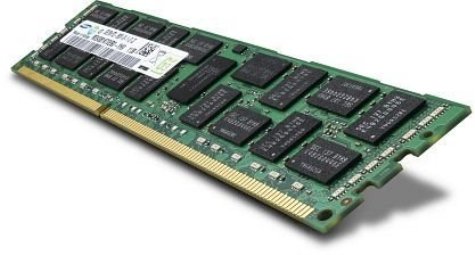
Designed for legacy server platforms, this 8GB DDR3-1333 RDIMM excels in memory-intensive workloads such as virtualization, in-memory databases, and high-reliability computing. Its dual-rank x4 configuration with ECC and registered signal buffering delivers robust data integrity and signaling stability, while operating at a low 1.35V to minimize power consumption in dense rack deployments.
1. ECC error detection and correction eliminates single-bit memory faults, safeguarding transactional integrity in always-on enterprise databases.
2. Registered signal buffering stabilizes command and address lines, allowing dense memory configurations without compromising host-bus reliability under heavy virtualization loads.
3. Dual Rank x4 organization leverages bank interleaving to maximize channel utilization, boosting sustained throughput for concurrent real-time analytics and caching services.
4. Eight-gigabyte capacity per DIMM supplies sufficient footprint for mid-scale virtual machines and container hosts while avoiding costly over-provisioning.
5. 1333MHz clock rate strikes a power-aware bandwidth window, supporting steady-state application delivery in thermally constrained, long-lifecycle server fleets.
The Samsung M393B1K70DH0-YH9Q5 is an 8GB DDR3 server RDIMM purpose-built for mission-critical environments where data integrity and continuous uptime are non-negotiable. Its four standout characteristics directly solve real operational pains. ECC error correction silently detects and fixes single-bit memory errors caused by cosmic radiation, preventing silent data corruption that could crash an entire virtualized cluster hosting dozens of tenants or introduce subtle inaccuracies in financial transaction logs. The registered signal buffer, meanwhile, cleans command and address signals so you can populate every DIMM slot in a database host without electrical loading issues; this means your SQL server stays reliably responsive at maximum capacity, not prone to intermittent unexplained reboots. Operating at a low 1.35V, versus the typical 1.5V, it significantly reduces power draw and heat output across a fleet of servers, directly lowering your facility’s electricity bill and cooling overhead. Finally, the dual-rank x4 organization utilizes rank interleaving to boost effective memory bandwidth. In an in-memory database like Redis or SAP HANA, this allows the memory controller to serve concurrent queries with lower latency, accelerating transactional throughput when every microsecond counts. Together, these translate into what truly matters: hardened data protection, maximized virtualization density, and faster insight from your critical datasets.
This memory module is server-grade DDR3 Registered ECC memory (8GB, 1333MHz, 1.35V). Its registered buffer and error correction are essential for enterprise workloads. Below are capacity recommendations for common server scenarios.
General Virtualization
Focus on cost-effective capacity with robust error protection. Populate four modules (32GB) for light VM workloads or eight modules (64GB) for moderate density on dual-socket hosts. Always distribute identical DIMMs across all memory channels to maintain uniform latency and leverage ECC against soft errors in multi-tenant environments.
In-Memory Database
Maximize total RAM under the memory controller limits. Fill every available DIMM slot with these 8GB RDIMMs—typically 12 to 24 modules (96GB to 192GB)—to keep entire datasets in memory. The dual-rank x4 organization improves bank-level parallelism, while registered buffering preserves signal integrity at full population.
High Performance Computing (HPC)
Bandwidth-sensitive simulations require balanced per-channel population. Install one or two identical modules per channel; a symmetrical configuration of 12 modules (96GB) across all channels delivers peak interleaved bandwidth. This approach minimizes latency and sustains high throughput for parallel CFD, molecular dynamics or seismic processing jobs.
Rigorously tested, this server memory fits Dell PowerEdge R720, HP DL380p Gen8, and Lenovo RD630.
Q: Can I mix this M393B1K70DH0-YH9Q5 with other memory modules of different brands or speeds?
A: Mixing is not recommended. For reliable server operation, use identical modules (same part number, speed, rank, and voltage). Mixing different brands or speeds may cause instability or system hangs, especially with registered ECC memory.
Q: Is this memory compatible with my system?
A: This DDR3-1333 Registered ECC RDIMM is designed for dual-processor or single-processor servers using Intel Xeon 5500/5600 series or AMD Opteron 6000 series platforms. Verify compatibility with your server board’s qualified vendor list (QVL).
Q: What is the recommended DIMM population order for optimal performance?
A: For dual-socket servers, populate identical DIMMs per channel in matched slots. Fill slot A1 and B1 first, then A2 and B2 to achieve balanced interleaving and optimal performance.
Q: Does this module support overclocking or XMP profiles?
A: No. As a server-grade Registered ECC DIMM running at JEDEC standard DDR3-1333 CL9, it does not support XMP or overclocking. It is engineered for strict stability and reliability at rated specifications.
Q: What warranty and typical failure rate can I expect?
A: This module carries a one-year warranty. Typical failure rate is extremely low for these enterprise-grade modules when operated within specifications, ensuring high reliability for 24/7 server environments.