











 Secure payments
Standard refund policy
Trade Assurance
Secure payments
Standard refund policy
Trade Assurance
| Model | M393B1K70EB0-CH9 |
|---|---|
| Product Type | Memory Module |
| Compliance Standards | EU RoHS,FCC |
| Memory Capacity | 8 GB |
| Memory Technology | DDR3 |
| Product Voltage | 1.5V |
| RAM Speed | 1333MHz |
| RAM Standard | DDR3-1333/PC3-10600 |
| Error Identifying | ECC |
| Signal Type | Registered |
| Column Access Strobe (CAS) | CL9 |
| Rank | Dual Rank x4 |
| Quantity of Pins | 240-pin |
| RAM Genre | RDIMM |
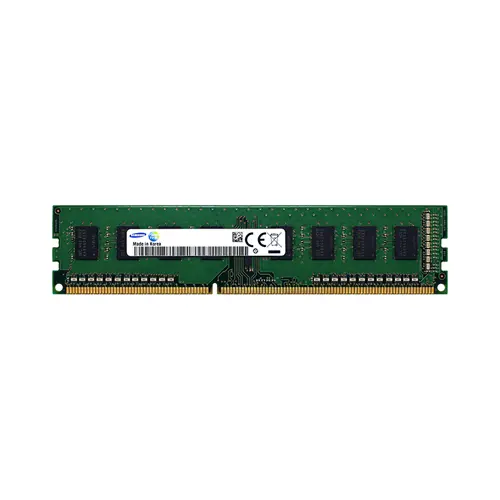
Designed for server environments, this Samsung M393B1K70EB0-CH9 is an 8GB DDR3-1333 registered ECC RDIMM (Dual Rank x4) that ensures data integrity and system stability under demanding workloads. Its registered signal type and ECC make it ideally suited for memory-intensive applications such as virtualization and in-memory databases where reliable, error-free operation at CL9 latency is critical.
1. ECC protection silently corrects single-bit memory errors in real time, safeguarding financial transactions and virtualized databases from silent data corruption that could otherwise cascade into system crashes.
2. Registered signal buffering stabilizes command and address lines across fully populated server boards, enabling seamless scaling to hundreds of gigabytes of RAM without compromising signal integrity under 24/7 operation.
3. Dual Rank x4 organization interleaves internal memory banks to boost effective bandwidth, which directly accelerates simultaneous VM migrations and reduces latency in dense cloud hosting environments.
4. 1333MHz clock speed delivers a balanced throughput envelope for mid-range enterprise workloads, ensuring consistent data flow to multiple CPU cores during heavy SQL query processing without thermal runaway.
5. CL9 low latency tightens the gap between data request and delivery, shrinking the response time for latency-sensitive services like in-memory caching clusters and real-time analytics dashboards.
Designed as a Registered DIMM with ECC, the Samsung M393B1K70EB0-CH9 is engineered for server environments where every bit of data integrity and system stability directly impacts business continuity. When you deploy this module in a dense virtualization cluster, the ECC functionality is not just a specification—it actively prevents single-bit memory errors from silently corrupting hypervisor memory spaces, which could otherwise crash dozens of virtual machines simultaneously. In a large in-memory database or financial transaction system, the Registered signal buffer and Dual Rank x4 organization work together to maintain signal quality across fully loaded memory channels, allowing you to confidently populate all 24 DIMM slots without sacrificing boot reliability or data throughput. This dual-rank design also enables bank interleaving, meaning the memory controller can hide refresh and access latencies, keeping your database queries responsive even under sustained 100% load. The DDR3-1333 speed at CL9 strikes a deliberate balance between power consumption and deterministic latency for legacy enterprise software that validates every memory transaction. In your mission-critical SQL server or ERP application, this translates to predictable performance where occasional bit flips are not converted into silent data corruption incidents that could take days to trace.
Server Memory Identified: This DDR3-1333 ECC Registered RDIMM (8GB, Dual Rank x4, CL9, 1.5V) is designed for legacy server platforms requiring reliability and registered buffering. Capacity planning must balance core density, channel population, and cost as DDR3 platforms age.
General Virtualization
Populate all memory channels symmetrically to maximize interleaving and avoid NUMA imbalances. For a dual-socket server with six channels per CPU, deploy twelve identical 8GB modules (96GB total) to allocate 4-6GB per light VM. Prioritizing balanced DIMM counts over raw capacity prevents bandwidth bottlenecks under mixed workloads.
In-Memory Database
Capacity is paramount; maximize slots with the highest supported rank count. Using 16x 8GB dual-rank modules (128GB) on a two-socket system keeps entire hot datasets in RAM for Redis or Memcached. Dual-rank modules deliver slightly higher bandwidth per channel, aiding large cache-line operations, but ensure the memory controller supports 2DPC at 1333MT/s without speed downclocking.
High-Performance Computing
Optimize for sustained bandwidth with all channels populated by identical dual-rank DIMMs. A stack of 12 modules per node (96GB) running at full 1333MT/s suits MPI workloads where memory bandwidth per core is critical. Avoid mixed single/dual-rank configurations; uniform dual-rank x4 modules ensure consistent latency and streaming throughput for stencil codes and CFD workloads.
Rigorously tested, compatible with servers like Dell PowerEdge R720, HP ProLiant DL380p Gen8, and other DDR3 ECC RDIMM platforms.
Q: Can I mix this M393B1K70EB0-CH9 with other memory modules of different brands or speeds?
A: Mixing RDIMMs of different brands or speeds is not recommended. It may cause signal integrity issues, requiring matched ECC and rank parameters for stable server operation.
Q: Is this memory compatible with my system?
A: This DDR3-1333 ECC Registered module supports Intel Xeon 5500/5600 series and AMD Opteron 6100/6200 platforms. Please verify your server board supports 1.5V 8GB Dual Rank x4 RDIMMs.
Q: What is the recommended DIMM population order for optimal performance?
A: Populate identical RDIMMs per memory channel starting with the farthest slot from the CPU. Follow your server manual to balance ranks across channels for maximum throughput.
Q: Does this module support overclocking or XMP profiles?
A: No. This is an enterprise JEDEC-compliant RDIMM (DDR3-1333 CL9) without XMP. It prioritizes data integrity and reliability over overclocking, unsuitable for enthusiast memory tuning.
Q: What warranty and typical failure rate can I expect?
A: We provide a 1-year warranty. As a Samsung server-grade module with rigorous testing, its AFR is typically below 0.5% under normal operating conditions.