











 Secure payments
Standard refund policy
Trade Assurance
Secure payments
Standard refund policy
Trade Assurance
| Model | M393B1K70QB0-YK0Q9 |
|---|---|
| Product Type | Memory Module |
| Compliance Standards | EU RoHS,FCC |
| Memory Capacity | 8 GB |
| Memory Technology | DDR3 |
| Product Voltage | 1.35V |
| RAM Speed | 1600MHz |
| RAM Standard | DDR3-1600/PC3-12800 |
| Error Identifying | ECC |
| Signal Type | Registered |
| Column Access Strobe (CAS) | CL11 |
| Rank | Dual Rank x4 |
| Quantity of Pins | 240-pin |
| RAM Genre | RDIMM |
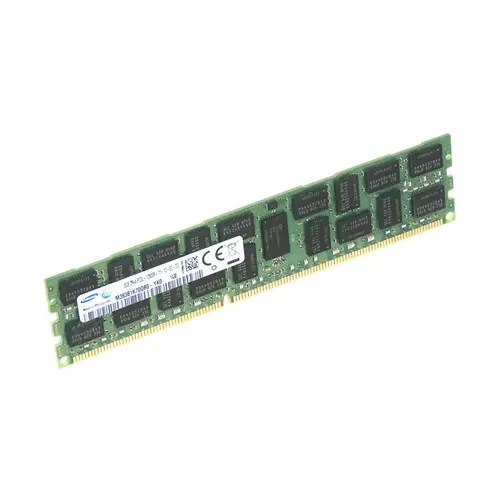
This Samsung M393B1K70QB0-YK0Q9 is a server-grade DDR3-1600 Registered DIMM with ECC, optimized for enterprise virtualization and memory-intensive database workloads where data integrity is critical. Its dual-rank x4 organization and 1.35V low-voltage operation enhance signal stability and energy efficiency in dense rack servers, while CL11 timing ensures reliable registered command/address buffering under heavy load.
1. Registered signal type buffers the command and address lines, enabling stable multi-DIMM populations per channel and sustaining integrity in high-density virtualization hosts.
2. ECC error identification automatically corrects single-bit flips in real time, eliminating silent data corruption during prolonged financial transaction processing.
3. Dual Rank x4 organization leverages rank interleaving to overlap data access cycles, maximizing channel utilization for bandwidth-heavy in-memory analytics.
4. 1.35V low-voltage operation trims energy consumption and thermal load per node, directly lowering cooling overhead in large-scale compute clusters.
5. 1600MHz clock speed supplies sufficient throughput to keep latency-sensitive database queries moving smoothly under concurrent user spikes.
The M393B1K70QB0-YK0Q9 is an 8GB DDR3L Registered DIMM engineered for server environments. Its ECC, registered buffering, low voltage, and dual-rank design deliver enterprise uptime and performance. In a virtualized cluster running dozens of VMs, the registered signal buffer stabilizes high-density memory configurations—preventing boot failures and random crashes when all slots are populated—so your hypervisor can confidently scale to terabytes of RAM. Meanwhile, the ECC engine silently corrects single-bit errors caused by cosmic radiation, protecting transactional databases and in-memory caches from silent data corruption that could otherwise propagate into financial miscalculations. The dual-rank x4 organization uses rank interleaving to boost bandwidth; for an in-memory database like Redis or SAP HANA, this lowers latency under concurrent loads, accelerating customer-facing transactions. The 1.35V low-voltage operation cuts power consumption per DIMM by roughly 20% compared to standard 1.5V DDR3, yielding substantial energy savings across a rack full of servers and reducing thermal stress while delivering resilience, efficiency, and speed.
General Virtualization
For general virtualization hosts running multiple VMs, deploy six to eight of these 8GB RDIMMs (48–64GB total) per socket. Populate two or four identical modules per memory channel in a balanced configuration to maintain uniform memory access and maximize throughput. This approach ensures sufficient headroom for memory overcommitment while leveraging registered ECC reliability.
In-Memory Database
In-memory databases demand large capacity and fault tolerance. Populate all available slots with these 8GB dual-rank modules, targeting 128GB or more per node. A fully symmetrical configuration across all memory channels minimizes latency and maximizes bandwidth, critical for real-time analytics. Always pair identical DIMMs to sustain ECC protection and avoid performance penalties from non-uniform configurations.
High-Performance Computing
HPC workloads benefit from memory bandwidth as much as capacity. Install eight or twelve of these 1.35V low-voltage RDIMMs, filling all memory channels per processor (e.g., 64–96GB). Populate one DIMM per channel initially to achieve the highest clock speed, then expand to two DIMMs per channel only if capacity requirements override the slight frequency drop. Symmetric population is mandatory for consistent parallel performance.
Strictly tested, compatible with Dell PowerEdge R720, HP ProLiant DL380p Gen8, Lenovo ThinkServer RD630, and more.
Q: Can I mix this M393B1K70QB0-YK0Q9 with other memory modules of different brands or speeds?
A: Mixing RDIMMs of different brands or speeds is not recommended. It may cause instability and ECC errors. For reliable operation, install identical Samsung modules with matching rank, speed, and CAS latency across all channels.
Q: Is this memory compatible with my server using Intel Xeon E5-2600 v2 processors?
A: Yes, this DDR3-1600 Registered ECC module is designed for dual-socket servers using Intel E5-2600 v2/v3 or AMD Opteron 6300 series platforms. Always verify with your motherboard's Qualified Vendor List (QVL) for full population support.
Q: What is the recommended DIMM population order for optimal performance with this RDIMM?
A: Populate identical DIMMs in matched sets across memory channels, starting with the slot farthest from the CPU per channel. For this dual-rank x4 module, balance populations to avoid memory bus loading and preserve full memory bandwidth.
Q: Does this module support overclocking or XMP profiles?
A: No. This Samsung server RDIMM runs at JEDEC standard DDR3-1600 with fixed CL11 timings. It does not support overclocking, XMP profiles, or voltage adjustments, as enterprise memory prioritizes data integrity and 24/7 stability.
Q: What warranty and typical failure rate can I expect with this M393B1K70QB0-YK0Q9?
A: This module includes a 1-year warranty. Samsung server DRAM maintains an extremely low annualized failure rate (typically under 0.2%) due to rigorous post-production burn-in testing, ensuring outstanding field reliability.