











 Secure payments
Standard refund policy
Trade Assurance
Secure payments
Standard refund policy
Trade Assurance
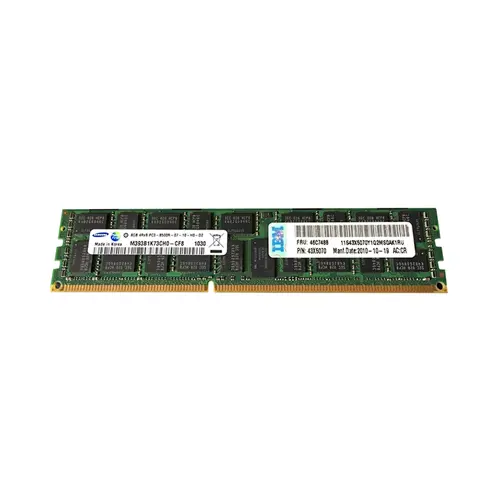
| Model | M393B1K73CH0-CF8 |
|---|---|
| Product Type | Memory Module |
| Compliance Standards | EU RoHS,FCC |
| Memory Capacity | 8 GB |
| Memory Technology | DDR3 |
| Product Voltage | 1.5V |
| RAM Speed | 1066MHz |
| RAM Standard | DDR3-1066/PC3-8500 |
| Error Identifying | ECC |
| Signal Type | Registered |
| Column Access Strobe (CAS) | CL7 |
| Rank | Quad Rank x8 |
| Quantity of Pins | 240-pin |
| RAM Genre | RDIMM |
Designed for legacy server platforms requiring DDR3-1066/PC3-8500, this 8GB Quad Rank x8 RDIMM with ECC and CL7 latency delivers robust data integrity for memory-dense virtualization and database workloads. Its registered signaling ensures stable operation in multi-DIMM configurations, while the quad-rank organization maximizes capacity per channel within older dual-socket systems.
1. ECC protection detects and corrects single-bit memory errors in real time, safeguarding transactional databases and financial computations against silent data corruption.
2. Registered signal type buffers command and address lines, enabling dense multi-DIMM configurations without sacrificing signal integrity in large-scale virtualization clusters.
3. Quad Rank x8 organization packs more DRAM chips onto the module, maximizing per-channel capacity for memory-hungry hypervisors that host dozens of VMs per node.
4. An 8-GB capacity per stick provides the headroom needed to run enterprise middleware, in-memory caches, or sprawling container workloads without immediate scale-out.
5. CL7 low-latency timing reduces the access delay during random read bursts, noticeably accelerating OLAP query throughput and metadata-intensive storage operations.
Based on the RDIMM classification and registered, ECC attributes, the M393B1K73CH0-CF8 is unquestionably a server-grade memory module engineered for mission-critical enterprise workloads where downtime is not an option. Its four defining characteristics directly translate into real-world resilience and performance. First, ECC error correction actively detects and fixes single-bit memory errors caused by cosmic radiation or electrical noise—meaning your financial transaction or virtual machine state does not silently corrupt over months of uptime. Second, the registered buffer stabilizes command signals by reducing electrical load on the memory controller, enabling you to populate all 24 DIMM slots without sacrificing signal integrity; this is precisely how dense virtualization clusters scale to hundreds of VMs per physical host. Third, the quad-rank x8 organization packs four independently addressable ranks on a single module, maximizing capacity density while maintaining balanced interleaving. In an in-memory database like SAP HANA or a Redis cluster, this layout enhances parallel access bandwidth, speeding up real-time analytics queries. Finally, the CAS 7 latency at 1066MHz ensures deterministic response times under heavy transactional loads. Together, these features mean you get uncompromised data fidelity, massive scale-out headroom, and consistent low-latency delivery—all essential when your business depends on a 24/7 reliable server infrastructure.
General Virtualization
For general virtualization hosts, populate at least six to twelve modules to balance memory capacity and memory bandwidth across multiple memory channels. A typical dual-socket server benefits from 96 GB (12×8 GB) to support numerous virtual machines without overcommitting. Because these Registered DIMMs operate at 1066 MHz, prioritize capacity and rank interleaving over speed, and leave half the slots free for future scaling.
In-Memory Database
In-memory databases demand maximum capacity and reliability. Fill all memory channels with identical 8 GB quad‑rank RDIMMs, reaching 128 GB or more per host to keep entire datasets in RAM. The ECC and registered signaling are critical here, preventing silent data corruption. With CL7 latency and quad‑rank loading, verify the memory controller downclock limits and consider upgrading to multi‑socket systems if additional capacity is needed.
High-Performance Computing
HPC clusters require balanced memory bandwidth per core. Install eight modules per node in a dual‑channel or quad‑channel configuration to saturate the memory bus. Though 1066 MHz is modest, the large capacity per module suits memory‑capacity‑bound workloads like fluid dynamics. Avoid mixing ranks or speeds within a channel; uniform quad‑rank DIMMs maintain predictable latency, while the 1.5 V registered design ensures stable operation under sustained full load.
Rigorously tested DDR3 server memory. Compatible with Dell PowerEdge R710, HP DL380 G7, IBM x3650 M3, and similar systems.
Q: Can I mix this M393B1K73CH0-CF8 with other memory modules of different brands or speeds?
A: Mixing RDIMMs of differing brands or speeds is not recommended. It may cause instability or prevent boot. For server environments, always use identical modules to ensure signal integrity and validated reliability.
Q: Is this memory compatible with my system?
A: This DDR3-1066 registered ECC DIMM is designed for Intel Xeon and select AMD Opteron server platforms. Verify your motherboard supports 1.5V, 240-pin RDIMMs with quad-rank architecture and ECC functionality in your server's qualified vendor list.
Q: What is the recommended DIMM population order for optimal performance?
A: For quad-rank RDIMMs, populate identical sticks per channel starting from the slot farthest from the CPU. Usually follow the server board's population guide: fill white/blue slots first to maintain balanced memory interleaving and maximize throughput.
Q: Does this module support overclocking or XMP profiles?
A: No. Server-class registered ECC memory like this M393B1K73CH0-CF8 prioritizes data integrity and stability over speed. It runs strictly at JEDEC standard DDR3-1066 without overclocking or XMP support.
Q: What warranty and typical failure rate can I expect?
A: This module includes a one-year warranty. Enterprise-grade ECC RDIMMs exhibit extremely low annualized failure rates under proper operating conditions, engineered for 24/7 mission-critical workloads with minimal defect probability.