











 Secure payments
Standard refund policy
Trade Assurance
Secure payments
Standard refund policy
Trade Assurance
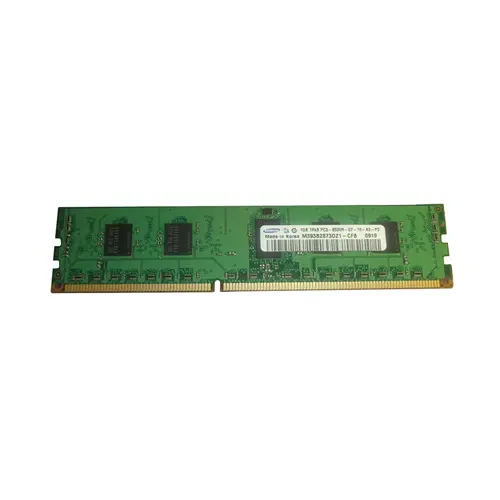
| Model | M393B2873DZ1-CF8 |
|---|---|
| Product Type | Memory Module |
| Compliance Standards | EU RoHS,FCC |
| Memory Capacity | 1 GB |
| Memory Technology | DDR3 |
| Product Voltage | 1.5V |
| RAM Speed | 1066MHz |
| RAM Standard | DDR3-1066/PC3-8500 |
| Error Identifying | ECC |
| Signal Type | Registered |
| Column Access Strobe (CAS) | CL7 |
| Rank | Single Rank x8 |
| Quantity of Pins | 240-pin |
| RAM Genre | RDIMM |
This DDR3-1066 Registered ECC RDIMM is purpose-built for legacy server platforms running mission-critical workloads such as virtualization and in-memory databases, where data integrity and stable multi-DIMM operation are essential. Its single-rank x8 architecture combined with CL7 latency and registered signaling ensures low access latency and superior signal integrity, while hardware ECC delivers robust single-bit error correction to safeguard transactional data.
1. ECC protection silently corrects single-bit errors in real time, preserving financial transaction integrity and preventing silent data corruption in long-running server workloads.
2. Registered signal buffering stabilizes command and address lines under fully populated configurations, eliminating memory-related system crashes during peak virtualization density.
3. Single Rank x8 layout minimizes inter-rank contention, delivering consistent access latency essential for latency-sensitive containerized microservices and caching layers.
4. CL7 low-latency timing accelerates small random data fetches, shrinking response times for in-memory databases handling high-frequency queries.
5. 1 GB capacity delivers a lean memory footprint for dedicated network appliances and lightweight hypervisor nodes, reducing idle power overhead per server.
This is a server-grade Registered ECC DDR3 module, purpose-built for mission-critical enterprise environments. Its error-correcting code (ECC) is not just a feature—it actively prevents single-bit memory errors that can silently corrupt transactional data in a virtualized cluster or cause a financial database node to return inaccurate results. When a hypervisor hosts multiple virtual machines, memory integrity directly safeguards SLAs and audit compliance.
The registered signal buffer on this RDIMM stabilizes command and address lines across a multi-DIMM channel, meaning you can populate all memory slots without signal degradation. In a dense 2U server running an in-memory database like Redis, this allows you scale capacity reliably while avoiding boot failures or intermittent crashes under heavy load. The single-rank x8 organization at 1066MHz offers predictable, low-latency access—rank interleaving overhead is eliminated, so the memory controller delivers consistent latency for synchronous replication or real-time analytics. Finally, the 1.5V operating voltage and EU RoHS compliance keep power budgets and regulatory risk low across a fleet, ensuring your data center expansion remains both cost-efficient and environmentally responsible. This module turns a simple specification into operational resilience.
General Virtualization
For hypervisor hosts running multiple VMs, populate all memory channels symmetrically to maximize bandwidth. Start with six or twelve identical M393B2873DZ1-CF8 modules (6×1 GB or 12×1 GB) to respect triple-channel architectures typical of DDR3 servers, ensuring balanced load and ECC protection. Scale by doubling identical DIMM sets—never mix different ranks or speeds—to maintain stability under contention.
In-Memory Database
Low-latency datasets demand fully populated channels with single-rank x8 RDIMMs like this one to reduce electrical loading and command bus overhead. Deploy the minimum number of modules that satisfy capacity while keeping all channels populated (e.g., three or six DIMMs for 3 GB/6 GB total) to hit the highest clock rate. Avoid mixing dual-rank DIMMs, as the single-rank design preserves signal integrity at 1066 MT/s and complements ECC scrubbing for data integrity.
High-Performance Computing
HPC clusters benefit from dense, uniform node configurations using registered ECC memory for result reliability. Fill every memory socket with this 1 GB RDIMM to achieve maximum aggregate capacity per node while retaining the registered command parity. For large-scale simulations, install 12 or 18 modules per dual-socket node (12–18 GB) symmetrical across CPU memory controllers; this single-rank arrangement ensures predictable thermal and power behaviour during sustained 1.5 V operation.
Rigorously tested, compatible server RAM for Dell R710/R720, HP DL380 G7, IBM x3650 M3.
Q: Can I mix this M393B2873DZ1-CF8 with other memory modules of different brands or speeds?
A: Mixing is not recommended. This Registered ECC DDR3 module requires identical RDIMMs; mixing with unbuffered, non‑ECC, or different speed DIMMs can cause boot failure, instability, or silent data corruption.
Q: Is this memory compatible with my system?
A: This DDR3-1066 Registered ECC DIMM targets server platforms using Intel Xeon 5500/5600 series or AMD Opteron 4100/6100 series. Confirm your board supports 1.5V RDIMMs, 1 GB single‑rank modules, and ECC functionality.
Q: What is the recommended DIMM population order for optimal performance?
A: Populate identical DIMMs per channel, starting with the slot farthest from the CPU. On dual‑socket servers, balance across channels and follow the platform’s population rules to maintain memory interleaving and ECC correctness.
Q: Does this module support overclocking or XMP profiles?
A: No. This enterprise‑grade Registered ECC module is built for stability at the JEDEC DDR3‑1066 standard. Overclocking or XMP is not supported, as server environments demand maximum reliability and data integrity.
Q: What warranty and typical failure rate can I expect?
A: This module includes a one‑year warranty. The typical annualized failure rate (AFR) for such server‑grade ECC memory is under 0.5% under normal operating conditions, ensuring long‑term reliability for critical applications.