











 Secure payments
Standard refund policy
Trade Assurance
Secure payments
Standard refund policy
Trade Assurance
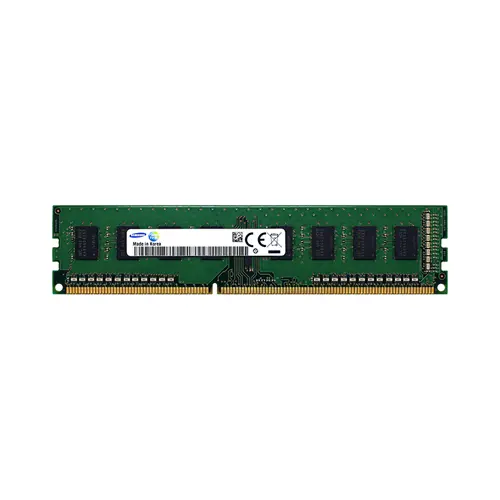
| Model | M393B2873DZ1-CH9 |
|---|---|
| Product Type | Memory Module |
| Compliance Standards | EU RoHS,FCC |
| Memory Capacity | 1 GB |
| Memory Technology | DDR3 |
| Product Voltage | 1.5V |
| RAM Speed | 1333MHz |
| RAM Standard | DDR3-1333/PC3-10600 |
| Error Identifying | ECC |
| Signal Type | Registered |
| Column Access Strobe (CAS) | CL9 |
| Rank | Single Rank x8 |
| Quantity of Pins | 240-pin |
| RAM Genre | RDIMM |
Designed for legacy server platforms, this Samsung 1GB DDR3-1333 RDIMM (M393B2873DZ1-CH9) with ECC and registered signaling ensures robust data integrity in virtualized environments and memory-intensive database applications. Its single-rank x8 configuration reduces electrical loading on the memory bus, enabling stable operation at CL9 latency in dense multi-DIMM deployments.
1. ECC memory detects and corrects single-bit errors in real time, preventing silent data corruption that could compromise financial records or database integrity in always-on enterprise servers.
2. Registered signal buffering stabilizes command and address signals across fully populated memory channels, enabling reliable operation when scaling to dozens of DIMMs in a virtualization rack.
3. RDIMM architecture integrates both ECC and register functions, delivering the fault tolerance and high capacity density required for consolidated cloud workloads and multi-tenant hosting.
4. Single Rank x8 organization minimizes electrical loading per channel, preserving clean signal timing in servers with three or more DIMMs per memory controller for sustained application uptime.
5. 1333MHz memory bandwidth provides steady data throughput for legacy business applications and light containerized services, balancing performance with thermal headroom in dense data center deployments.
As a server-focused DDR3 Registered DIMM, the M393B2873DZ1-CH9 leverages four essential traits—ECC, registered buffering, 1333MHz CL9 performance, and strict 1.5V compliance—to solve critical data center challenges. ECC correction directly protects virtualized environments: a single undetected bit-flip in a VMware cluster can crash VMs or corrupt a Redis in-memory store. By silently fixing errors, ECC prevents cascading failures. The registered buffer reduces controller load, enabling you to fill every DIMM slot for maximum capacity without compromising signal integrity—vital when scaling a SAP HANA database that demands terabytes of stable memory. Meanwhile, 1333MHz with CL9 ensures low-latency data fetches, keeping transaction response times snappy under load. Finally, the standard 1.5V voltage guarantees trouble-free compatibility across enterprise server generations, protecting your hardware investment. For virtualization and memory-driven analytics, this module translates directly into non-stop uptime and ironclad data accuracy.
General Virtualization
For virtualized hosts, memory capacity and reliability are paramount. Use at least eight to twelve of these 1GB RDIMMs per server to achieve 8–12 GB total, populating all memory channels evenly for balanced performance. The ECC and registered design guarantees data integrity under multiple VM workloads, while the low 1.5V draw helps manage thermal density in densely-packed nodes.
In-Memory Database
In-memory databases demand low latency and absolute data correctness. Install six to eight modules to build a 6–8 GB pool, configuring them in identical pairs across channels to avoid performance penalties. The single-rank x8 organization and CL9 latency deliver swift access, and registered buffering ensures stable signal integrity even when all banks are heavily stressed by large datasets.
High-Performance Computing
HPC clusters require maximum memory bandwidth and fault tolerance. Fully populate each node’s DIMM slots—typically 12 to 16 modules—to aggregate 12–16 GB, enabling the highest possible throughput for parallel MPI tasks. The 1333 MHz speed and ECC protection eliminate silent data corruption during long-running simulations, while the registered interface supports the large module count without signal degradation.
Rigorously tested server memory, compatible with Dell PowerEdge R720, HP DL380p Gen8, IBM x3650 M4.
Q: Can I mix this M393B2873DZ1-CH9 with other memory modules of different brands or speeds?
A: Mixing is strongly discouraged. In server environments, mismatched brands, speeds, or ranks can cause signal integrity and stability issues, potentially leading to downtime or data corruption. Use identical modules for guaranteed compatibility.
Q: Is this memory compatible with my system?
A: This DDR3-1333 Registered ECC RDIMM is compatible with server platforms supporting 1.5V RDIMMs, such as Intel Xeon 5500/5600 series or AMD Opteron 6100/6200 series. Verify your server board's Qualified Vendor List (QVL) for exact model support.
Q: What is the recommended DIMM population order for optimal performance?
A: Follow your server motherboard manual. Generally, populate the first slot of each memory channel (often the blue slot closest to the CPU) first. Balanced channel population ensures optimal interleaving and bandwidth. Consult the system's specific guidelines for exact order.
Q: Does this module support overclocking or XMP profiles?
A: No. This is an enterprise-grade server module built to strict JEDEC standards for mission-critical stability. Overclocking and XMP are not supported; the module operates at its native DDR3-1333 JEDEC profile to ensure 24/7 reliability.
Q: What warranty and typical failure rate can I expect?
A: This unit carries a 1-year warranty. Samsung server memory features an extremely low Annualized Failure Rate (AFR) due to rigorous validation. Expect enterprise-class reliability suitable for demanding, always-on server environments.