











 Secure payments
Standard refund policy
Trade Assurance
Secure payments
Standard refund policy
Trade Assurance
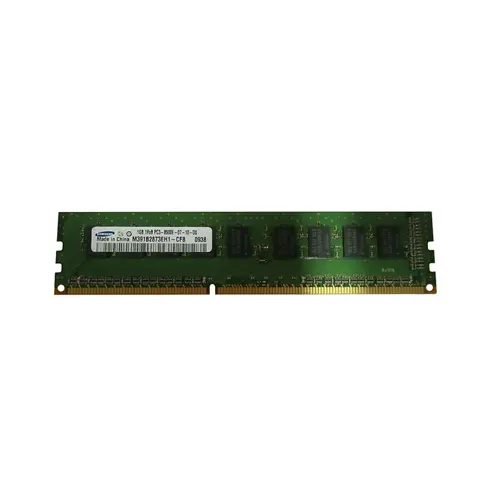
| Model | M393B2873EH1-CF8 |
|---|---|
| Product Type | Memory Module |
| Compliance Standards | CE,WEEE,RoHS |
| Memory Capacity | 1 GB |
| Memory Technology | DDR3 |
| Product Voltage | 1.5V |
| RAM Speed | 1066MHz |
| RAM Standard | DDR3-1066/PC3-8500 |
| Error Identifying | ECC |
| Signal Type | Registered |
| Column Access Strobe (CAS) | CL7 |
| Rank | Single Rank x8 |
| Quantity of Pins | 240-pin |
| RAM Genre | RDIMM |
This is a DDR3 Registered ECC memory module designed for server platforms, where its ECC and registered signal type ensure critical data integrity and stable operation under high-density memory configurations. The single-rank x8 organization combined with a CAS latency of 7 delivers low-latency throughput ideal for virtualization and in-memory database workloads that demand consistent access times.
1. Registered signal type ensures consistent electrical loading and signal integrity across all DIMM slots, enabling enterprise servers to support maximum memory capacities for dense virtualization without stability compromises.
2. ECC error correction provides real-time detection and repair of memory faults, protecting critical server workloads like financial transactions and database operations from silent data corruption.
3. RDIMM architecture buffers command and address signals, allowing multi-socket servers to scale memory channels efficiently while maintaining reliable operation under heavy consolidation.
4. Single Rank x8 organization reduces inter-rank latency and power draw, delivering more predictable response times for latency-sensitive enterprise applications such as high-frequency trading platforms.
5. DDR3 technology supplies a proven, energy-efficient foundation for legacy server infrastructure, ensuring broad compatibility and dependable uptime during phased data center upgrades.
Designed for the data center, the M393B2873EH1-CF8 is a server-grade registered DDR3 RDIMM, and its four defining characteristics directly address the pain points of IT infrastructure. The built-in ECC engine continuously scans and corrects single-bit memory errors, which means a critical financial transaction or a patient record in a healthcare database is shielded from silent data corruption that could otherwise cascade into costly outages. The registered buffer redistributes the command and address signals, stabilizing the electrical load so you can populate all 24 DIMM slots on a virtualization host with 192 GB of memory without signal degradation—essential when consolidating dozens of virtual machines on a single physical node. Its industry-standard 1.5 V operating voltage balances thermal management and power draw across dense server farms, keeping cooling overhead predictable. Furthermore, the single-rank x8 organization and CL7 latency provide tight access timing that benefits memory-intensive caching layers like Redis or Memcached, where sub-millisecond response is the difference between a seamless user experience and a sluggish application. Together, these attributes translate into uncompromised uptime and consistent performance for your mission-critical workloads.
General Virtualization
For light to moderate VM densities with DDR3-era servers, populate at least six identical M393B2873EH1-CF8 modules across three memory channels per CPU to sustain 1066 MT/s speeds. Configure balanced DIMMs per channel to avoid bus speed downgrades, targeting 24 GB to 48 GB total for basic hypervisor workloads. Avoid mixing ranks or speeds, as registered ECC memory is strict about uniform configurations.
In-Memory Database
Maximize capacity by installing three quad-rank or dual-rank RDIMMs per channel, though this single-rank x8 module forces lower ranks per channel, limiting per-socket capacity to around 48–96 GB. Given the CL7 latency and 1066 MHz speed, this module suits small-scale Redis or Memcached instances where data fits within the populated capacity. For larger in-memory datasets, consider higher-capacity 8 GB or 16 GB registered DIMMs of the same generation.
High-Performance Computing (HPC)
Balance bandwidth and capacity by installing one or two DIMMs per channel—this single-rank module at one DIMM per channel delivers 1066 MHz with CL7, maximizing memory throughput per core for memory-bound HPC codes. For cluster nodes running MPI tasks, equip each socket identically with six or twelve modules to maintain symmetric memory access and avoid NUMA penalties. Capacity per node should match working set sizes; supplement with SSD swap only if acceptable for checkpointing, not active computation.
Validated server memory, rigorously tested with Dell PowerEdge R710/R720, HP ProLiant DL380 G7, and more.
Q: Can I mix this M393B2873EH1-CF8 with other memory modules of different brands or speeds?
A: Mixing is not recommended. Registered ECC memory demands matched ranks, timings, and speeds for stable operation. Mismatched modules can cause system instability or POST failures in server environments.
Q: Is this memory compatible with my server system?
A: This DDR3-1066 RDIMM is designed for Intel Xeon 5500/5600 series and AMD Opteron 6100/6200 platforms. Verify your motherboard supports registered ECC modules and a 1.5V operating voltage.
Q: What is the recommended DIMM population order for optimal performance?
A: Follow your server board manual. Generally, populate channels symmetrically—start with slots farthest from the CPU on each channel. Use identical DIMMs per channel to enable dual- or triple-channel interleaving.
Q: Does this module support overclocking or XMP profiles?
A: No. RDIMMs are engineered for enterprise reliability, not overclocking. They adhere to JEDEC standard timings and lack XMP profiles. Overclocking is unsupported and may violate warranty and risk data integrity.
Q: What warranty and typical failure rate can I expect?
A: This module includes a 1-year warranty. Actual failure rates are extremely low, typically under 0.5% annually, as validated under strict JEDEC and RoHS compliance standards for 24/7 server operation.