











 Secure payments
Standard refund policy
Trade Assurance
Secure payments
Standard refund policy
Trade Assurance
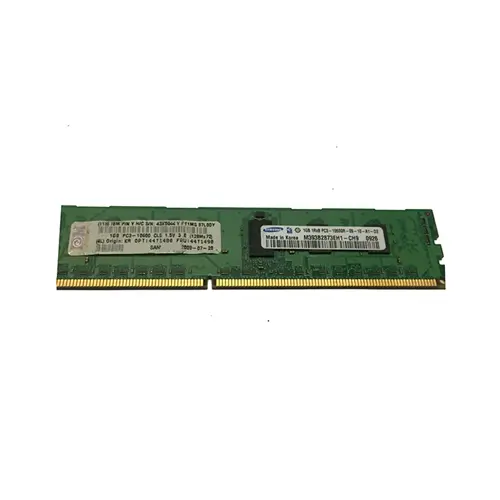
| Model | M393B2873EH1-CH9 |
|---|---|
| Product Type | Memory Module |
| Compliance Standards | EU RoHS,FCC |
| Memory Capacity | 1 GB |
| Memory Technology | DDR3 |
| Product Voltage | 1.5V |
| RAM Speed | 1333MHz |
| RAM Standard | DDR3-1333/PC3-10600 |
| Error Identifying | ECC |
| Signal Type | Registered |
| Column Access Strobe (CAS) | CL9 |
| Rank | Single Rank x8 |
| Quantity of Pins | 240-pin |
| RAM Genre | RDIMM |
This DDR3-1333 Registered ECC RDIMM (M393B2873EH1-CH9) is purpose-built for entry-level servers and legacy enterprise platforms, delivering strong data integrity in virtualized environments, lightweight databases, and memory-intensive transactional workloads. Its single-rank x8 organization paired with registered signaling minimizes bus loading and improves signal stability across multiple DIMMs per channel, while ECC protection ensures reliable operation at CL9 latency for sustained uptime in 24/7 deployments.
1. ECC error correction silently detects and rectifies single-bit memory faults, preserving data integrity in financial transaction logs and hypervisor memory without service interruption.
2. Registered signal buffering re-drives command and address buses, enabling large DIMM populations with uncompromised stability in virtualized multi-socket server platforms.
3. 1333MHz transfer rate yields per-channel bandwidth of 10.6GB/s, sustaining steady throughput for concurrent live-migration workloads and memory-hungry in-memory databases.
4. CL9 column access latency shortens the data fetch window, delivering faster query responses under heavy OLTP loads where every nanosecond impacts end-user experience.
5. Single-rank x8 organization minimizes electrical loading on the memory channel, improving signal margins and thermal behavior in dense rack-scale deployments.
The M393B2873EH1-CH9 is a server-grade DDR3 Registered DIMM purpose-built for mission-critical enterprise environments, not desktop or laptop systems. Its four defining characteristics directly solve the real pain points that keep data center architects awake at night.
Start with ECC error correction: in a dense virtualization cluster running dozens of VMs, a single undetected bit flip in RAM can corrupt hypervisor data structures and cascade into silent VM crashes or data loss. This module’s integrated ECC detects and corrects single-bit errors on the fly, preserving the integrity of your virtualized workloads and in-memory databases like Redis or SAP HANA where every transaction must be absolutely trustworthy.
The Registered (buffered) design addresses scalability turbulence. Without a register to re-drive address and command signals, high-capacity memory configurations suffer electrical loading that leads to instability. With this RDIMM, you can populate a 2-socket server fully—critical for maximizing VM density per physical host and reducing licensing costs.
A single-rank x8 organization and CL9 latency at 1333MHz deliver predictable, efficient data access. For a memory database whose query throughput depends on deterministic latency and bandwidth, this rank structure avoids the scheduling conflicts of dual-rank modules while keeping command rates high. Together, these features mean your database transactions commit faster and your virtual machines run stably under load—not just specs on paper, but measurable service continuity and performance when revenue depends on uptime.
Capacity Planning for DDR3 Registered ECC Memory (M393B2873EH1-CH9)
This Samsung 1GB DDR3-1333 RDIMM is designed exclusively for server platforms, where registered ECC support is critical for data integrity and 24/7 stability. Capacity planning must consider the modest 1GB density and the scalability needs of modern server workloads.
General Virtualization
In virtualized environments, total memory capacity dictates VM density. With only 1GB modules, populate all available channels with multiple DIMMs per channel to reach a usable baseline. Aim for at least 16–24 modules (16–24GB) for a light hypervisor host running a few small VMs, but be aware that this density will quickly become a bottleneck for any production setup.
In-Memory Database
In-memory databases like Redis or Memcached demand large, low-latency memory pools. A single 1GB DIMM is inadequate. Build the maximum supported configuration by populating all 12 or 24 DIMM slots with 1GB RDIMMs, but even a fully loaded 24GB system severely limits dataset sizes. For meaningful caching or database acceleration, consider migrating to higher-density modules.
High-Performance Computing (HPC)
HPC clusters require high bandwidth and large per-node memory for simulation data. Use the maximum number of identical DIMMs to achieve balanced interleaving across memory channels. Deploying 12–24 modules per node will deliver 12–24GB of ECC-protected memory, sufficient only for lightweight computational tasks. Cluster scaling can aggregate capacity, but per-node limits may constrain complex models.
Strictly tested server RDIMM, compatible with Dell PowerEdge R620/R720, HP ProLiant DL380p Gen8, and IBM System x3650 M4.
Q: Can I mix this M393B2873EH1-CH9 with other memory modules of different brands or speeds?
A: Mixing is not recommended for server RDIMMs. Different brands, ranks, or speeds may cause stability issues. For guaranteed reliability in registered ECC environments, always install identical modules with the same MPN and batch.
Q: Is this memory compatible with my system?
A: It is compatible with servers using Intel Xeon 5500/5600 or AMD Opteron 4100/6100 platforms that support DDR3-1333 Registered ECC memory. Please verify your motherboard's qualified vendor list (QVL) for confirmation.
Q: What is the recommended DIMM population order for optimal performance?
A: Populate identical DIMMs per channel, starting with the farthest slot from the CPU. For dual-processor systems, balance memory across both CPUs according to your server board's manual to ensure full memory interleaving.
Q: Does this module support overclocking or XMP profiles?
A: No. This is a server-grade Registered ECC DIMM designed for 24/7 stability at JEDEC standard DDR3-1333 CL9. It does not support overclocking or XMP profiles, as data integrity is the priority.