











 Secure payments
Standard refund policy
Trade Assurance
Secure payments
Standard refund policy
Trade Assurance
| Model | M393B2G70DB0-CH9 |
|---|---|
| Product Type | Memory Module |
| Compliance Standards | EU RoHS,FCC |
| Memory Capacity | 16 GB |
| Memory Technology | DDR3 |
| Product Voltage | 1.5V |
| RAM Speed | 1333MHz |
| RAM Standard | DDR3-1333/PC3-10600 |
| Error Identifying | ECC |
| Signal Type | Registered |
| Column Access Strobe (CAS) | CL9 |
| Rank | Dual Rank x4 |
| Quantity of Pins | 240-pin |
| RAM Genre | RDIMM |
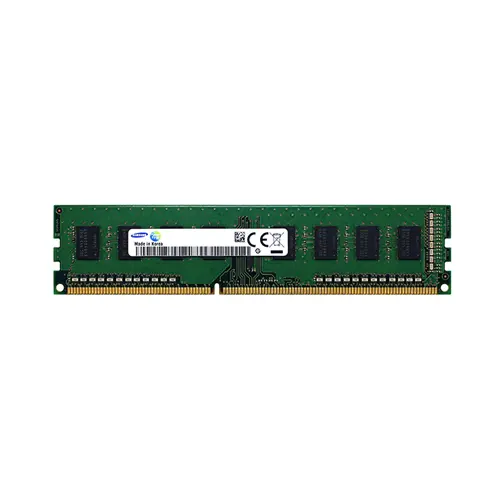
This Samsung 16GB DDR3-1333 Registered ECC RDIMM is designed for legacy server platforms requiring high data integrity, making it well-suited for virtualization hosts and memory-intensive database applications where reliability is paramount. Its dual-rank x4 configuration with registered signaling stabilizes higher-density memory channels, while ECC provides single-bit error correction to prevent silent data corruption in mission-critical environments.
1. ECC protection detects and corrects single-bit memory errors, preventing silent data corruption in mission-critical databases and financial transaction systems.
2. Registered signal buffering stabilizes high-capacity memory configurations, enabling densely populated servers without compromising command bus integrity.
3. Dual Rank x4 organization keeps memory channels fully saturated, critical for consistent virtual machine performance under heavy consolidation workloads.
4. DDR3 technology ensures seamless drop-in compatibility with legacy server platforms, extending the operational lifespan of existing data center investments.
5. Generous module capacity accommodates larger in-memory caches and higher virtual machine density per physical host, reducing licensing and footprint costs.
When you are running a consolidated virtualization cluster or an in-memory database, memory errors are not just an inconvenience—they are a direct threat to data integrity and service uptime. The Samsung M393B2G70DB0-CH9 is engineered precisely for these mission-critical environments. As a 16GB DDR3-1333 Registered RDIMM, its four defining characteristics translate directly into real-world resilience. First, ECC actively corrects single-bit errors, eliminating silent data corruption that could crash a financial transaction database or poison a live VM image. Second, the Registered signal architecture buffers control signals, enabling you to populate all memory channels with large-capacity DIMMs without signal degradation, which is vital when you need to allocate hundreds of gigabytes across a multi-node hypervisor cluster. Third, its dual-rank x4 organization leverages rank interleaving to overlap memory accesses, boosting effective bandwidth for latency-sensitive workloads like Redis or SAP HANA—this means one rank can be precharging while the other responds, reducing idle cycles during peak query storms. Finally, a native 1.5V design and CL9 latency deliver steady, predictable power consumption, helping to control thermal loads in densely packed server racks where every watt matters. This module keeps your data accurate and your services running, even under heavy, sustained load.
The M393B2G70DB0-CH9 is a server DDR3-1333 ECC Registered RDIMM with dual-rank x4 organization, 16GB capacity. Below are capacity planning suggestions for typical server roles:
General Virtualization
Distribute identical 16GB modules across all memory channels to sustain multiple VMs efficiently. Begin with 128GB (eight DIMMs) on a dual-socket system, keeping one DIMM per channel free for expansion. Upgrade to 256GB by filling the second slot per channel as VM density increases. Registered ECC ensures data integrity.
In-Memory Database
These workloads demand the entire dataset reside in RAM. Maximize capacity by populating every slot—a 24-slot server gives 384GB. Stick to two dual-rank DIMMs per channel at 1333MHz for stable operation. Plan socket-level memory limits to accommodate future scaling.
High-Performance Computing (HPC)
Bandwidth is critical; populate all memory channels with one 16GB DIMM each. For quad-channel processors, install 128GB (8×16GB) to balance data paths. Use identical dual-rank RDIMMs and avoid mixing speeds to prevent performance pitfalls during parallel tasks.
Rigorously tested server memory, compatible with Dell R720, HP DL380p G8, IBM x3650 M4, and Cisco C240 M3.
Q: Can I mix this M393B2G70DB0-CH9 with other memory modules of different brands or speeds?
A: Mixing this registered ECC module with different brands or speeds is not recommended, as it may cause system instability and compatibility issues. For reliable server operation, use identical modules.
Q: Is this memory compatible with my system?
A: This module is compatible with servers supporting DDR3-1333 Registered ECC memory, such as those based on Intel Xeon E5 series or AMD Opteron platforms. Verify your server's memory specifications for compatibility.
Q: What is the recommended DIMM population order for optimal performance?
A: For optimal performance, populate DIMMs per the server manufacturer's guidelines, typically starting from the farthest slot from the CPU per channel. Balance memory across channels to maximize bandwidth.
Q: Does this module support overclocking or XMP profiles?
A: No, this server-grade registered ECC module does not support overclocking or XMP profiles. It operates at standard JEDEC timings to ensure maximum stability and data integrity in enterprise environments.
Q: What warranty and typical failure rate can I expect?
A: This module includes a one-year warranty. As an enterprise-class product, it exhibits a very low annualized failure rate (AFR), ensuring high reliability for critical server workloads.