











 Secure payments
Standard refund policy
Trade Assurance
Secure payments
Standard refund policy
Trade Assurance
| Model | M393B2G70EB0-CK0 |
|---|---|
| Product Type | Memory Module |
| Compliance Standards | EU RoHS,FCC |
| Memory Capacity | 16 GB |
| Memory Technology | DDR3 |
| Product Voltage | 1.5V |
| RAM Speed | 1600MHz |
| RAM Standard | DDR3-1600/PC3-12800 |
| Error Identifying | ECC |
| Signal Type | Registered |
| Column Access Strobe (CAS) | CL11 |
| Rank | Dual Rank x4 |
| Quantity of Pins | 240-pin |
| RAM Genre | RDIMM |
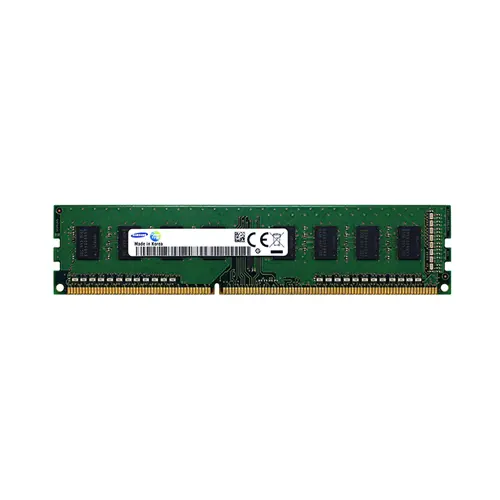
This is a server-class DDR3-1600 Registered ECC DIMM, purpose-built for virtualization clusters and memory-intensive database workloads where data integrity is non-negotiable. Its dual-rank x4 configuration and registered signaling maintain clean signal integrity under heavy load, while ECC actively corrects single-bit errors to keep mission-critical services online around the clock.
1. A 16GB capacity per module provides ample headroom for memory-intensive server workloads, allowing higher virtual machine density without immediate hardware expansion.
2. ECC protection detects and corrects single-bit errors in real time, guarding against silent data corruption in mission-critical database and financial transaction systems.
3. Registered buffering stabilizes signals across the memory bus, making it possible to populate all DIMM slots without compromising command integrity in large-scale rack servers.
4. The dual-rank x4 organization interleaves memory accesses and fully utilizes each channel’s bandwidth, sustaining predictable low-latency performance under heavy virtualization consolidation.
5. Operating as a DDR3-1600/PC3-12800 module, it supplies a peak throughput of 12.8 GB/s per channel, efficiently handling concurrent data streams in mid-range enterprise servers.
The M393B2G70EB0-CK0 is unmistakably a server-class registered DIMM, engineered for platforms where downtime is not an option. Its defining feature, Error Correcting Code, actively detects and corrects single-bit memory errors caused by cosmic radiation or electrical interference. In a virtualized cluster hosting dozens of critical virtual machines, a single undetected bit flip in DRAM can corrupt hypervisor data, silently cascading into VM crashes and hours of forensic recovery. ECC transforms that risk into a transparent, auto-corrected event, preserving uptime and data fidelity with zero operational impact.
Equally vital is the registered signal topology. By buffering command and address lines through an on-DIMM register, this module maintains sharp signal integrity even when a server is fully populated across 12 or 24 slots. For a large in-memory database like SAP HANA or Redis, this means you can scale to massive capacities without sacrificing the 1600MT/s speed. The dual-rank x4 organization then amplifies usable bandwidth through rank interleaving, allowing simultaneous read and write streams during complex analytical queries. Together, these characteristics ensure that every terabyte of data remains not just accessible, but instantly and reliably available under heavy, constant load.
General Virtualization
For a virtualized host running multiple VMs, install RDIMMs in balanced configurations across all available memory channels to maximize bandwidth. A typical 2-socket server with 16 DIMM slots per CPU should be populated with at least eight 16GB modules per processor to reach 128GB per socket, avoiding performance penalties from unbalanced access. Leave room for growth by using half the slots initially, allowing future expansion without replacing existing modules.
In-Memory Database
In-memory databases like SAP HANA or Redis demand low latency and high reliability, making ECC Registered DIMMs essential. Deploy the maximum supported memory by fully populating all channels with these 16GB RDIMMs, aiming for 256GB to 1TB per server to keep entire datasets in RAM. Use dual-rank modules in every channel to leverage rank interleaving for a measurable latency reduction under heavy workloads.
High-Performance Computing
HPC clusters require consistent, error-free operation across hundreds of nodes, so ECC buffering prevents silent data corruption during long-running simulations. Equip each compute node with an equal number of DIMMs per memory channel—typically six or eight modules for a 3-channel or 4-channel DDR3 architecture—to achieve 96GB or 128GB and sustain peak memory bandwidth. For dual-socket nodes, mirror the configuration across CPUs to avoid NUMA imbalances that can throttle parallel MPI jobs.
Rigorously tested, this server memory is compatible with Dell PowerEdge R720/R620, HP ProLiant DL380p Gen8, Lenovo ThinkServer RD430, and similar systems.
Q: Can I mix this M393B2G70EB0-CK0 with other memory modules of different brands or speeds?
A: Mixing with different brands or speeds is strongly discouraged in server environments. It often leads to instability and may disable ECC or cause system boot failures. Always use identical modules.
Q: Is this memory compatible with my system?
A: This DDR3-1600 Registered ECC RDIMM targets server platforms like Intel Xeon E5-2600 v1/v2 and select AMD Opteron series. Verify your board supports 240-pin DDR3 RDIMMs with ECC.
Q: What is the recommended DIMM population order for optimal performance?
A: Follow your server board manual. Typically, balance memory across memory channels, populating identical slots per channel (e.g., A1/B1 first) to enable optimal interleaving and maximum bandwidth.
Q: Does this module support overclocking or XMP profiles?
A: No. Server memory prioritizes data integrity and stability. This module runs only at JEDEC standard DDR3-1600 timings and does not support overclocking or XMP profiles.
Q: What warranty and typical failure rate can I expect?
A: This product comes with a 1-year warranty. Equipped with ECC, the typical annualized failure rate is under 2%, ensuring dependable operation in mission-critical server deployments.