











 Secure payments
Standard refund policy
Trade Assurance
Secure payments
Standard refund policy
Trade Assurance
| Product Type | Memory Module |
|---|---|
| Compliance Standards | |
| Memory Capacity | 16 GB |
| Memory Technology | DDR3 |
| Product Voltage | 1.35 V |
| RAM Speed | 1600 MHz |
| RAM Standard | DDR3-1600/PC3-12800 |
| Error Identifying | ECC |
| Signal Type | Registered |
| Column Access Strobe (CAS) | CL11 |
| Rank | Dual Rank x4 |
| Quantity of Pins | 240-pin |
| RAM Genre | RDIMM |
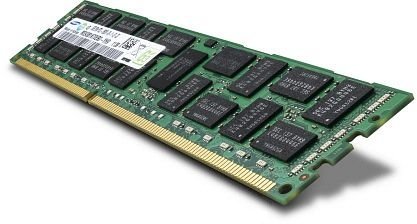
Designed for server-class platforms, this 16GB DDR3-1600 RDIMM is ideally suited for virtualization hosts and in-memory databases where data integrity under heavy load is critical. Its registered signal architecture and ECC correction maintain stability across densely populated memory channels, while the dual-rank x4 organization at 1.35V optimizes bandwidth efficiency and reduces power consumption in 24/7 operation.
1. ECC error correction actively detects and fixes single-bit memory errors, preventing silent data corruption in mission-critical database and virtualization workloads.
2. Registered signal buffering stabilizes electrical loads on the memory bus, allowing fully populated servers to maintain reliability under heavy memory configurations.
3. Dual Rank x4 organization interleaves data access across two internal rank groups, boosting sustained bandwidth for multiple concurrent virtual machines.
4. 16GB capacity per module increases memory density per server node, directly enabling higher VM consolidation ratios without sacrificing guest performance.
5. 1.35V low-voltage operation reduces datacenter power draw and cooling demands, lowering total cost of ownership in large-scale deployments.
Your server infrastructure is defined by uptime and data integrity—this Samsung M393B2G70EB0-YK0 16GB DDR3 RDIMM is engineered precisely for that mission. As a registered ECC module operating at a low 1.35V, it directly addresses the hidden costs of memory errors and power draw in densely populated racks. In a virtualization cluster hosting dozens of VMs, the registered buffer stabilizes the command and address lines between the CPU and the dual-rank x4 DRAM arrays, allowing you to populate all 24 slots on a dual-socket board without signal degradation. This means you can confidently scale up guest density without risking silent data corruption from unbuffered loading. That reliability is non-negotiable for an in-memory database like SAP HANA or Redis: the ECC engine actively corrects single-bit flips caused by background radiation, preventing transactional errors that could propagate into financial records or customer orders. Meanwhile, the dual-rank organization sustains higher bandwidth under concurrent access patterns, so your OLAP queries finish faster even under heavy mixed workloads, while the 1.35V operation shrinks power and cooling costs across your entire fleet. What this gives you is predictable, error-free performance where every watt matters and every bit must be correct.
General Virtualization
For general virtualization hosts, use multiples of these 16 GB DDR3 RDIMMs to balance per‑VM memory and consolidation ratios. A typical dual‑socket server with three memory channels per CPU should be populated with six identical modules (one per channel) to maintain balanced memory access, delivering 96 GB total. For higher density, install two modules per channel (12 modules, 192 GB) to support more virtual machines without sacrificing uniform latency.
In‑Memory Database
In‑memory databases demand large, reliable capacity and low latency. Deploy the maximum supported number of these ECC registered DIMMs across all memory channels, aiming for at least 256 GB (16 modules) to keep entire datasets resident in RAM. Populate all channels symmetrically—preferably with two dual‑rank DIMMs per channel—to enable rank interleaving and maximize throughput under heavy transactional loads.
High‑Performance Computing
HPC workloads benefit from high memory bandwidth and error resilience. Configure nodes with a balanced population of these 1600 MT/s RDIMMs, placing one or two modules per channel to fully exploit the available memory channels. In dual‑socket systems, a common sweet spot is 12 modules (192 GB) using two DIMMs per channel in a 6‑channel topology, delivering the throughput needed for parallel simulations while ECC guards against silent data corruption during long compute runs.
Strictly tested for compatibility with Dell PowerEdge R720/R620, HP DL380p Gen8, IBM x3650 M4, and similar DDR3 ECC servers.
Q: Can I mix this M393B2G70EB0-YK0 with other memory modules of different brands or speeds?
A: Mixing this RDIMM with different brands or speeds is strongly discouraged. It may cause signal integrity issues and system instability. For validated reliability, use identical Samsung M393B2G70EB0-YK0 modules exclusively.
Q: Is this memory compatible with my system?
A: This DDR3-1600 ECC Registered DIMM is compatible with servers based on Intel Xeon E5-2600 v1/v2 or AMD Opteron 6300 series platforms. Please confirm your motherboard supports 1.35V low-voltage RDIMMs and consult its qualified vendor list.
Q: What is the recommended DIMM population order for optimal performance?
A: Follow your server board’s population guide. Typically, populate identical DIMMs per channel starting with the slots farthest from the CPU. This ensures balanced memory interleaving and optimal throughput across all memory channels.
Q: Does this module support overclocking or XMP profiles?
A: No, this module does not support overclocking or XMP. It is a server-grade Registered DIMM engineered to strict JEDEC DDR3-1600 standards, prioritizing error-free stability and 24/7 enterprise reliability over speed flexibility.
Q: What warranty and typical failure rate can I expect?
A: This memory includes a one-year warranty. Samsung enterprise RDIMMs like the M393B2G70EB0-YK0 typically demonstrate an annualized failure rate well below 0.5%, reflecting their design for continuous mission-critical operation.