











 Secure payments
Standard refund policy
Trade Assurance
Secure payments
Standard refund policy
Trade Assurance
| Model | M393B2K70CM0-YF804 |
|---|---|
| Product Type | Memory Module |
| Compliance Standards | EU RoHS,FCC |
| Memory Capacity | 16 GB |
| Memory Technology | DDR3 |
| Product Voltage | 1.35V |
| RAM Speed | 1066MHz |
| RAM Standard | DDR3-1066/PC3-8500 |
| Error Identifying | ECC |
| Signal Type | Registered |
| Column Access Strobe (CAS) | CL7 |
| Rank | Quad Rank x4 |
| Quantity of Pins | 240-pin |
| RAM Genre | RDIMM |
This is a server-grade DDR3 RDIMM designed for legacy enterprise platforms, ideally suited for virtualization hosts and memory-resident databases where data integrity is critical. The module’s ECC and registered signal type ensure robust error correction and stable multi-DIMM operation, while the Quad Rank x4 organization and low 1.35V operating voltage maximize capacity density and energy efficiency in 24/7 data center environments.
1. ECC protection corrects single-bit errors in real time, safeguarding data integrity in always-on enterprise servers where memory faults can silently corrupt financial records or customer databases.
2. Registered signal buffering decouples the memory controller from the DRAM load, preserving signal integrity and enabling reliable operation even when all 24 DIMM slots in a rack server are fully populated.
3. Quad Rank x4 organization delivers higher logical bank density per module, allowing virtualization hosts to allocate more memory to guest VMs without sacrificing performance under heavy consolidation.
4. Low 1.35V operation cuts power draw and thermal output per DIMM, directly reducing energy costs and improving long-term reliability in dense data center deployments.
5. 16GB capacity per stick provides substantial headroom for memory-intensive server applications like in-memory caching and large-scale analytics, minimizing costly swap-to-disk events.
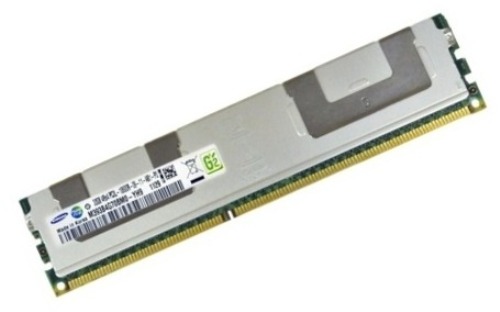
The Samsung M393B2K70CM0-YF804 is a 16GB DDR3 Registered DIMM purpose-built for enterprise servers, where every bit of data integrity and system stability counts. Its ECC technology continuously detects and corrects single-bit memory errors, silently preventing silent data corruption during critical financial transactions or database commit operations—failures that simple unbuffered memory would never catch. The registered, or buffered, architecture isolates the controller from heavy electrical loads, so you can fully populate all memory channels in a dense virtualization cluster without signal degradation. This directly translates to reliably hosting dozens of virtual machines on a single node, even under peak loads. As a quad-rank x4 module, it maximizes capacity per slot, giving memory-intensive workloads like in-memory databases or real-time analytics platforms the massive, low-latency footprint they require; its organized interleaving improves bandwidth utilization under parallel query execution. Operating at a low 1.35V further reduces thermal stress and power draw across your data center, lowering cooling costs and extending component lifespan in always-on deployments. This memory is not just capacity—it is your assurance that virtualized services remain stable and transactional data stays accurate, session after session.
Memory Type Identification: This Samsung M393B2K70CM0-YF804 is a server-grade DDR3 RDIMM with ECC and registered signaling, operating at 1066MHz (PC3-8500) at 1.35V. Its 16GB capacity and quad-rank design make it suitable for dense memory configurations in legacy server platforms.
General Virtualization
For general virtualization, populate memory channels symmetrically to sustain consistent performance under multi-VM workloads. Deploy six or eight of these 16GB modules across all memory channels (e.g., 6 x 16GB = 96GB) to provide ample headroom for hypervisor overhead and guest memory allocation. Avoid mixing ranks within a channel to maintain signal integrity on older DDR3 platforms.
In-Memory Database
In-memory databases demand maximum capacity and fault tolerance. Leverage the ECC capability by fully populating all available DIMM slots with these 16GB RDIMMs—aim for 128GB or 256GB configurations to house large datasets entirely in RAM. Pair with memory mirroring or sparing if supported, balancing the capacity penalty against the critical uptime requirements of transactional systems.
High-Performance Computing (HPC)
HPC applications benefit from balanced bandwidth and low latency configurations. Install one RDIMM per channel initially to maximize memory bandwidth via independent channels; a per-socket configuration of 4 x 16GB achieves 64GB with full channel utilization. Scale up with a second identical set if capacity is the primary bottleneck, but prioritize uniform DIMM population to prevent NUMA imbalances in multi-socket nodes.
Rigorously tested server memory, compatible with Dell PowerEdge R710/R610, HP DL380 G7, IBM x3650 M3, and similar systems.
Q: Can I mix this M393B2K70CM0-YF804 with other memory modules of different brands or speeds?
A: Mixing is not advised. Unmatched brands, speeds, or ranks can undermine ECC and registered signal integrity, risking system instability. Always use identical modules validated together for your server platform.
Q: Is this memory compatible with my system?
A: This DDR3-1066 Registered ECC DIMM targets servers with Intel Xeon E5-2600 v1/v2 or AMD Opteron 6300 platforms. Confirm your board's QVL and ensure it supports quad-rank, 1.35V RDIMMs.
Q: What is the recommended DIMM population order for optimal performance?
A: Install quad-rank DIMMs in the first slot of each memory channel (e.g., DIMM_A1, B1). Populating more than two per channel may reduce speed to 800MHz. Refer to your server's population guidelines.
Q: Does this module support overclocking or XMP profiles?
A: No. As an enterprise RDIMM, it adheres strictly to JEDEC standard DDR3-1066 CL7 timings and does not support overclocking or XMP profiles. Reliable operation at rated speed is prioritized.
Q: What warranty and typical failure rate can I expect?
A: This module comes with a one-year warranty. Enterprise-grade DDR3 RDIMMs have an annualized failure rate typically below 0.5%, backed by stringent testing and ECC for sustained mission-critical reliability.