











 Secure payments
Standard refund policy
Trade Assurance
Secure payments
Standard refund policy
Trade Assurance
| Model | M393B2K70CM0-YF8K4 |
|---|---|
| Product Type | Memory Module |
| Compliance Standards | EU RoHS,FCC |
| Memory Capacity | 16 GB |
| Memory Technology | DDR3 |
| Product Voltage | 1.35V |
| RAM Speed | 1066MHz |
| RAM Standard | DDR3-1066/PC3-8500 |
| Error Identifying | ECC |
| Signal Type | Registered |
| Column Access Strobe (CAS) | CL7 |
| Rank | Quad Rank x4 |
| Quantity of Pins | 240-pin |
| RAM Genre | RDIMM |
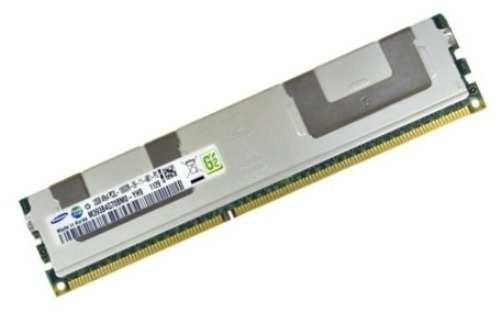
This is a server-grade 16GB DDR3-1066 Registered ECC DIMM operating at a low 1.35V, tailored for virtualization and memory-intensive database workloads that demand uncompromising data integrity. Its Quad Rank x4 organization maximizes density per channel, while ECC and the registered buffer ensure signal stability and fault-tolerant operation in multi-slot enterprise platforms.
1. ECC error correction detects and corrects single-bit memory faults in real time, preserving data integrity for mission-critical databases and financial transactions.
2. Registered signal buffering stabilizes command and address lines, enabling dense server memory configurations without compromising signal integrity under heavy load.
3. Quad Rank x4 organization maximizes per‑channel capacity density, allowing more virtual machines to run simultaneously on a single server without physical expansion.
4. 1.35V low‑voltage operation reduces overall server power draw and cooling requirements, directly lowering TCO in large‑scale data center deployments.
5. 16GB capacity provides ample headroom for memory‑intensive enterprise applications, sustaining high throughput under simultaneous user access and background services.
The M393B2K70CM0-YF8K4 is a server-class Registered DDR3 module for mission-critical workloads. Its ECC corrects single-bit errors silently—vital when a bit-flip in an in-memory database like Redis or SAP HANA could cascade into undetected corruption and costly outages. The registered buffer enables full 24-DIMM population in a dual-socket server, directly increasing VMware or Hyper-V virtual machine density without signal integrity compromises. Quad-rank x4 organization maximizes bank-level parallelism, noticeably reducing latency under the random, concurrent access patterns common in heavily consolidated virtualization hosts. A 1.35V low-voltage design slashes power draw and cooling costs, which adds up dramatically across a fully populated rack. For a virtualized infrastructure or a memory analytics node, these features mean greater uptime, more VMs per host, snappier transactional performance, and a measurably lower total cost of ownership.
The Samsung M393B2K70CM0-YF8K4 is a server-grade 16GB DDR3-1066 ECC Registered RDIMM with quad-rank x4 organization. Below are capacity planning guidelines for three server workload scenarios.
General Virtualization
This RDIMM’s ECC protection ensures data integrity for dense virtual machine deployments. In a dual-socket server, install 6 to 8 identical modules (96–128 GB) across channels, balancing ranks to maintain interleaving. Such a configuration supports 20–30 light-to-medium VMs comfortably while registered buffering stabilizes multi-tenant memory access.
In-Memory Database
Low CAS latency (CL7) and registered signaling suit in-memory databases like Redis or SAP HANA. Deploy a full complement of 16 modules (256 GB) per server, carefully respecting quad-rank per-channel limits—often two DIMMs per channel—to avoid speed downgrades to 800 MHz. This delivers the capacity and reliability needed for large, mission-critical datasets.
High-Performance Computing (HPC)
HPC workloads demand balanced bandwidth and capacity under sustained load. Populate each memory channel with two quad-rank DIMMs, yielding a typical 128 GB (8x16 GB) per node while preserving the full 1066 MHz speed. This configuration minimizes rank contention and maximizes consistent memory throughput for parallel MPI-based scientific simulations.
Strictly tested Samsung DDR3 RDIMM; compatible with Dell PowerEdge R620/R720, HP ProLiant DL380p Gen8, IBM System x3650 M4.
Q: Can I mix this M393B2K70CM0-YF8K4 with other memory modules of different brands or speeds?
A: Mixing is not recommended. This registered ECC RDIMM requires identical ranks, voltage, and timings. Mixing brands or speeds may cause instability, unbuffered modules are incompatible, and system validation is strongly advised.
Q: Is this memory compatible with my Intel or AMD server platform?
A: It is compatible with DDR3-based Intel Xeon E5-2600 v1/v2 and AMD Opteron 6300 series platforms supporting registered ECC RDIMMs. Verify your board supports quad-rank, 1.35V, and PC3-8500R specifications.
Q: What is the recommended DIMM population order for optimal performance with this 16GB quad-rank module?
A: Populate identical quad-rank DIMMs per memory channel following your server board's guide, typically slots 1 then 3. Balance capacity across CPUs. Avoid mixing ranks in the same channel to maintain signal integrity and rated speed.
Q: Does this module support overclocking or XMP profiles?
A: No. As a registered server DIMM designed for stability, it operates only at fixed JEDEC timings (DDR3-1066, CL7). Overclocking and XMP are not supported; the product prioritizes data integrity over performance tuning.
Q: What warranty and typical failure rate can I expect for this M393B2K70CM0-YF8K4?
A: This module includes a 1-year warranty. Typical AFR is under 0.5% per year in controlled server environments. ECC corrects single-bit errors, but proper cooling and compliant usage minimize long-term failure risk.