











 Secure payments
Standard refund policy
Trade Assurance
Secure payments
Standard refund policy
Trade Assurance
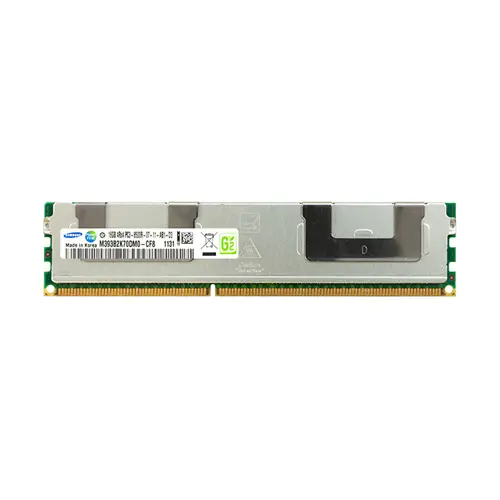
| Model | M393B2K70DM0-CF8 |
|---|---|
| Product Type | Memory Module |
| Compliance Standards | EU RoHS,FCC |
| Memory Capacity | 16 GB |
| Memory Technology | DDR3 |
| Product Voltage | 1.5V |
| RAM Speed | 1066MHz |
| RAM Standard | DDR3-1066/PC3-8500 |
| Error Identifying | ECC |
| Signal Type | Registered |
| Column Access Strobe (CAS) | CL7 |
| Rank | Quad Rank x4 |
| Quantity of Pins | 240-pin |
| RAM Genre | RDIMM |
Designed for legacy server platforms, this Samsung 16GB DDR3-1066 Registered DIMM leverages ECC and a Quad Rank x4 configuration to deliver robust data integrity and high memory density, making it well-suited for virtualization hosts and memory-resident databases where stability under heavy load is critical. Its Registered signal type ensures reliable operation in fully populated multi-DIMM channels, while the CL7 latency provides a narrow timing advantage over standard 1333MHz modules in clock-constrained 1066MHz environments.
1. Generous per-module capacity supports higher virtual machine density per node, directly cutting hardware footprint and per-core licensing overhead in consolidated data centers.
2. ECC protection silently corrects single-bit memory errors, safeguarding data integrity for financial transactions and long-running analytical workloads without service interruption.
3. Registered buffering sustains clean signal integrity across fully populated memory channels, making it practical to scale up to large total memory capacities without compromising uptime.
4. Quad Rank x4 architecture keeps the memory controller’s channels deeply saturated, delivering steady bandwidth under the simultaneous demands of multi-tenant database and virtualization environments.
5. Aggressive CAS timing minimizes access latency to frequently used data, accelerating real-time query responses and improving transaction throughput in latency-sensitive enterprise applications.
Based on the RDIMM registered genre and ECC error correction, this is definitively server-grade memory built for mission‑critical enterprise environments. The Samsung M393B2K70DM0-CF8 module integrates four crucial characteristics—ECC, registered buffering, a quad‑rank x4 design enabling 16 GB capacity, and a low CAS latency of 7—that directly answer the hidden pain points of virtualization clusters and in‑memory databases.
In a dense virtualization cluster, silent data corruption is unacceptable. The ECC engine detects and corrects single‑bit errors, preventing a flipped bit from crashing multiple virtual machines or silently poisoning financial transactions. Meanwhile, the registered buffer reduces electrical load on the memory controller, so you can populate all 24 DIMM slots without signal decay, and the quad‑rank 16 GB modules let you scale to hundreds of gigabytes per host for maximum VM density. For an in‑memory database like Redis or SAP HANA, this same combination guarantees transactional integrity while the CL7 latency slashes cache access times, speeding up real‑time analytics. The quad‑rank organization delivers consistent bandwidth even under heavy write pressure, and the registered clock driver keeps timing rock‑steady when every nanosecond counts. This memory transforms theoretical reliability into practical uptime.
This part is a 16GB DDR3-1066 Registered ECC RDIMM (quad-rank, 1.5V), typical of legacy server platforms. Its quad-rank design offers high capacity per slot but limits per-channel population under full speed.
General Virtualization
Virtualization demands large, reliable memory. Install 12 identical modules (3 per channel in a 4-channel server) for 192 GB of balanced NUMA memory. Always use matched sets to avoid ECC errors and maintain stable performance.
In-Memory Database
Achieve maximum capacity with all 18 or 24 slots populated, yielding 288–384 GB, but verify platform rank limits. Installing more than two quad-rank DIMMs per channel usually drops the speed to 800 MHz. Balance density against latency by using only two DIMMs per channel for 128 GB at full 1066 MHz.
High-Performance Computing (HPC)
Bandwidth is critical. Populate one DIMM per channel to keep the memory bus at 1066 MHz. In a dual-socket system, eight modules (128 GB) maximize per-core bandwidth. If dual-rank kits are unavailable, these quad-rank RDIMMs still provide a dense, budget-friendly solution for throughput-sensitive workloads.
Server memory rigorously tested, compatible with Dell PowerEdge R720, HP DL380p Gen8, Lenovo RD430, and similar ECC RDIMM systems.
Q: Can I mix this M393B2K70DM0-CF8 with other memory modules of different brands or speeds?
A: Mixing is strongly discouraged. This DDR3 RDIMM with ECC and Quad Rank x4 organization may cause instability or POST failures if combined with dissimilar ranks, speeds, or unbuffered modules. Always use identical kits for server reliability.
Q: Is this memory compatible with my Intel Xeon E5-2600 v2 / AMD Opteron 6300 server platform?
A: This DDR3-1066 Registered ECC module is designed for dual-processor platforms with C602/C606J (Intel) or SR5690/SR5670 (AMD) chipsets. Verify your board supports Quad Rank 240-pin RDIMMs and 1.5V operation to ensure stability.
Q: What is the recommended DIMM population order for optimal performance?
A: Populate identical modules per memory channel, starting with the farthest slot from the CPU. Install Quad Rank DIMMs first, typically in slots 1 and 4 per channel. Consult your server manual—incorrect order may limit speed or capacity.
Q: Does this module support overclocking or XMP profiles?
A: No. This is a JEDEC-compliant server RDIMM with fixed CL7 timings and 1.5V. Overclocking or XMP is not supported; the module operates strictly at DDR3-1066 to maintain data integrity in enterprise environments.
Q: What warranty and typical failure rate can I expect?
A: This Samsung M393B2K70DM0-CF8 module carries a standard 1-year warranty. Enterprise DDR3 ECC RDIMMs exhibit an annualized failure rate below 0.5% under rated conditions, ensuring high reliability for mission-critical applications.