











 Secure payments
Standard refund policy
Trade Assurance
Secure payments
Standard refund policy
Trade Assurance
| Product Type | Memory Module |
|---|---|
| Memory Capacity | 32 GB |
| Memory Technology | DDR3 |
| Product Voltage | 1.35 V |
| RAM Speed | 1333 MHz |
| RAM Standard | DDR3-1333/PC3-10600 |
| Error Identifying | ECC |
| Signal Type | Registered |
| Column Access Strobe (CAS) | CL9 |
| Rank | Quad Rank x4 |
| Quantity of Pins | 240-pin |
| RAM Genre | RDIMM |
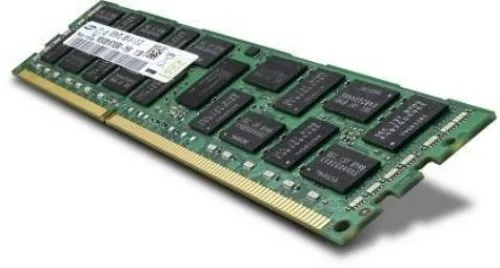
This is server-grade memory, optimized for virtualization and in-memory databases where data integrity is paramount. Its Registered ECC design with a Quad Rank x4 configuration delivers high-density 32 GB capacity at a low 1.35 V, ensuring stable signal integrity and error correction under heavy load.
1. ECC protection ensures single-bit errors are corrected in real time, safeguarding transactional data integrity in financial and database server workloads.
2. Registered signal buffering stabilizes command and address lines, allowing large memory populations to run reliably across fully loaded server nodes.
3. 32 GB capacity per module maximizes memory density per CPU socket, directly expanding the number of virtual machines a hypervisor can host.
4. Quad Rank x4 organization packs more DRAM devices onto the module, enabling higher total capacity per channel for in-memory analytics without sacrificing signal quality.
5. 1.35 V low-voltage operation cuts power consumption per DIMM, which lowers datacenter cooling overhead and energy costs across dense server fleets.
When you are responsible for enterprise uptime, the Samsung M393B4G70DM0-YH9 RDIMM is not just a component—it is a safeguard. As a 32 GB DDR3-1333 registered module with ECC and a 1.35 V operating voltage, this memory directly addresses the failures that keep data center managers awake at night. In a dense virtualization cluster running dozens of VMs, a single undetected bit flip in ordinary RAM can silently corrupt a database transaction. The error-correcting code here detects and corrects single-bit errors, turning a potential financial discrepancy into a non-event. That same integrity, paired with the registered buffer that stabilizes signal across the module’s quad rank x4 organization, becomes critical when you deploy an in-memory database like Redis or Memcached: the server can sustain heavy read/write concurrency with predictable latency instead of risking data inconsistency during peak loads. The low 1.35 V power draw also compounds across a rack, lowering thermal stress and your electricity bill without sacrificing the steady 1333 MT/s throughput that keeps your applications responsive. Simply put, this DIMM transforms hardware stability into business continuity.
General Virtualization
For a typical hypervisor hosting 10–15 moderate VMs, start with four of these 32 GB DDR3L-1333 RDIMMs (128 GB total) in a dual-socket server, populating one DIMM per channel on each CPU to balance capacity and memory bandwidth. If your workloads demand more memory per VM or you run memory-overcommit, scale to eight modules (256 GB) while keeping channels populated symmetrically to avoid NUMA imbalances. Always prefer identical quad-rank modules across all channels to maintain reliable ECC operation at the rated 1.35 V.
In-Memory Database
In-memory databases like Redis or SAP HANA thrive on low latency and high capacity, so deploy six to eight of these 32 GB ECC RDIMMs (192–256 GB) per socket, fully populating the memory channels closest to the CPU. Quad-rank modules draw more power and may force a slight speed reduction on some platforms; validate that your server supports four quad-rank DIMMs per channel at 1333 MT/s. For clustered databases, mirror this configuration across all nodes and budget for a warm standby node with identical memory sizing to sustain failover.
High-Performance Computing (HPC)
For memory-bandwidth-sensitive HPC jobs, install two DIMMs per channel across all available channels—typically eight modules per dual-socket node (256 GB total)—to maximize interleaving and sustain 1.35 V efficiency. Use fully balanced population (equal capacity per CPU socket) so that MPI processes see symmetric memory access. When the workload can tolerate a capacity-first approach, fill all channels with one DIMM per channel first before adding a second rank per channel, monitoring channel loading so the memory bus does not downclock below 1333 MT/s.
Rigorously tested for server compatibility with Dell PowerEdge R720, HP ProLiant DL380p Gen8, and more.
Q: Can I mix this M393B4G70DM0-YH9 with other memory modules of different brands or speeds?
A: Mixing brands or speeds is not recommended for RDIMM server memory. Mismatched modules may cause instability, POST failures, or reduced reliability. All installed DIMMs should match this module's exact specifications.
Q: Is this memory compatible with my system?
A: This 32GB DDR3-1333 ECC Registered RDIMM is compatible with servers using Intel Xeon E5-2400/2600 v1/v2 or AMD Opteron 6300 series platforms. Please verify your motherboard's Qualified Vendor List for RDIMM support.
Q: What is the recommended DIMM population order for optimal performance?
A: For quad-rank RDIMMs, populate identical modules per channel following your server board's guide, typically starting with the blue slots. Balanced memory channels maximize interleaving and bandwidth in multi-CPU configurations.
Q: Does this module support overclocking or XMP profiles?
A: No, this is server-grade ECC Registered memory operating strictly at JEDEC-standard DDR3-1333 with CL9 timing. Overclocking and XMP are not supported to ensure 24/7 data integrity and platform stability.
Q: What warranty and typical failure rate can I expect?
A: This module includes a 1-year warranty. As enterprise-class memory with rigorous screening, it delivers an extremely low annualized failure rate (AFR), typically under 0.5%, ensuring reliable long-term operation.