











 Secure payments
Standard refund policy
Trade Assurance
Secure payments
Standard refund policy
Trade Assurance
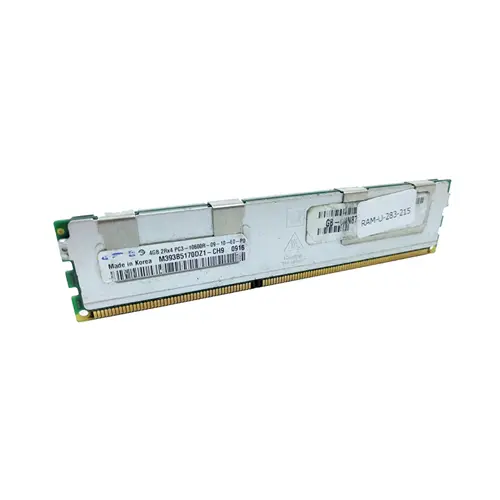
| Model | M393B5170DZ1-CH9 |
|---|---|
| Product Type | Memory Module |
| Compliance Standards | EU RoHS,FCC |
| Memory Capacity | 4 GB |
| Memory Technology | DDR3 |
| Product Voltage | 1.5V |
| RAM Speed | 1333MHz |
| RAM Standard | DDR3-1333/PC3-10600 |
| Error Identifying | ECC |
| Signal Type | Registered |
| Column Access Strobe (CAS) | CL9 |
| Rank | Dual Rank x4 |
| Quantity of Pins | 240-pin |
| RAM Genre | RDIMM |
The M393B5170DZ1-CH9 is a registered DDR3-1333 ECC RDIMM with a dual-rank x4 organization and CL9 latency, delivering robust signal integrity and hardware-level error correction for mission-critical server environments. It is ideally suited for virtualization farms and in-memory database platforms where strict data integrity and reliable low-latency operation are essential.
1. ECC memory detects and corrects single-bit errors on the fly, preserving data integrity for critical financial transactions and preventing silent corruption in always-on virtualization hosts.
2. Registered signal buffering offloads the memory controller by re-driving address and command lines, enabling fully populated multi-rank configurations without sacrificing signal integrity in dense rack servers.
3. Dual Rank x4 organization interleaves accesses across two ranks, sustaining peak channel bandwidth under heavy database query concurrency and improving latency hiding for large memory footprints.
4. A 4 GB module capacity offers a cost-effective building block for light web-serving clusters or edge caching nodes, where moderate memory density pairs with high reliability.
5. 1333 MHz clock speed yields 10.6 GB/s of sustained bandwidth per channel, efficiently serving high-throughput storage caching and file serving without bottlenecking low-latency I/O operations.
The Samsung M393B5170DZ1-CH9 is a server-grade DDR3 Registered DIMM engineered to solve real-world data center challenges. Its first critical feature is ECC error correction, which silently fixes single-bit memory errors. In a virtualization cluster running dozens of VMs, an uncorrected bit flip can corrupt a database transaction or crash a hypervisor, but ECC turns that risk into a non-issue. Second, the Registered buffer reduces the electrical load on the memory controller, allowing you to populate every DIMM slot. For a VMware or Hyper-V host, this means stable scaling to hundreds of virtual machines without signal degradation when you need maximum memory footprint. Third, the Dual Rank x4 organization interleaves accesses across two internal ranks, significantly improving bandwidth utilization. In an in-memory database like SAP HANA or Redis under heavy concurrent queries, this translates directly to faster response times. Finally, the standard 1.5V operating voltage and CL9 timing keep thermal output well under control in dense rack deployments, lowering cooling overhead while sustaining 1333MHz speed. Together, these attributes deliver the data integrity, scalability, and energy-conscious performance your mission-critical workloads demand.
General Virtualization
For dense virtualization hosts, populate at least six to eight identical M393B5170DZ1-CH9 modules to enable balanced memory interleaving across all memory channels. A typical dual-socket server with 12 DIMM slots can deliver 48–64 GB by using 4 GB Registered DIMMs in a symmetric configuration, which comfortably supports 20–30 light to medium VMs without NUMA penalties. Prioritize channel balance over raw capacity to maintain consistent latency under mixed workloads.
In-Memory Database
In-memory databases demand capacity and sustained throughput, so populate all available memory channels with dual-rank x4 RDIMMs like this Samsung module to maximize bank-level parallelism. A minimum of 64 GB (16 × 4 GB) is recommended for moderate datasets; scale to 128 GB or beyond by filling every slot, but always verify the platform’s maximum supported RDIMM capacity and rank limits. Configure memory sparing or mirroring only if the database node also serves critical transactional workloads requiring high availability.
High-Performance Computing
HPC clusters benefit from fully populated, identical DIMMs per node to deliver predictable bandwidth under parallel MPI jobs. Equip each node with enough modules—typically 12 or 16—to saturate all DDR3 channels, yielding aggregate bandwidth above 60 GB/s per socket. Because 4 GB modules limit per-node capacity, reserve this configuration for capacity-light, bandwidth-sensitive simulations and complement with faster interconnects to avoid memory-bound stalls.
Server-grade validation: rigorously tested, compatible with Dell PowerEdge R710, R720, HP ProLiant DL380 G7, G8, and more.
Q: Can I mix this M393B5170DZ1-CH9 with other memory modules of different brands or speeds?
A: Mixing brands or speeds is not recommended. Server platforms require strict matching for ECC Registered DIMMs; mismatched modules may cause instability or POST failures. Use identical part numbers to ensure reliable dual-channel operation.
Q: Is this memory compatible with my system?
A: This DDR3 Registered ECC module is designed for servers using Intel Xeon 5500/5600 series or AMD Opteron 4100/6100 platforms with 240-pin support. Please consult your system’s qualified vendor list (QVL) for exact compatibility.
Q: What is the recommended DIMM population order for optimal performance?
A: Populate identical modules per channel starting from the farthest slot from the CPU (e.g., A1, B1, C1). Maintain balanced configuration across all memory channels as detailed in your server board manual for best throughput and interleaving.
Q: Does this module support overclocking or XMP profiles?
A: No. This is a JEDEC‑standard DDR3‑1333 Registered ECC module built for data integrity in servers. It does not feature XMP profiles and is not designed for overclocking, prioritizing stability and error correction.
Q: What warranty and typical failure rate can I expect?
A: We provide a one-year warranty. As an enterprise‑class RDIMM, this module exhibits a very low annualized failure rate (typically below 0.5%), ensuring exceptional reliability and data integrity compared to desktop memory.