











 Secure payments
Standard refund policy
Trade Assurance
Secure payments
Standard refund policy
Trade Assurance
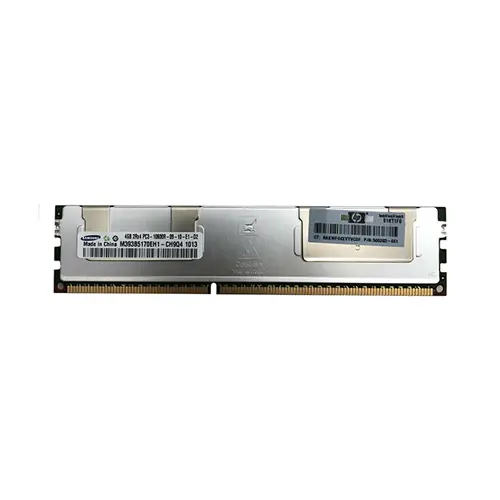
| Model | M393B5170EH1-CH9Q4 |
|---|---|
| Product Type | Memory Module |
| Compliance Standards | EU RoHS,FCC |
| Memory Capacity | 4 GB |
| Memory Technology | DDR3 |
| Product Voltage | 1.5V |
| RAM Speed | 1333MHz |
| RAM Standard | DDR3-1333/PC3-10600 |
| Error Identifying | ECC |
| Signal Type | Registered |
| Column Access Strobe (CAS) | CL9 |
| Rank | Dual Rank x4 |
| Quantity of Pins | 240-pin |
| RAM Genre | RDIMM |
Designed for server platforms, this Samsung M393B5170EH1-CH9Q4 is a DDR3-1333 Registered DIMM with ECC, ideally suited for virtualization hosts and memory-intensive database workloads where data integrity is paramount. Its dual-rank x4 organization and registered signaling ensure stable operation under heavy load by reducing electrical loading on the memory bus, while the CL9 latency and 1.5V operation deliver consistent throughput at a balanced power profile.
1. ECC protection silently corrects single-bit errors, preserving data integrity and eliminating costly downtime in always-on transaction processing servers.
2. Registered signal buffering stabilizes high-capacity memory buses, allowing dense multi-DIMM configurations vital for large-scale virtualization and in-memory analytics.
3. Dual-rank x4 organization interleaves bank accesses to sustain peak channel throughput, boosting performance consistency for multi-tenant cloud workloads.
4. The 4 GB density matches scale-out node architectures, optimizing per-slot capacity for dedicated caching or lightweight container services without wasting idle power.
5. 1333 MHz clock speed delivers steady bandwidth, keeping latency-sensitive enterprise applications like online query engines responsive under concurrent user loads.
As a server memory specialist, I’ll highlight the Samsung M393B5170EH1-CH9Q4, a DDR3 4GB Registered ECC RDIMM purpose-built for mission-critical environments. Its four core attributes directly address real-world IT pain points. The ECC engine corrects single-bit errors, preventing silent data corruption that could crash a virtual machine or distort in-memory database transactions. Next, the Registered signal buffer stabilizes high-capacity memory arrays—a must in virtualization clusters where densely populated slots drive reliable scaling for numerous VMs. The Dual Rank, x4 architecture further boosts bandwidth through interleaving and provides superior chip-level error containment versus x8, vital for in-memory analytics where latency is measured in microseconds. Finally, the 1.5V operating voltage and CL9 timing deliver a mature balance of power efficiency and round-the-clock stability. On paper these specifications may look technical, but in your data center they translate directly into hardened uptime, consistent query performance, and the confidence to consolidate more virtual workloads without compromising data integrity.
This ECC Registered 240‑pin RDIMM is a server memory module. Capacity planning using its 4 GB dual‑rank DDR3‑1333 specifications follows.
General Virtualization
For reliable VM hosting, populate all memory channels identically with these 4 GB modules. A dual‑socket triple‑channel server can use six modules (24 GB) for light to moderate VM densities, or twelve modules (48 GB) for heavier loads, ensuring symmetric interleaving and full ECC coverage.
In‑Memory Database
Maximise capacity and maintain low, uniform latency by filling every slot with identical 4 GB RDIMMs. Target two DIMMs per channel wherever possible—12 modules (48 GB) on mid‑range platforms or 24 modules (96 GB) on larger boards—to keep entire datasets resident in RAM without performance penalties.
High‑Performance Computing
Prioritise memory bandwidth by installing exactly one DIMM per channel; for example, eight modules (32 GB total) in a quad‑channel platform deliver full channel speed. Use only these dual‑rank x4 RDIMMs, as mixing ranks or capacities can degrade throughput and compromise the steady performance required by parallel HPC jobs.
Rigorously tested Samsung M393B5170EH1-CH9Q4 4GB DDR3 RDIMM compatible with Dell PowerEdge R720, HP ProLiant DL380p Gen8, and IBM x3650 M4.
Q: Can I mix this M393B5170EH1-CH9Q4 with other memory modules of different brands or speeds?
A: Mixing brands or speeds is not recommended for this registered ECC server module. It can cause instability and unbuffered errors. For mission‑critical environments, always use identical modules with matching rank, voltage, and timing to ensure validated compatibility and uptime.
Q: Is this memory compatible with my system?
A: This DDR3-1333 registered ECC RDIMM targets Intel Xeon 5500/5600 series, E5-2400/2600 v1/v2 platforms, and select AMD Opteron servers. Confirm that your board supports 1.5V, 240-pin DDR3 ECC RDIMM and check the qualified vendor list for M393B5170EH1-CH9Q4.
Q: What is the recommended DIMM population order for optimal performance?
A: Populate identical DIMMs in matched sets per memory channel, typically starting with bank 1 of each CPU. On dual-processor servers, balance modules evenly across channels. Always follow your motherboard’s population guide to maintain interleaving and maximum throughput.
Q: Does this module support overclocking or XMP profiles?
A: No. As an enterprise registered ECC DIMM, this module operates strictly at JEDEC standard DDR3-1333 with CL9 timings. Overclocking and XMP are not supported, ensuring consistent signal integrity and RAS characteristics in server deployments.
Q: What warranty and typical failure rate can I expect?
A: This module includes a 1-year warranty against defects. Typical annualized failure rate (AFR) for server‑grade RDIMMs is around 0.1–0.3%, reflecting rigorous production testing and superior component reliability for 24/7 operation.