











 Secure payments
Standard refund policy
Trade Assurance
Secure payments
Standard refund policy
Trade Assurance
| Model | M393B5170FH0-CF8 |
|---|---|
| Product Type | Memory Module |
| Compliance Standards | EU RoHS,FCC |
| Memory Capacity | 4 GB |
| Memory Technology | DDR3 |
| Product Voltage | 1.5V |
| RAM Speed | 1066MHz |
| RAM Standard | DDR3-1066/PC3-8500 |
| Error Identifying | ECC |
| Signal Type | Registered |
| Column Access Strobe (CAS) | CL7 |
| Rank | Dual Rank x4 |
| Quantity of Pins | 240-pin |
| RAM Genre | RDIMM |
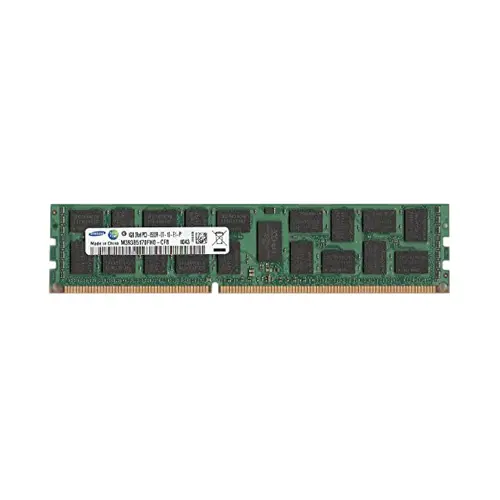
This DDR3-1066 Registered ECC RDIMM is purpose-built for legacy server platforms requiring stable, high-integrity memory, making it well-suited for virtualization hosts and light in-memory database workloads where data correctness is non-negotiable. The dual-rank x4 organization improves memory bandwidth utilization in multi-DIMM configurations, while CL7 latency and registered signaling ensure reliable signal integrity under sustained enterprise loads.
1. ECC protection automatically corrects single-bit errors and detects multi-bit faults, preserving data integrity in mission-critical databases and financial transactions.
2. Registered signal buffering stabilizes command and address lines, enabling a high-density memory population without compromising server uptime under full load.
3. Dual Rank x4 organization interleaves rank accesses to maximize channel utilization, boosting memory throughput for virtualized workloads and large-scale container deployments.
4. CL7 low column access latency shortens the delay to first data word, accelerating in-memory caching and real-time analytics in data center environments.
5. 1066MHz operating speed delivers a consistent base bandwidth per channel, supporting predictable performance in scale-out server clusters and content delivery nodes.
In today’s always‑on data centers, the Samsung M393B5170FH0‑CF8 4 GB DDR3 Registered DIMM is far more than a legacy upgrade—it’s a strategic asset for server stability. Its ECC capability is your first defense against silent bit‑flips. Imagine a virtualized cluster hosting a dozen e‑commerce VMs: a single uncorrected memory error could corrupt a hypervisor page, knocking all guests offline. ECC catches and corrects such errors before they cascade, preserving uptime. The Registered (buffered) design tames electrical loading, letting you fully populate all memory channels on a dual‑socket board without signal degradation—vital when scaling your VMware farm to 256 GB or more. Configured as a Dual Rank x4 module, it employs rank interleaving to overlap commands across ranks, effectively doubling the bank groups available and smoothing out memory traffic during peak database loads. Paired with a quick CL7 latency, this ensures that Redis, SAP HANA, or transactional SQL databases experience consistent, low‑lag response even under concurrency. For IT managers accountable for data integrity and 99.999 % availability, this memory directly translates into fewer unexplained outages, stable performance under load, and a longer hardware lifespan by suppressing soft errors. It’s a practical choice that safeguards your server ROI, and with EU RoHS and FCC compliance it integrates responsibly into any regulated data center.
This is a Server DDR3 ECC Registered DIMM (RDIMM) with 4 GB capacity, 1066 MHz speed, dual rank x4, and CL7 latency. It is designed for legacy enterprise servers and workstations requiring data integrity and memory reliability.
General Virtualization
Virtualized environments demand high total capacity to run many VMs concurrently. Populate all memory channels symmetrically with identical 4 GB RDIMMs to enable memory interleaving and avoid bottlenecks. In a dual-socket server with three channels per CPU, installing six modules provides 24 GB of balanced capacity; scaling to 12 modules yields 48 GB for moderate VM density. Always match ranks per channel to maintain consistent performance.
In-Memory Database
In-memory databases such as Redis or SAP HANA rely on large, low-latency memory pools. Given the 4 GB per module, maximize socket capacity by filling every slot—e.g., 18 DIMMs for 72 GB total in a typical 2U server. The CL7 latency helps deliver fast data access. Distribute modules evenly across all memory controllers to sustain high throughput under heavy cache pressure.
High-Performance Computing
HPC workloads require maximum memory bandwidth. Install identical 4 GB RDIMMs in every channel to enable full memory interleaving. A six-channel configuration (common in dual-socket LGA1366/LGA2011 servers) with six dual-rank x4 DIMMs provides 24 GB while exploiting bank-level parallelism. Although 1066 MHz limits peak bandwidth, populating all channels is critical; avoid leaving channels empty, as it degrades aggregate throughput in parallel jobs.
Rigorously tested RDIMM for Dell PowerEdge R710/R510, HP DL380 G7, IBM x3650 M3.
Q: Can I mix this M393B5170FH0-CF8 with other memory modules of different brands or speeds?
A: Mixing is not recommended. For server stability and ECC integrity, use identical modules. Different speeds force the system to run at the lowest common specification, potentially causing performance or reliability issues.
Q: Is this memory compatible with my server system (Intel or AMD)?
A: This DDR3 Registered ECC RDIMM is designed for servers using Intel Xeon 5500/5600 series or AMD Opteron 6100/6200 platforms. Verify your motherboard supports 4GB Dual Rank x4, 240-pin modules and 1.5V operation.
Q: What is the recommended DIMM population order for optimal performance?
A: Follow your server board’s memory population guidelines. Typically, populate identical DIMMs per channel starting with the primary slots. Balanced configuration across all memory channels ensures optimal bandwidth and avoids performance degradation.
Q: Does this module support overclocking or XMP profiles?
A: No. This is a JEDEC-compliant server memory module running at PC3-8500 with CL7 timings. It does not support overclocking or XMP profiles, as reliability and data integrity are prioritized over speed in enterprise environments.
Q: What warranty and typical failure rate can I expect?
A: This module comes with a one-year warranty. It undergoes rigorous production testing to meet enterprise reliability standards, resulting in an extremely low annualized failure rate (AFR) in properly cooled and compatible server environments.