











 Secure payments
Standard refund policy
Trade Assurance
Secure payments
Standard refund policy
Trade Assurance
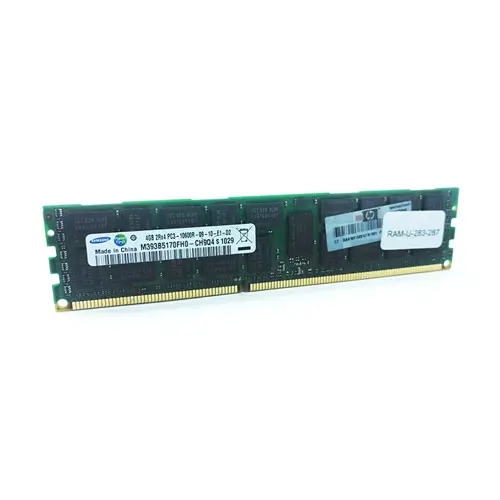
| Model | M393B5170FH0-CH9Q4 |
|---|---|
| Product Type | Memory Module |
| Compliance Standards | EU RoHS,FCC |
| Memory Capacity | 4 GB |
| Memory Technology | DDR3 |
| Product Voltage | 1.5V |
| RAM Speed | 1333MHz |
| RAM Standard | DDR3-1333/PC3-10600 |
| Error Identifying | ECC |
| Signal Type | Registered |
| Column Access Strobe (CAS) | CL9 |
| Rank | Dual Rank x4 |
| Quantity of Pins | 240-pin |
| RAM Genre | RDIMM |
This Samsung M393B5170FH0-CH9Q4 is a server-grade DDR3 RDIMM engineered for stability in virtualized environments and memory-intensive enterprise workloads, with ECC and registered signal buffering ensuring data integrity across large memory arrays. Its Dual Rank x4 organization combined with CL9 latency delivers balanced throughput for database and consolidation platforms, making it an optimal fit for legacy Xeon E5/E3 servers still demanding reliable, high-capacity DDR3-1333 memory.
1. ECC protection actively detects and corrects single-bit memory errors, preventing silent data corruption that could compromise the integrity of transactional databases and financial records.
2. Registered signal buffering re-drives address and command lines, enabling dense multi-module configurations without signal degradation—essential for maintaining stability in large-scale virtualization hosts.
3. Dual-rank x4 organization exploits internal bank interleaving to keep data pipelines saturated, boosting effective bandwidth for concurrent virtual machine and container workloads.
4. Mainstream operating speed delivers a balanced bandwidth envelope suitable for steady-state web serving and content delivery, while avoiding the excess thermal stress that can degrade long-term reliability.
5. Economical module capacity serves as a cost-efficient building block for memory tiering or dedicated appliance roles, where preserving data integrity matters far more than raw storage density.
The M393B5170FH0-CH9Q4 is a server-class DDR3 Registered DIMM purpose‑built for data‑center workloads where reliability defines your bottom line. In a virtualized cluster, a single cosmic‑ray bit flip can silently corrupt a hypervisor and cascade into multiple VM failures. ECC correction actively detects and fixes these errors on the fly, preserving uptime and safeguarding your data integrity without any user‑visible disruption. The Registered buffering reclocks command and address signals, so you can fully populate memory channels with multiple 4 GB modules while maintaining clean signal integrity. This means your host can scale to 96 GB or more, confidently consolidating dozens of applications on one box without intermittent crashes. The dual‑rank x4 organization interleaves memory banks to raise sustained bandwidth, directly accelerating in‑memory databases like Redis or SAP HANA—queries that scan massive key‑value stores finish faster, shrinking transaction latencies for real‑time analytics. Running at 1333 MHz with a CL9 latency and standard 1.5 V, the module delivers dependable throughput and seamless drop‑in compatibility inside legacy enterprise servers that still power your critical production workloads.
Server Memory Identified
The M393B5170FH0-CH9Q4 is a DDR3-1333 4GB Registered ECC DIMM, designed exclusively for server-class platforms that demand data integrity and stability under continuous load. Plan capacity around dual‑ or multi‑CPU architectures where all channels should be populated uniformly.
General Virtualization
Populate all memory channels with identical 4GB modules to balance capacity and cost per VM. For a typical dual‑socket server running 20–30 light VMs, install 12–16 modules (48–64 GB) across all channels to avoid memory ballooning and ensure NUMA awareness.
In-Memory Database
Maximise module count within the server’s limit to keep the entire dataset in RAM. Use 16 or more 4GB RDIMMs per socket to reach 64–128 GB, enabling fast in-memory caching and reducing disk I/O latency for Redis, Memcached, or SAP HANA instances.
High‑Performance Computing
Leverage the Registered ECC feature for error‑resilient parallel computations. Fill every memory channel with one 4GB RDIMM to achieve optimal interleaving and peak bandwidth; for a dual‑socket node, 16 modules (64 GB total) supply sufficient capacity for large MPI job arrays and simulation datasets while preventing silent data corruption.
Rigorously tested for server compatibility. Compatible with Dell PowerEdge R710, R720, HP DL380 G7, IBM x3650 M3.
Q: Can I mix this M393B5170FH0-CH9Q4 with other memory modules of different brands or speeds?
A: Mixing RDIMMs with different brands or speeds is not recommended. It can cause signal integrity issues and system instability. All modules within a server should ideally have identical part numbers to guarantee reliable ECC operation.
Q: Is this memory compatible with my system?
A: This is a DDR3 Registered RDIMM. It requires a server motherboard with a chipset supporting registered ECC memory, such as Intel C600 series for Xeon E5-2400/2600 v1/v2 processors. Verify your system's qualified vendor list.
Q: What is the recommended DIMM population order for optimal performance?
A: Follow your server vendor's manual. Typically, populate identical DIMMs per channel, starting with slots furthest from the CPU. For dual-rank RDIMMs like this, install one DIMM per channel first to maximize memory bandwidth.
Q: Does this module support overclocking or XMP profiles?
A: No. Server-grade RDIMMs are engineered for stability, not overclocking. They strictly adhere to JEDEC standards (DDR3-1333, CL9) and lack XMP profiles. Overclocking would compromise ECC data integrity in mission-critical environments.
Q: What warranty and typical failure rate can I expect?
A: This module comes with a 1-year warranty. Designed for 24/7 enterprise operation, it has a very low annualized failure rate (AFR) under 1%, assuming proper thermal management and no physical damage.