











 Secure payments
Standard refund policy
Trade Assurance
Secure payments
Standard refund policy
Trade Assurance
| Model | M393B5170FH0-YF8 |
|---|---|
| Product Type | Memory Module |
| Compliance Standards | EU RoHS,FCC |
| Memory Capacity | 4 GB |
| Memory Technology | DDR3 |
| Product Voltage | 1.35V |
| RAM Speed | 1066MHz |
| RAM Standard | DDR3-1066/PC3-8500 |
| Error Identifying | ECC |
| Signal Type | Registered |
| Column Access Strobe (CAS) | CL7 |
| Rank | Dual Rank x4 |
| Quantity of Pins | 240-pin |
| RAM Genre | RDIMM |
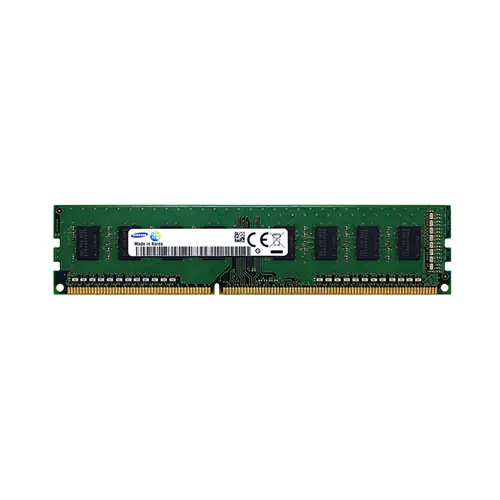
This Samsung DDR3-1066 registered ECC module (M393B5170FH0-YF8) is purpose-built for entry-level servers and legacy virtualization platforms where data integrity and stability under moderate loads are paramount. Its dual-rank x4 organization, combined with registered signal buffering and 1.35V low-voltage operation, ensures reliable memory interleaving and reduced power consumption for applications such as light database hosting or virtualized file services.
1. Registered signal buffering stabilizes command and address lines, allowing server boards to support high-density DIMM counts for expansive virtualization hosts.
2. End-to-end ECC protection catches and corrects memory faults automatically, essential for preserving data integrity in always-on mission-critical databases.
3. The dual-rank organization interleaves memory accesses across internal banks, sustaining peak bandwidth under multiple concurrent virtual machine workloads.
4. Low-voltage DDR3L operation cuts power consumption at the DIMM level, directly reducing cooling requirements and energy bills in large-scale server farms.
5. A low CAS latency profile shrinks the delay between a read command and data delivery, giving latency-bound enterprise applications a measurable performance boost.
Based on the Registered DIMM form factor, ECC support, and buffered architecture, the Samsung M393B5170FH0-YF8 is unmistakably a server-grade memory module built for enterprise reliability rather than consumer desktops or laptops. Its four defining characteristics translate directly into mission-critical uptime and performance. First, the ECC capability actively corrects single-bit memory errors that naturally occur due to cosmic radiation or electrical noise; in a virtualized cluster running dozens of VMs, an undetected bit flip can silently corrupt transactional data or crash a hypervisor, so ECC is your insurance against costly silent data corruption. Second, the registered buffer stabilizes signal integrity by reducing the electrical load on the CPU’s memory controller, allowing dense server boards to populate all 24 DIMM slots without compromising signal quality. This is essential when scaling up memory capacity for in-memory databases like SAP HANA, where terabyte-class datasets demand every channel to operate flawlessly. Third, the dual-rank x4 organization leverages rank interleaving, effectively overlapping data accesses to sustain higher bandwidth and lower latency under heavy concurrent workloads, a tangible win for virtualized environments where multiple tenants compete for I/O. Finally, the 1.35V low-voltage design directly slashes power consumption and thermal dissipation across a rack of servers. For data centers running hundreds of nodes 24/7, that reduction in energy and cooling cost isn’t just an eco-friendly label—it’s a measurable operating expense saving that accumulates with every watt shaved off your memory subsystem.
Server Memory Identified: This is a DDR3-1066 Registered ECC RDIMM (4GB, 1.35V, CL7, Dual Rank x4), designed for servers and workstations requiring data integrity and stability under sustained loads.
General Virtualization
Populate all available memory channels symmetrically with these 4GB RDIMMs to maximize total capacity and memory bandwidth. In a dual‑socket platform, installing two or three DIMMs per channel provides the RAM footprint needed for higher VM density. ECC ensures host and guest stability during memory‑intensive consolidation.
In‑Memory Database
Fill every DIMM slot to create the largest possible reliable memory pool, as in‑memory databases demand both capacity and fault tolerance. While 4GB modules limit total scale, a fully loaded system with balanced ranks delivers deterministic latency and prevents data corruption through registered ECC operation.
High Performance Computing
Configure a balanced memory layout by installing identical 4GB DIMMs in equal numbers across all memory channels to sustain peak bandwidth. Low CL7 latency and dual‑rank interleaving help reduce access bottlenecks in parallel workloads. Keep population within optimal speed limits to avoid frequency derating under heavy channel loading.
Server memory rigorously tested; compatible with Dell PowerEdge R710, HP ProLiant DL380 G7, IBM x3650 M3.
Q: Can I mix this M393B5170FH0-YF8 with other memory modules of different brands or speeds?
A: Mixing different brands or speeds is strongly discouraged in server environments. It often causes memory training failures, erratic POST, and silent data corruption. For optimal reliability, populate all channels with identical RDIMMs.
Q: Is this memory compatible with my system?
A: This DDR3-1066 Registered ECC RDIMM is compatible with Intel Xeon 5600/5500 series and AMD Opteron 6100/6200 series platforms. Please cross-check the D2 RDIMM support on your server board’s official Qualified Vendor List (QVL).
Q: What is the recommended DIMM population order for optimal performance?
A: Populate identical DIMMs per channel, starting with the blue slot (often furthest from the CPU) first. Always balance memory across all available memory channels and adhere to the population sequence printed on your server's chassis to enable full memory bandwidth.
Q: Does this module support overclocking or XMP profiles?
A: No. Server-grade Registered ECC memory operates strictly at JEDEC-standard timings (CL7 at 1066MHz). Overclocking and XMP profiles are disabled by design to guarantee 24/7 data integrity and platform stability, not peak frequency.
Q: What warranty and typical failure rate can I expect?
A: This module is covered by a 1-year warranty. The typical Annualized Failure Rate (AFR) is under 0.5% under normal operating conditions, reflecting the robust build quality required for reliable enterprise server deployments.