











 Secure payments
Standard refund policy
Trade Assurance
Secure payments
Standard refund policy
Trade Assurance
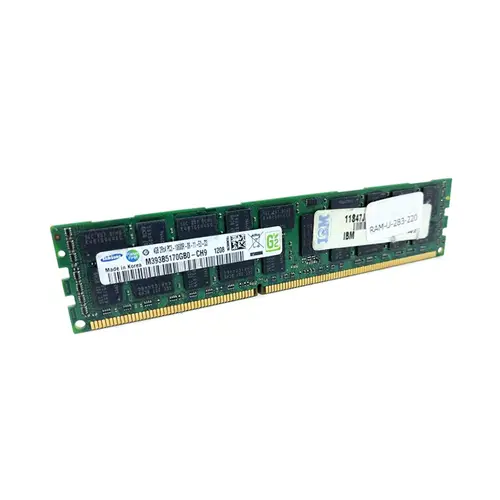
| Model | M393B5170GB0-CH9Q9 |
|---|---|
| Product Type | Memory Module |
| Compliance Standards | EU RoHS,FCC |
| Memory Capacity | 4 GB |
| Memory Technology | DDR3 |
| Product Voltage | 1.5V |
| RAM Speed | 1333MHz |
| RAM Standard | DDR3-1333/PC3-10600 |
| Error Identifying | ECC |
| Signal Type | Registered |
| Column Access Strobe (CAS) | CL9 |
| Rank | Dual Rank x4 |
| Quantity of Pins | 240-pin |
| RAM Genre | RDIMM |
This DDR3-1333 ECC Registered DIMM (RDIMM) is engineered specifically for server platforms running memory-intensive workloads such as virtualization and in-memory databases, where the combination of Error Correcting Code (ECC) and a registered signal buffer ensures data integrity and command address stability even under fully loaded configurations. The dual-rank x4 organization further enhances memory bandwidth through rank interleaving, and the CL9 latency provides responsive access for enterprise applications demanding consistent performance.
1. ECC protection continuously scans and corrects single-bit errors, eliminating silent data corruption risks that could crash virtualized workloads or compromise financial transaction integrity.
2. Registered buffer architecture isolates command and address loading from the memory controller, enabling high-density configurations that keep large-scale hypervisor hosts stable under full memory slot population.
3. Dual Rank x4 organization amplifies bank-level parallelism, ensuring sustained bandwidth when dozens of virtual machines contend for memory simultaneously across shared storage networks.
4. Modest single-digit CAS latency minimizes the gap between a read request and data delivery, directly accelerating server application response times in latency-sensitive database operations.
5. Standard DDR3 operating voltage guarantees drop-in compatibility with legacy server infrastructures, helping data centers extend hardware lifecycles without unexpected power delivery issues.
When you deploy the Samsung M393B5170GB0-CH9Q9, you are not simply installing a 4GB DDR3 module—you are safeguarding your mission‑critical infrastructure. This RDIMM’s registered architecture buffers command and address signals, allowing your server to populate multiple DIMMs per channel without signal degradation. In a dense virtualization cluster, that directly translates to deploying dozens of virtual machines with consistent, reliable memory performance even under full load. The integrated ECC continuously detects and corrects single‑bit errors, silently preventing data corruption that could crash a live database or produce incorrect financial calculations. Pair that error protection with the module’s dual‑rank x4‑based organization, and you unlock higher sustained bandwidth and bank‑level parallelism. For an in‑memory analytics engine like SAP HANA or an active Redis cluster, this means faster query response times because the memory controller can interleave accesses across ranks, minimizing idle cycles. The 1333MHz speed and CL9 latency deliver a balanced, power‑efficient (1.5V) solution that keeps thermal profiles manageable in dense rack environments without sacrificing throughput. Every transfer, every byte, stays accurate and responsive—keeping your virtualized workloads and data‑intensive applications running exactly as designed.
General Virtualization
Populate all memory channels symmetrically with these 4 GB DDR3 RDIMMs. For a dual‑socket server with triple‑channel architecture, install six identical modules (three per CPU) to obtain a balanced 24 GB configuration. ECC protection and registered buffering deliver the stability required for hosting multiple virtual machines; add a second DIMM per channel to reach 48 GB when consolidating heavier workloads.
In‑Memory Database
Maximize capacity by fully utilizing the registered DIMM design. On a triple‑channel platform, install two 4 GB modules per channel (twelve modules total) to build a 48 GB pool, which suits moderate in‑memory datasets. For larger databases, populate all three DIMM slots per channel if the platform supports it, achieving 72 GB with eighteen modules while still relying on the same 4 GB RDIMM to maintain consistent latency and error correction.
High‑Performance Computing
Achieve peak memory bandwidth by filling every memory channel with identical 4 GB RDIMMs. A typical dual‑socket, quad‑channel node benefits from eight modules (one per channel) for a 32 GB configuration. Keep the population balanced across all channels and sockets to avoid NUMA bottlenecks, ensuring maximum throughput for parallel simulations and computational fluid dynamics.
Server-grade RDIMM, rigorously tested, guaranteed compatible with Dell PowerEdge R720, HP ProLiant DL380p Gen8, Lenovo ThinkServer RD430.
Q: Can I mix this M393B5170GB0-CH9Q9 with other memory modules of different brands or speeds?
A: Mixing different brands, speeds, or ranks in a server is strongly discouraged. It can cause signal integrity issues and system instability. Always populate with identical Samsung M393B5170GB0-CH9Q9 modules to ensure validated compatibility and reliable 24/7 operation.
Q: Is this memory compatible with my system?
A: This DDR3 1333MHz ECC Registered RDIMM is designed for Intel Xeon E5/E5v2 or AMD Opteron 6300/8300 platforms. Verify your server board supports 1.5V, 240-pin RDIMMs and accepts dual-rank x4-bit DRAM modules before purchase.
Q: What is the recommended DIMM population order for optimal performance?
A: For typical dual-socket servers, populate identical RDIMMs in the slots farthest from the CPU first, usually starting with channel 0 blue slots. Follow your motherboard's memory population guide to enable balanced NUMA and maintain dual-channel performance.
Q: Does this module support overclocking or XMP profiles?
A: No. Registered DDR3 server memory operates strictly to JEDEC specifications and does not support XMP or overclocking. The CL9 timings and 1333MHz speed are fixed to guarantee maximum data integrity and compatibility in enterprise server environments.
Q: What warranty and typical failure rate can I expect?
A: This module comes with a 1-year warranty. As a Samsung enterprise-grade memory built with rigorous screening and ECC technology, it delivers a very low annualized failure rate (AFR), typically below industry average for server memory when operated within specifications.