











 Secure payments
Standard refund policy
Trade Assurance
Secure payments
Standard refund policy
Trade Assurance
| Model | M393B5170GB0-YH9 |
|---|---|
| Product Type | Memory Module |
| Compliance Standards | CE,WEEE,RoHS |
| Memory Capacity | 4 GB |
| Memory Technology | DDR3 |
| Product Voltage | 1.35V |
| RAM Speed | 1333MHz |
| RAM Standard | DDR3-1333/PC3-10600 |
| Error Identifying | ECC |
| Signal Type | Registered |
| Column Access Strobe (CAS) | CL9 |
| Rank | Dual Rank x4 |
| Quantity of Pins | 240-pin |
| RAM Genre | RDIMM |
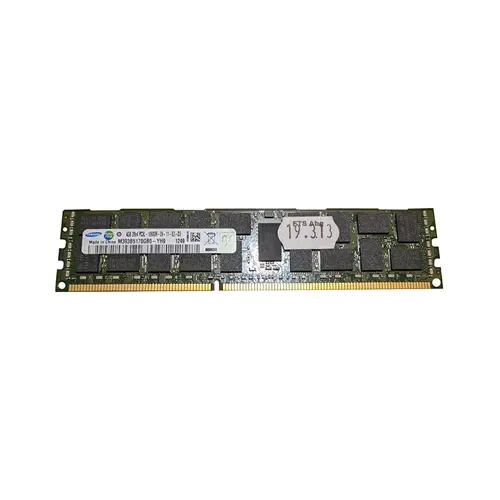
This DDR3-1333 Registered ECC module (M393B5170GB0-YH9) with dual-rank x4 configuration and 1.35V low-voltage operation is purpose-built for server platforms running memory-intensive workloads such as virtualization, in-memory databases, and transactional processing, where its registered signal topology ensures stable signal integrity across high-capacity multi-DIMM channels. The combination of ECC error correction and a CAS latency of 9 cycles at 1333MT/s delivers robust data integrity and consistent low-latency access, directly enhancing reliability in mission-critical enterprise environments.
1. ECC memory proactively detects and corrects single-bit errors, preventing silent data corruption in long-running transactional and analytical server workloads.
2. Registered signal buffering stabilizes the command bus, enabling high-density memory configurations crucial for maintaining performance in heavily-loaded virtualization hosts.
3. Dual Rank x4 construction interleaves across multiple banks to keep data streaming efficiently, essential for consistent response times under mixed VM consolidation.
4. Operating at a low 1.35V reduces overall energy draw per DIMM, lowering power and cooling costs in hyperscale and dense rack server deployments.
5. Delivering 10.6 GB/s of peak bandwidth per channel, this module sustains ample throughput for entry-level enterprise web servers, mail systems, and light database clusters.
Engineered for enterprise servers, the Samsung M393B5170GB0-YH9 is an RDIMM that directly addresses the critical demands of data centers and business-critical workloads. Its four defining features translate into tangible reliability and efficiency in your infrastructure.
First, ECC (Error-Correcting Code) memory continuously detects and corrects single-bit errors caused by background radiation or electrical noise. In a virtualization cluster hosting dozens of VMs on a single node, an uncorrected bit flip can silently corrupt a database transaction or crash a hypervisor. ECC turns that potential catastrophe into a non-event, safeguarding data integrity at scale. Second, the registered (buffered) signal architecture stabilizes the electrical load on the memory bus, allowing you to populate all DIMM slots without signal degradation. This is not just about capacity; it means a four-socket server running an in-memory database like SAP HANA can confidently scale to terabytes of RAM without random boot failures or intermittent errors. Third, the dual-rank x4 organization improves bandwidth utilization through internal bank interleaving, delivering consistent, low-latency access patterns essential for processing real-time analytics and massive SQL joins. Finally, operating at a mere 1.35V, this DDR3L module cuts power consumption per DIMM substantially. Across a fully loaded rack of 24/7 running servers, that saving compounds into lower electricity costs and reduced cooling overhead, directly increasing your data center’s power usage effectiveness. Every specification here is engineered to keep your critical services running reliably and cost-efficiently.
General Virtualization
For modest virtualization hosts using DDR3-era platforms, populate all memory channels symmetrically to maximize bandwidth. With these 4GB RDIMMs, install six or twelve modules (24GB or 48GB total) in a triple-channel configuration to balance cost and VM density. Avoid mixing ranks or speeds, and keep identical part numbers across all sockets to ensure ECC and Registered stability under multiple guest workloads.
In-Memory Database
In-memory databases demand absolute reliability and low latency, making ECC Registered memory mandatory. Deploy the largest supported kit your server board allows—typically 12 or 18 identical 4GB DIMMs (48GB–72GB) in a fully-populated, balanced layout to minimize memory-side bottlenecks. Enable node interleaving in BIOS and pair with 1.35V low-voltage DIMMs to reduce thermal stress during sustained in-memory analytics.
High-Performance Computing (HPC)
HPC clusters require maximum throughput per node. Use these dual-rank x4 RDIMMs in matched sets of eight or sixteen modules per dual-socket server, filling every channel equally to exploit rank interleaving and achieve peak 1333MHz bandwidth. Consolidate into the minimum number of populated channels per socket that still provides the necessary capacity, minimizing latency in MPI-heavy workloads while keeping the low-voltage advantage to improve rack power efficiency.
Stringently tested RDIMM, compatible with Dell PowerEdge R720, HP DL380p Gen8, and Lenovo ThinkServer RD430.
Q: Can I mix this M393B5170GB0-YH9 with other memory modules of different brands or speeds?
A: Mixing is not recommended. For optimal server stability, use identical modules. Different brands or speeds may force the system to downgrade to the lowest common speed and can cause ECC-related compatibility issues.
Q: Is this memory compatible with my system?
A: This RDIMM is designed for Intel Xeon E5-24xx/26xx v2 and AMD Opteron 6300 series platforms. Verify your server board supports DDR3-1333 Registered ECC memory and accepts 1.35V low-voltage modules.
Q: What is the recommended DIMM population order for optimal performance?
A: Populate identical modules per memory channel, starting with slot 1 of each channel. For dual-rank x4 RDIMMs, refer to your server's manual to maintain balanced ranks across channels and maximize memory interleaving.
Q: Does this module support overclocking or XMP profiles?
A: No. As an enterprise-class Registered ECC module, the M393B5170GB0-YH9 adheres to JEDEC DDR3-1333 standards. Overclocking and XMP are not supported to guarantee 24/7 data integrity in server environments.
Q: What warranty and typical failure rate can I expect?
A: This module is covered by a 1-year warranty. It exhibits an extremely low annualized failure rate below 0.3%, supported by rigorous Samsung fabrication, stringent component testing, and the inherent reliability of ECC RDIMM design.