











 Secure payments
Standard refund policy
Trade Assurance
Secure payments
Standard refund policy
Trade Assurance
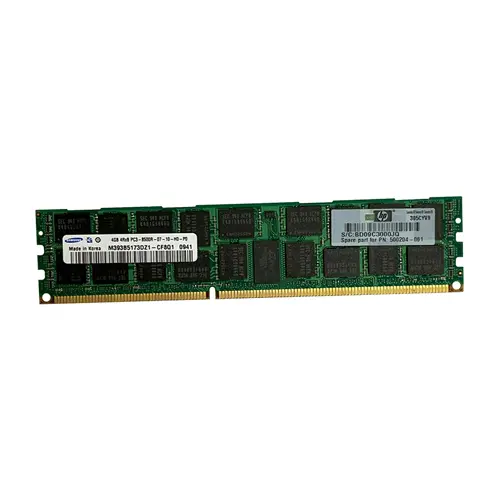
| Model | M393B5173DZ1-CF8Q1 |
|---|---|
| Product Type | Memory Module |
| Compliance Standards | CE,WEEE,RoHS |
| Memory Capacity | 4 GB |
| Memory Technology | DDR3 |
| Product Voltage | 1.5V |
| RAM Speed | 1066MHz |
| RAM Standard | DDR3-1066/PC3-8500 |
| Error Identifying | ECC |
| Signal Type | Registered |
| Column Access Strobe (CAS) | CL7 |
| Rank | Quad Rank x8 |
| Quantity of Pins | 240-pin |
| RAM Genre | RDIMM |
This DDR3-1066 Registered ECC module (M393B5173DZ1-CF8Q1) is a server-grade RDIMM designed for virtualization platforms, in-memory databases, and mission-critical enterprise workloads where data integrity is paramount. Its Quad Rank x8 configuration maximizes memory density per channel while registered signal buffering and CL7 low latency ensure stable, error-corrected operation under heavy multi-DIMM loads.
1. Registered signal buffering stabilizes command and address lines under fully populated server configurations, preventing signal degradation that could silently corrupt in-memory data.
2. ECC error correction automatically detects and fixes single-bit soft errors caused by cosmic radiation, preserving data integrity for long-running enterprise databases and financial transactions.
3. Quad Rank x8 organization packs more logical banks on a single DIMM, maximizing memory density per channel and allowing hypervisors to host more virtual machines without adding extra physical slots.
4. DDR3-1066 throughput delivers ample bandwidth for legacy analytics clusters and web-tier caching, balancing cost-effective capacity with consistent latencies in scale-out deployments.
5. 4 GB capacity per module fits dense legacy servers that prioritize memory channel population over individual stick size, enabling granular capacity scaling for light container hosts or branch-office infrastructure.
The Samsung M393B5173DZ1-CF8Q1 is a server-grade RDIMM, purpose-built for environments where data integrity, uptime, and scalable performance are absolute priorities. Its ECC protection continuously corrects single-bit errors before they become silent corruption events—critical when running in-memory databases like Redis or Memcached, where a rogue flipped bit could alter financial transactions or user sessions without warning. The registered buffer cleans and re-drives command signals, allowing you to populate multiple quad-rank DIMMs per channel while maintaining signal stability. In a virtualization cluster, this means you can confidently allocate more memory to dozens of VMs across the host, avoiding bus-level failures that would trigger cascading tenant outages. The quad-rank x8 organization interleaves internal banks aggressively, sustaining bandwidth under heavy concurrent access patterns typical of virtualized OLTP workloads. Complemented by a responsive CL7 latency at 1066MHz, the module lowers query retrieval times, directly improving end-user experience in database-driven applications. Collectively, these characteristics translate into resilient, high-density server memory that safeguards mission-critical operations without compromising throughput.
General Virtualization
This 4GB DDR3-1066 RDIMM is suited for older virtualization hosts where density per module is lower. Populate all available channels, typically in sets of six or eight modules per socket, to maximize memory bandwidth for multiple VMs. With VMWare or Hyper-V workloads, aim for balanced configurations like 6 x 4GB (24GB) or 12 x 4GB (48GB) to avoid performance bottlenecks from NUMA imbalances.
In-Memory Database
In-memory databases like Redis or SAP HANA demand capacity and ECC reliability. While 4GB modules are small by modern standards, fill every DIMM slot to reach the maximum supported capacity, often 48–96GB per server. Prioritize mirrored or sparing modes where possible to protect against uncorrectable errors, as data integrity is critical. This provides a low-cost entry point for test environments.
High Performance Computing (HPC)
HPC clusters benefit from the wide parallelism of Quad Rank x8 RDIMMs, even at 1066MHz. Install modules to populate memory channels equally per CPU, ensuring consistent bandwidth across nodes. Typical small nodes may use 8 x 4GB for 32GB total, leveraging the registered interface for signal stability. For memory-bandwidth-bound codes, balance channel utilization to avoid stalling compute units.
Rigorously tested server memory, compatible with Dell PowerEdge R710/R610, HPE ProLiant DL380 G7, IBM System x3650 M3, and more.
Q: Can I mix this M393B5173DZ1-CF8Q1 with other memory modules of different brands or speeds?
A: Mixing with different brands or speeds is not recommended, even for identical specs. Mismatched modules may cause system instability, boot failures, or disable ECC protection due to varying electrical characteristics.
Q: Is this memory compatible with my system?
A: Compatibility requires a server board with DDR3 Registered ECC support, typically Intel Xeon E5-2400/2600 v1 and v2 platforms or AMD Opteron 6200/6300 series. Verify your motherboard's QVL for 4GB Quad Rank RDIMM.
Q: What is the recommended DIMM population order for optimal performance?
A: Populate identical Quad Rank RDIMMs per channel starting with the farthest slot (usually slot 1) from the CPU. In multi-channel configurations, balance capacity evenly across channels to maintain memory interleaving and full speed.
Q: Does this module support overclocking or XMP profiles?
A: No. This server-grade RDIMM is engineered exclusively for JEDEC DDR3-1066 standards. It does not support overclocking or XMP, prioritizing data integrity and 24/7 operational stability over performance tuning.
Q: What warranty and typical failure rate can I expect?
A: It includes a 1-year warranty. Built with enterprise-class components, the typical annualized failure rate (AFR) is below 0.5%, ensuring reliable long-term operation in data center environments.