











 Secure payments
Standard refund policy
Trade Assurance
Secure payments
Standard refund policy
Trade Assurance
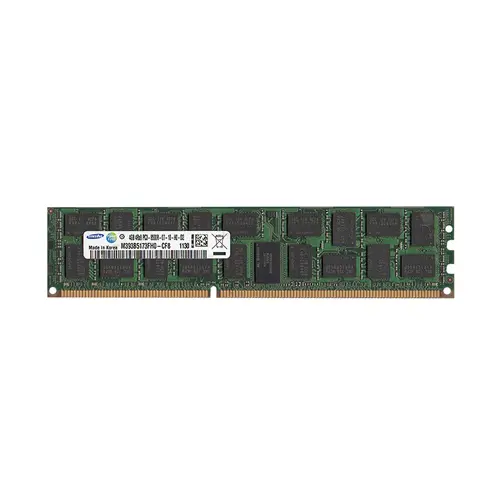
| Model | M393B5173FH0-CF8 |
|---|---|
| Product Type | Memory Module |
| Compliance Standards | EU RoHS,FCC |
| Memory Capacity | 4 GB |
| Memory Technology | DDR3 |
| Product Voltage | 1.5V |
| RAM Speed | 1066MHz |
| RAM Standard | DDR3-1066/PC3-8500 |
| Error Identifying | ECC |
| Signal Type | Registered |
| Column Access Strobe (CAS) | CL7 |
| Rank | Quad Rank x8 |
| Quantity of Pins | 240-pin |
| RAM Genre | RDIMM |
Designed for server environments, this DDR3-1066 RDIMM is ideally suited for memory-intensive workloads such as virtualization and in-memory databases where data integrity is paramount. Its registered signal type and ECC ensure stable operation across fully populated quad-rank configurations, while the low CL7 latency improves responsiveness under heavy transactional loads.
1. Registered signal type buffers command and address lines, enabling up to three DIMMs per channel without signal degradation for maximum server memory scalability.
2. ECC technology detects and corrects single-bit memory errors automatically, preserving data integrity in financial transactions and database operations where even a bit flip is unacceptable.
3. Quad Rank x8 organization packs a high capacity onto a single module, allowing dense virtualization hosts to run more VMs per server without wasting physical DIMM slots.
4. CL7 low column access latency reduces the time the memory controller waits for data, accelerating in-memory analytics and real-time query responses under stringent service level agreements.
5. A standard 1.5V operating voltage ensures consistent electrical margins across multi-socket servers, maintaining rock-solid stability in continuous 24/7 uptime environments.
In the server environments where this RDIMM lives, unscheduled downtime and silent data corruption are not just inconveniences—they are revenue killers. The Samsung M393B5173FH0-CF8’s four critical attributes directly neutralize those threats. Its ECC logic continuously scans and corrects single-bit flips, so when you run an in-memory financial database or a Redis caching layer, a stray cosmic ray won’t quietly rewrite a transaction record into a liability. The Registered buffer is equally vital: in a fully populated VMware cluster server, clean electrical re-driving of address and command signals allows the host to recognize all Quad Rank modules without signal collapse, letting you safely scale to hundreds of gigabytes. That Quad Rank x8 organization itself enables aggressive rank interleaving, serving concurrent memory requests from dozens of virtual machines without bottlenecking. And because every nanosecond counts in latency-sensitive SAP HANA queries, the tight CL7 CAS timing at 1066MHz ensures the memory answers the CPU faster. For the infrastructure owner, this means total data integrity during continuous operation, stable large-capacity deployments, and predictable, snappy response—transforming hardware specs into genuine business continuity.
General Virtualization
Deploy six or eight M393B5173FH0-CF8 modules per server to reach 24 GB or 32 GB total, providing a reliable foundation for 8–12 light virtual machines. The ECC and registered design ensure data integrity under sustained multi-tenant loads. Populate identical quad-rank DIMMs across all memory channels to maintain balanced interleaving and avoid performance penalties from rank mismatches.
In-Memory Database
Maximize capacity by filling every available DIMM slot – a dual-socket platform with 12–16 of these 4 GB RDIMMs yields 48–64 GB, enough for moderate Redis or MySQL in-memory datasets. The registered ECC protection is critical for transactional consistency; however, the 1066 MHz speed and quad-rank loading may restrict per-channel DIMM count, so consult your server’s rank-limitation matrix before scaling beyond one DIMM per channel.
High Performance Computing
For bandwidth-sensitive HPC, populate all memory channels with one quad-rank DIMM each to achieve the widest parallel access pattern while respecting rank-per-channel ceilings. The 1066 MT/s clock and CL7 latency suit workloads that prize capacity and error resilience over raw throughput, but for floating-point–heavy simulations consider pairing these modules with a newer server generation once higher frequency becomes necessary.
Server-grade memory, rigorously tested and compatible with Dell PowerEdge R720, HP DL380p Gen8, and Lenovo System x3650 M4.
Q: Can I mix this M393B5173FH0-CF8 with other memory modules of different brands or speeds?
A: Mixing with different brands or speeds is not recommended for registered server memory. It may cause instability or failure to POST. For reliable operation, use identical Samsung modules with the same rank, voltage, and CL7 latency.
Q: Is this memory compatible with my Intel Xeon or AMD Opteron server platform?
A: This DDR3-1066 Registered ECC RDIMM is compatible with dual-socket servers using Intel Xeon 5500/5600 series or AMD Opteron 6100/6200 series chipsets. Verify your motherboard's qualified vendor list supports quad-rank, 1.5V, 240-pin configurations.
Q: What is the recommended DIMM population order for optimal performance?
A: Populate identical quad-rank RDIMMs per memory channel, starting with the farthest slot from the CPU. For dual-processor systems, balance memory across both nodes. Consult the server's manual for specific slot numbering to maintain interleaving and minimize loading.
Q: Does this module support overclocking or XMP profiles?
A: No. Registered ECC server memory adheres strictly to JEDEC DDR3-1066 specifications for stability. Overclocking and XMP profiles are not supported and would compromise data integrity in mission-critical environments.
Q: What warranty and typical failure rate can I expect?
A: This module carries a one-year warranty against manufacturing defects. With rigorous Samsung fabrication, the annualized failure rate is typically below 0.5%, ensuring high reliability in data center workloads under specified thermal and voltage conditions.