











 Secure payments
Standard refund policy
Trade Assurance
Secure payments
Standard refund policy
Trade Assurance
| Model | M393B5173FH0-CF8Q4 |
|---|---|
| Product Type | Memory Module |
| Compliance Standards | EU RoHS,FCC |
| Memory Capacity | 4 GB |
| Memory Technology | DDR3 |
| Product Voltage | 1.5V |
| RAM Speed | 1066MHz |
| RAM Standard | DDR3-1066/PC3-8500 |
| Error Identifying | ECC |
| Signal Type | Registered |
| Column Access Strobe (CAS) | CL7 |
| Rank | Quad Rank x8 |
| Quantity of Pins | 240-pin |
| RAM Genre | RDIMM |
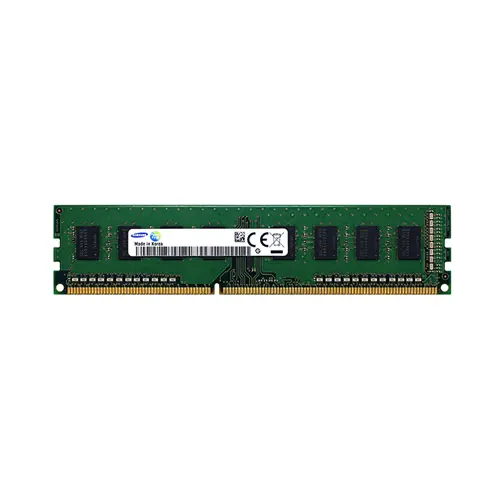
Designed for server environments, this Samsung M393B5173FH0-CF8Q4 DDR3-1066 RDIMM leverages registered signaling and ECC to ensure data integrity under sustained, heavy workloads. Its quad-rank x8 configuration enables high memory density per channel, making it ideally suited for virtualization hosts and memory-intensive databases where reliability and consistent latency (CL7) are critical.
1. With ECC protection, single-bit memory errors are detected and corrected in real time, preventing silent data corruption that could compromise long-running virtualization hosts and financial databases.
2. Registered signal buffering on the RDIMM stabilizes command and address lines, allowing the system to scale to higher total memory capacities across multiple channels without sacrificing signal integrity.
3. The Quad Rank x8 organization interleaves multiple internal ranks to keep server memory banks fully utilized, enhancing sustained throughput under heavy transactional and consolidation workloads.
4. DDR3 technology offers a proven, energy-efficient legacy platform for cost-sensitive enterprise deployments, ensuring broad compatibility with existing server infrastructures.
5. Tight CAS latency reduces the initial data access delay, speeding up cache misses and delivering snappier performance for latency-critical database and web server applications.
Based on the RDIMM form factor, Registered signal type, and ECC error identification, the M393B5173FH0-CF8Q4 is unequivocally a server-grade memory module. In mission‑critical data center environments, its four defining characteristics translate directly into tangible business continuity and performance.
First, ECC error correction actively detects and corrects single‑bit memory errors caused by background radiation or cosmic particles. For a virtualized cluster hosting dozens of VMs, a silent bit flip in a hypervisor page table can corrupt guest states or crash an entire node; ECC ensures data integrity at the silicon level, preventing unplanned downtime and data corruption that could violate SLA agreements. Second, the Registered buffer architecture stabilizes the electrical load on the memory bus, allowing the system to populate all four channels with Quad Rank DIMMs without signal degradation. This is vital for in‑memory databases like SAP HANA or Redis clusters, where maximizing capacity under heavy concurrent access directly determines query throughput — a non‑registered layout would force the server to throttle speed or limit population. The Quad Rank x8 organization further amplifies capacity per module, enabling denser RAM configurations that keep large datasets resident in memory. Finally, the CL7 latency at 1066MHz delivers predictable, low‑latency access right at the sweet spot where many enterprise workloads balance bandwidth and response time, ensuring that transactional databases and high‑frequency trading logs commit with microsecond consistency rather than suffering rank‑miss penalties.
General Virtualization
Populate all memory channels symmetrically with two of these 4GB quad‑rank registered DIMMs per channel, yielding 48GB on a typical dual‑socket triple‑channel server. ECC and registered buffering provide the stability needed for mixed VM workloads, while the balanced configuration leverages full interleaved bandwidth without overspending on speed.
In‑Memory Database
For memory‑resident databases like Redis or SAP HANA, maximize raw capacity by fully loading every DIMM slot. A dual‑processor board packed with these 4GB quad‑rank RDIMMs can reach 96GB or more, even if multiple quad‑rank modules per channel force a downclock to 800MHz. The ECC protection is essential for keeping your entire dataset error‑free in RAM.
High Performance Computing
Install a single 4GB quad‑rank RDIMM per memory channel to maintain the full DDR3‑1066 speed and reduce electrical loading, prioritizing bandwidth for simulation codes. When capacity is the bottleneck, use two modules per channel but expect a frequency drop—benchmark your specific HPC application to strike the right balance between raw throughput and total memory size.
Rigorously tested server DDR3 RDIMM, compatible with Dell PowerEdge R710, R510, HP DL380 G7, DL360 G7, IBM x3650 M3.
Q: Can I mix this M393B5173FH0-CF8Q4 with other memory modules of different brands or speeds?
A: Mixing different brands or speeds is not recommended for server environments. It can cause instability, POST failures, or silent data corruption. Always use identical Samsung RDIMMs with matching rank and CAS to ensure validated, reliable operation.
Q: Is this memory compatible with my system?
A: This DDR3 1066 registered ECC RDIMM is compatible with servers using Intel Xeon 5500/5600 series or AMD Opteron 4100/6100 platforms. Your motherboard must support 1.5V quad-rank RDIMMs and have available 240-pin slots.
Q: What is the recommended DIMM population order for optimal performance?
A: Populate slots according to your server board’s memory configuration guide, typically starting with the first slot of each channel. For quad-rank 4GB RDIMMs, install in sets of three or four DIMMs per processor to maintain balanced memory interleaving and peak bandwidth.
Q: Does this module support overclocking or XMP profiles?
A: No. This is a server-grade registered ECC module designed purely for reliability. It adheres to JEDEC DDR3-1066 standards and does not support overclocking, XMP, or other performance tuning profiles.
Q: What warranty and typical failure rate can I expect?
A: This Samsung module includes a 1-year replacement warranty. It is built for enterprise workloads with an extremely low annualized failure rate, typically below 0.5%, ensuring dependable long-term operation in 24/7 data center environments.