











 Secure payments
Standard refund policy
Trade Assurance
Secure payments
Standard refund policy
Trade Assurance
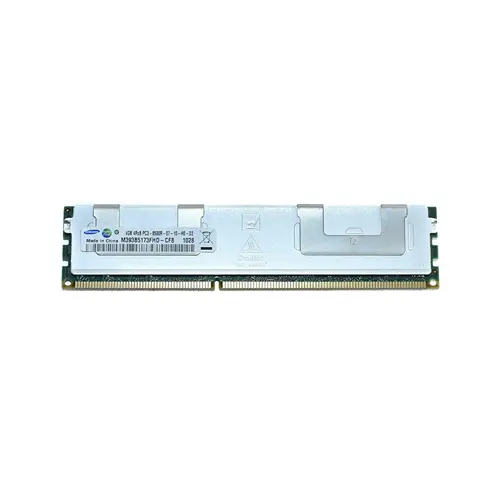
| Model | M393B5173FHD-CF8 |
|---|---|
| Product Type | Memory Module |
| Compliance Standards | EU RoHS,FCC |
| Memory Capacity | 4 GB |
| Memory Technology | DDR3 |
| Product Voltage | 1.5V |
| RAM Speed | 1066MHz |
| RAM Standard | DDR3-1066/PC3-8500 |
| Error Identifying | ECC |
| Signal Type | Registered |
| Column Access Strobe (CAS) | CL7 |
| Rank | Quad Rank x8 |
| Quantity of Pins | 240-pin |
| RAM Genre | RDIMM |
The M393B5173FHD-CF8 is a server-grade DDR3-1066 registered ECC RDIMM, purpose-built for virtualization and memory-intensive database workloads where data integrity is non-negotiable. Its registered signal architecture stabilizes command and address lines under heavy loading, and the quad-rank x8 organization combined with ECC and CL7 latency maximizes capacity density while tightly guarding against single-bit errors.
1. ECC protection catches and corrects single-bit errors, preserving data integrity for critical enterprise workloads like financial databases and virtualization hosts.
2. Registered signal buffering stabilizes command and address lines, allowing fully populated server boards to scale memory without compromising reliability.
3. Quad Rank x8 organization packs more logical banks per channel, boosting memory-level parallelism and sustaining throughput under heavy virtual machine consolidation.
4. CL7 low column-access latency shrinks memory fetch overhead, giving transactional and analytics engines faster response times for real-time decision support.
5. Standard 1.5 volt operation balances energy efficiency with thermal headroom, helping dense rack servers maintain consistent clock stability during continuous uptime.
Designed for demanding server environments, the Samsung M393B5173FHD-CF8 is an RDIMM that turns four architectural strengths into tangible business resilience. Its ECC technology automatically detects and corrects single-bit memory errors, which is non-negotiable for financial transaction databases where even one flipped bit can corrupt a ledger entry or halt a trading system. The registered signal buffer stabilizes the command and address lines, enabling large-scale virtualization clusters to run dozens of virtual machines without signal decay or random reboots during peak loads. A quad-rank x8 organization packs higher density per module, allowing you to maximize memory capacity across limited DIMM slots in a 2U rack server—essential for in-memory caching platforms like Redis that demand expansive, contiguous memory pools. The DDR3-1066 speed with a CL7 latency hits an optimal midpoint between throughput and response time, accelerating query processing in virtualized SQL farms without overstressing legacy power budgets. Together, these features transform a simple memory upgrade into a reliability foundation for around-the-clock enterprise workloads.
Capacity Planning for Samsung M393B5173FHD-CF8 (Server RDIMM)
This 4GB DDR3-1066 ECC Registered Quad-Rank RDIMM is designed for server workloads. Use the following per-scenario capacity planning advice.
General Virtualization
Maximize total RAM by populating all memory channels with identical quad-rank modules, balancing them across sockets. Under full load the bus may down-clock to 800MHz, but the added capacity is essential for high VM density. A typical dual-socket server with 24 of these DIMMs delivers 96GB, ideal for consolidating many light to moderate virtual machines.
In-Memory Database
Install the maximum number of supported modules to create a large, resilient memory pool; ECC and registered signaling ensure integrity. Databases like SAP HANA favor capacity over speed, so operating at 800MHz is perfectly fine. Also enable mirroring or rank sparing to protect against multi-bit errors without downtime.
High-Performance Computing (HPC)
For latency- and bandwidth-critical jobs, limit each memory channel to a single quad-rank DIMM. This maintains the full 1066MHz speed and yields 12–16GB per socket. If applications demand more memory, scale horizontally across nodes using a fast interconnect rather than degrading per-node performance.
Validated server memory, rigorously tested. Compatible with Dell PowerEdge R710/R720, HP DL380p Gen8, IBM System x3650 M4.
Q: Can I mix this M393B5173FHD-CF8 with other memory modules of different brands or speeds?
A: Mixing RDIMMs of different brands or speeds is not recommended. It may cause system instability or POST failures. For reliable operation, use identical modules with the same Samsung part number, timing, and rank.
Q: Is this memory compatible with my Intel Xeon E5 or AMD Opteron G34 server platform?
A: It is compatible with servers using DDR3 RDIMM slots, such as Intel Xeon E5-2600/E5-2400 series and AMD Opteron 6300 series. Verify your motherboard supports 4GB Quad Rank x8 1066MHz modules.
Q: What is the recommended DIMM population order for optimal performance with this Quad Rank module?
A: Populate identical Quad Rank RDIMMs starting from the first slot of each memory channel. Follow your server’s manual for rank-aware balancing; typically, install one DIMM per channel first to maximize bandwidth.
Q: Does this module support overclocking or XMP profiles?
A: No, this server-grade RDIMM does not support overclocking or XMP. It operates strictly at JEDEC standard DDR3-1066 with CL7 timings. Stability and data integrity are prioritized over performance tuning.
Q: What warranty and typical failure rate can I expect from this memory?
A: This Samsung module includes a one-year warranty. Enterprise RDIMMs like this have an annualized failure rate (AFR) typically below 0.5% under proper operating conditions, ensuring high reliability.