











 Secure payments
Standard refund policy
Trade Assurance
Secure payments
Standard refund policy
Trade Assurance
| Model | M393B5270BH1-YH9 |
|---|---|
| Product Type | Memory Module |
| Compliance Standards | EU RoHS,FCC |
| Memory Capacity | 4 GB |
| Memory Technology | DDR3 |
| Product Voltage | 1.35V |
| RAM Speed | 1333MHz |
| RAM Standard | DDR3-1333/PC3-10600 |
| Error Identifying | ECC |
| Signal Type | Registered |
| Column Access Strobe (CAS) | CL9 |
| Rank | Single Rank x4 |
| Quantity of Pins | 240-pin |
| RAM Genre | RDIMM |
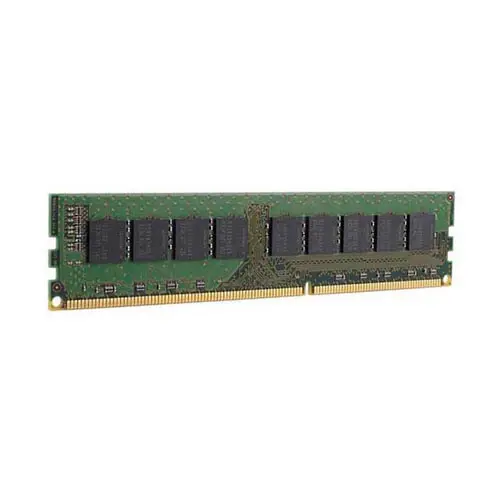
Designed for legacy server platforms, this Samsung M393B5270BH1-YH9 is a DDR3-1333 Registered ECC RDIMM that excels in virtualization and in-memory database workloads where data integrity is paramount. Its 1.35 V low-voltage operation, single-rank x4 configuration, and registered signaling ensure stable 24/7 operation and reduced power consumption in dense rack deployments.
1. ECC protects against memory errors silently corrupting transactional data, delivering the reliability demanded by database and virtualization hosts.
2. Registered architecture amplifies signal integrity for large memory populations, allowing server boards to maximize RAM capacity without sacrificing uptime.
3. Ultra-low voltage operation trims per-DIMM power draw, significantly improving energy efficiency in hyperscale server farms.
4. Single-rank configuration with narrow DRAM device width boosts resilience by isolating faults to smaller data chunks, critical for maintaining availability under error conditions.
5. Compact capacity serves as optimal building block for cost-effective edge servers or appliances where dedicated task memory needs are modest and predictable.
As a server-grade 4 GB DDR3 RDIMM, the Samsung M393B5270BH1-YH9 exploits four properties that matter most in virtualized clusters and in-memory databases: ECC error correction, registered buffering, 1.35V low-power operation, and stable 1333MHz CL9 performance. In a VMware farm, a single undetected bit-flip can take down dozens of VMs; ECC instantly corrects soft errors, preserving uptime and data integrity. The registered buffer lightens the electrical load, allowing three DIMMs per channel to build large, reliable memory pools—critical when an in-memory database like Redis must keep the entire dataset in fault-free RAM. Operating at 1.35V instead of 1.5V trims power and cooling costs by about 20% across a rack, directly lowering your TCO. Finally, the consistent 1333MHz speed and CL9 latency guarantee predictable throughput, so transaction-heavy applications maintain low response times under load. This memory means you scale virtual footprints and accelerate memory-centric workloads without sacrificing stability or efficiency.
General Virtualization
With only 4 GB per module, these RDIMMs are best suited for modest virtualization hosts. Deploy six to eight modules across triple-channel or quad-channel memory controllers to reach 24–32 GB, providing enough headroom for several light VMs. Avoid populating fewer channels, as balanced DIMM distribution ensures optimal memory bandwidth for multiple guest workloads.
In-Memory Database
In-memory databases demand high capacity and low latency; a single 4 GB DIMM is insufficient. Install the maximum supported quantity—typically 12 or 16 modules in dual-socket servers—to approach 48–64 GB, though this still limits real‑time analytics. For production datasets, prefer higher‑density RDIMMs and consider pairing these modules only in small test or development environments.
High-Performance Computing
HPC clusters thrive on memory bandwidth. Populate all memory channels uniformly with identical 4 GB RDIMMs to enable full interleaving and maximize throughput per core. For example, eight modules in a dual-processor system deliver 32 GB of registered DDR3-1333, adequate for parallel simulations that scale across nodes rather than fit entirely in memory.
Certified compatible with Dell PowerEdge R720, HPE ProLiant DL380p Gen8, Lenovo System x3650 M4, and similar servers after rigorous testing.
Q: Can I mix this M393B5270BH1-YH9 with other memory modules of different brands or speeds?
A: Mixing different brands or speeds on a server platform is not recommended. Mismatched Registered ECC DIMMs may cause instability, boot failures, or reduced reliability. Use identical part numbers for guaranteed compatibility.
Q: Is this memory compatible with my system?
A: This DDR3-1333 Registered ECC RDIMM is designed for servers using Intel Xeon E5-2400/2600 v1/v2 or AMD Opteron 6200/6300 series platforms with C600/C602 chipsets. Please verify your motherboard's QVL or OEM compatibility list.
Q: What is the recommended DIMM population order for optimal performance?
A: Follow your server motherboard manual. Typically, populate identical DIMMs per channel starting from the farthest slot (e.g., slot 1, then 2). Balanced channel loading ensures maximum memory bandwidth and stability.
Q: Does this module support overclocking or XMP profiles?
A: No. This is a server-grade Registered ECC DIMM built for 24/7 data integrity. Overclocking and XMP profiles are not supported, as they compromise the error correction and reliability required in enterprise environments.
Q: What warranty and typical failure rate can I expect?
A: This module includes a 1-year warranty. The failure rate is extremely low, aligning with enterprise-class reliability standards (typical AFR well under 0.5%). It is rigorously tested for mission-critical server deployments.