











 Secure payments
Standard refund policy
Trade Assurance
Secure payments
Standard refund policy
Trade Assurance
| Model | M393B5270CH0-CH9Q4 |
|---|---|
| Product Type | Memory Module |
| Compliance Standards | EU RoHS,FCC |
| Memory Capacity | 4 GB |
| Memory Technology | DDR3 |
| Product Voltage | 1.5V |
| RAM Speed | 1333MHz |
| RAM Standard | DDR3-1333/PC3-10600 |
| Error Identifying | ECC |
| Signal Type | Registered |
| Column Access Strobe (CAS) | CL9 |
| Rank | Single Rank x4 |
| Quantity of Pins | 240-pin |
| RAM Genre | RDIMM |
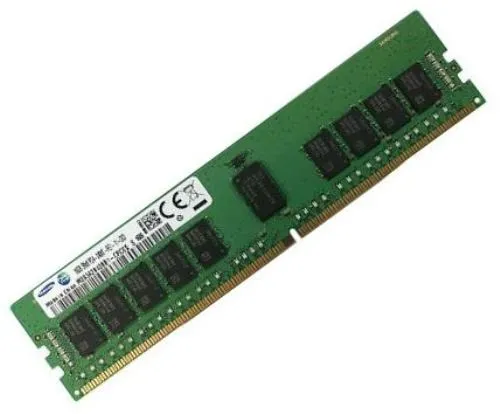
Designed for server environments, this Samsung M393B5270CH0-CH9Q4 is a 4GB DDR3-1333 Registered DIMM with ECC that ensures data integrity and system stability in memory-intensive workloads like virtualization and in-memory databases. Its single-rank x4 organization and CL9 latency reduce the electrical loading on the memory bus, enabling reliable operation at 1.5V in dense, multi-DIMM server configurations.
1. ECC protection silently corrects single-bit errors and detects multi-bit faults, preventing silent data corruption in financial transactions or critical databases that cannot tolerate downtime.
2. Registered signal buffering stabilizes high-capacity memory configurations by reducing electrical load on the memory controller, enabling reliable operation of multi-DIMM channels in dense rack servers.
3. RDIMM designation guarantees compatibility with enterprise server boards, allowing system builders to populate all memory slots without sacrificing signal integrity under 24/7 operation.
4. Single Rank x4 organization maximizes bank-level parallelism within a single rank, delivering steady bandwidth that keeps latency-sensitive virtualization hosts responsive under varied tenant loads.
5. 4GB capacity per module provides a fine-grained building block for total memory tuning, letting admins right-size Hyper-V or VMware nodes without wasting expensive capacity on light-duty application servers.
The M393B5270CH0-CH9Q4 is a DDR3 Registered DIMM purpose-built for servers, not desktops or notebooks. Its four defining properties directly address the relentless demands of enterprise data centers: ECC error correction, Registered signal buffering, a Single Rank x4 organization, and stable 1333MHz operation at CL9.
In a virtualized cluster running dozens of VMs on VMware ESXi, memory integrity is non-negotiable. The ECC on this module detects and corrects single-bit errors in real time, silently preventing bit flips caused by cosmic radiation or electrical noise from corrupting a financial transaction inside a virtual machine or causing a hypervisor crash. Without ECC, silent data corruption could cascade across an entire tenant environment, eroding trust and compliance. Simultaneously, the Registered buffer re-drives address and command signals, stabilizing the electrical load when populating dense server boards with multiple DIMMs per channel. This means you can reliably scale to 256GB or more per host without sacrificing uptime, enabling higher consolidation ratios.
For an in-memory analytics database like Redis or SAP HANA, where every query runs against data held entirely in DRAM, the Single Rank x4 architecture proves critical. By using x4-wide DRAM chips in a single rank, the module reduces the channel’s per-rank capacitance, allowing the memory controller to command it with tighter row-to-column access delays. Paired with a predictable CL9 latency, this gives the database sub-microsecond responsiveness during high-concurrency online transaction processing. Even at 1.5V and 1333MHz, this module delivers a deterministic, energy-conscious profile for scale-out clusters, where every saved watt reduces cooling overhead and the proven DDR3 platform extends the life of legacy infrastructures without compromising data fidelity.
General Virtualization
This 4 GB DDR3-1333 ECC Registered DIMM suits older server platforms. For general virtualization, target 48–64 GB by populating 12–16 modules evenly across all memory channels of a dual-socket system. Symmetric configuration per CPU maximizes interleaving and bandwidth, efficiently supporting moderate VM density without oversubscribing resources.
In-Memory Database
Capacity is the driving factor to keep entire datasets in RAM. Fill all available RDIMM slots—often 18 or 24 in dual-processor nodes—to reach 72–96 GB. Always use identical modules from a single batch to guarantee signal integrity and rely on ECC to protect critical data structures against single-bit errors.
High-Performance Computing
Prioritize sustained memory bandwidth and latency avoidance. Install one DIMM per channel (typically 4 or 6 modules per CPU) to run at full 1333 MHz without downclocking. A total of 48 GB (12 modules) suffices for many compute-bound workloads; minor capacity padding prevents swap while keeping configurations clean and predictable for job scheduling.
Rigorously tested RDIMM: compatible with Dell PowerEdge R720, HP DL380p Gen8, Lenovo x3650 M4.
Q: Can I mix this M393B5270CH0-CH9Q4 with other memory modules of different brands or speeds?
A: Mixing Registered ECC memory with different brands or speeds is not recommended. It can cause instability or boot failures. For server reliability, always use identical modules validated for your platform.
Q: Is this memory compatible with my Intel Xeon E5 or AMD Opteron server?
A: This DDR3-1333 Registered ECC RDIMM supports servers based on Intel 5500/5600 series or AMD G34/C32 platforms. Confirm your board's QVL and support for 4GB single-rank x4 DIMMs.
Q: What is the recommended DIMM population order for optimal performance?
A: Follow your server's technical guide, populating identical DIMMs per channel. Typically, start with the first slot of each memory channel (e.g., A1, B1) to enable balanced interleaving.
Q: Does this module support overclocking or XMP profiles?
A: No. This is a JEDEC-compliant server Registered ECC DIMM. Overclocking and XMP are not supported, as the module prioritizes data integrity and continuous 24/7 operational stability.
Q: What warranty and typical failure rate can I expect?
A: It includes a 1-year warranty. Enterprise-class ECC modules exhibit very low annualized failure rates, typically around 0.1–0.2%, when operated within specified temperature and voltage conditions.