











 Secure payments
Standard refund policy
Trade Assurance
Secure payments
Standard refund policy
Trade Assurance
| Model | M393B5270DH0-CK0Q9 |
|---|---|
| Product Type | Memory Module |
| Compliance Standards | EU RoHS,FCC |
| Memory Capacity | 4 GB |
| Memory Technology | DDR3 |
| Product Voltage | 1.5V |
| RAM Speed | 1600MHz |
| RAM Standard | DDR3-1600/PC3-12800 |
| Error Identifying | ECC |
| Signal Type | Registered |
| Column Access Strobe (CAS) | CL11 |
| Rank | Single Rank x4 |
| Quantity of Pins | 240-pin |
| RAM Genre | RDIMM |
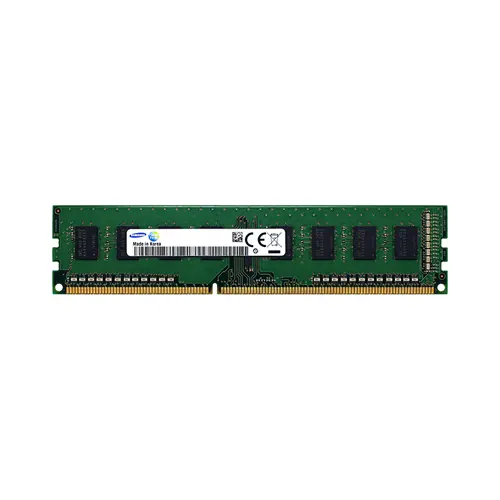
This Samsung M393B5270DH0-CK0Q9 is a server-grade DDR3-1600 Registered DIMM with ECC, purpose-built for virtualization platforms and in-memory databases where data integrity and uptime are critical. Its single-rank x4 organization and registered signal topology ensure lower electrical loading on the memory bus, enabling stable operation at 1600 MT/s with CL11 latency even in fully populated multi-DIMM configurations.
1. ECC protection detects and corrects single-bit errors in real-time, preventing silent data corruption in financial transaction processing and mission-critical databases.
2. Registered clock buffers stabilize signal integrity across fully loaded memory channels, enabling large-capacity 24/7 server operation without instability.
3. The 1600 MT/s transfer rate translates to a peak bandwidth of 12.8 GB/s per channel, reducing latency spikes during heavy virtualization and in-memory caching workloads.
4. Single Rank x4 organization allows the memory controller to drive one rank per channel efficiently, maximizing throughput consistency for consolidated virtual machines.
5. A 4 GB module capacity balances cost and density, letting IT architects scale up to dozens of VMs per node when populating all DIMM slots in a high-density rack server.
In mission-critical server environments, the M393B5270DH0-CK0Q9 RDIMM is engineered to overcome the most pressing challenges of data integrity and scalability. Its Error-Correcting Code (ECC) technology continuously scans for and corrects single-bit memory errors—silent data corruption that can crash a virtualization cluster or return inaccurate results from an in-memory database like Redis or SAP HANA. The registered (buffered) architecture decouples the memory controller from the DRAM load, enabling 24-DIMM-slot population in a dual-socket server without signal degradation; this translates to running more virtual machines per host and maintaining stability under heavy consolidation. With a 1600MHz clock speed and CL11 latency, the module delivers the high bandwidth demanded by concurrent transactional workloads. Its single-rank x4 design minimizes electrical loading on the memory bus, allowing the server to sustain peak transfer rates even in fully loaded configurations. For IT operators, this eliminates unexplained hiccups, scaling RAM to terabytes preserving integrity and uptime.
General Virtualization
A hypervisor hosting multiple moderate VMs benefits from balanced capacity and redundancy. Populate at least six of these 4 GB RDIMMs across three memory channels per CPU (18–24 GB total) to allow efficient memory interleaving while leaving room for growth. Always install identical DIMMs in sets of three to maintain triple-channel mode and avoid performance penalties from unbalanced configurations.
In-Memory Database
In-memory datasets demand both low latency and uncompromised data integrity. Deploy the maximum number of supported DIMMs—typically 12 or 16 modules per dual-socket server—to reach 48–64 GB capacity, ensuring the working set resides entirely in RAM. The registered ECC design corrects single-bit errors on the fly, which is critical for transactional consistency long after a memory cell begins to degrade.
High-Performance Computing
HPC clusters prioritize aggregate memory bandwidth over per-node capacity. Install one DIMM per channel in each node—commonly six modules per socket for a hexa‑channel platform—yielding 24 GB of full-speed bandwidth for MPI‑based simulations. Because compute nodes are often scaled horizontally, the low power draw of these 1.5 V single-rank RDIMMs reduces thermal load across hundreds of identical servers, improving overall datacenter efficiency.
Strictly tested for compatibility with DDR3 servers: Dell PowerEdge R720, HP ProLiant DL380p Gen8, Lenovo ThinkServer RD430.
Q: Can I mix this M393B5270DH0-CK0Q9 with other memory modules of different brands or speeds?
A: Mixing different brands or speeds within a server is not recommended. For registered ECC memory, identical modules ensure signal integrity, stability, and reliable multi-channel operation under continuous loads.
Q: Is this memory compatible with my system?
A: This DDR3-1600 registered ECC RDIMM is designed for dual-socket servers using Intel Xeon E5-2600 series or AMD Opteron 6300 series platforms. Please verify your server board's Qualified Vendor List for full compatibility.
Q: What is the recommended DIMM population order for optimal performance?
A: Populate identical DIMMs in the first slot of each memory channel to balance interleaving. Refer to your server manual for exact layout; typically, fill all white or blue slots first to maximize bandwidth.
Q: Does this module support overclocking or XMP profiles?
A: No. As an enterprise registered DDR3 ECC module, it does not support XMP or overclocking. It operates strictly at JEDEC-standard timings (PC3-12800, CL11) to guarantee data integrity and platform stability.
Q: What warranty and typical failure rate can I expect?
A: This module includes a 1-year warranty. Its ECC design and Samsung's rigorous production testing yield an extremely low AFR, making it suitable for 24/7 mission-critical server environments.