











 Secure payments
Standard refund policy
Trade Assurance
Secure payments
Standard refund policy
Trade Assurance
| Model | M393B5270EB0-CK0 |
|---|---|
| Product Type | Memory Module |
| Compliance Standards | EU RoHS,FCC |
| Memory Capacity | 4 GB |
| Memory Technology | DDR3 |
| Product Voltage | 1.5V |
| RAM Speed | 1600MHz |
| RAM Standard | DDR3-1600/PC3-12800 |
| Error Identifying | ECC |
| Signal Type | Registered |
| Column Access Strobe (CAS) | CL11 |
| Rank | Single Rank x4 |
| Quantity of Pins | 240-pin |
| RAM Genre | RDIMM |
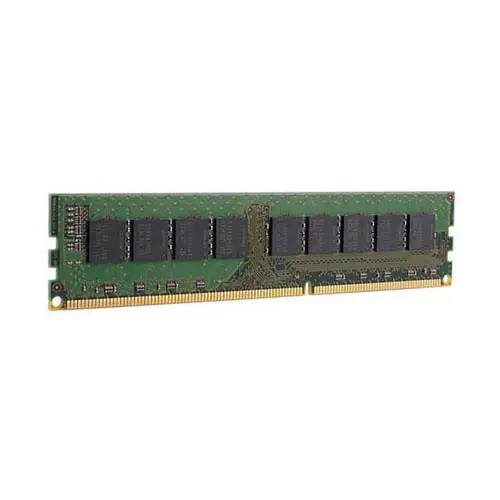
Designed for server platforms, the M393B5270EB0-CK0 is a DDR3-1600 registered ECC RDIMM that ensures data integrity and system stability in mission-critical environments. Its single-rank x4 organization and CL11 latency provide balanced performance ideal for virtualization, in-memory databases, and workloads where error correction and reliable registered signaling are paramount.
1. ECC error correction proactively detects and corrects single-bit memory faults, preventing silent data corruption in transactional databases and financial processing systems.
2. Registered signal buffering stabilizes address and command lines under heavy load, allowing fully populated memory channels without signal degradation in dense server enclosures.
3. RDIMM architecture re-drives control signals to support higher capacity per channel, maximizing VM density for enterprise virtualization platforms.
4. 1600 MHz speed unlocks 12.8 GB/s peak throughput per DIMM, accelerating real-time analytics and caching workloads that demand fast in-memory access.
5. Single Rank x4 organization reduces per-module electrical load, enabling servers to populate all slots while respecting tight thermal and power budgets in 1U rack deployments.
When you deploy a virtualization cluster hosting dozens of business-critical VMs, a single uncorrected memory error can cascade into data corruption, application crashes, and costly downtime. The Samsung M393B5270EB0-CK0, a 4GB DDR3-1600 RDIMM, is engineered specifically to eliminate that risk. Its ECC technology continuously detects and corrects single-bit errors, directly preserving data integrity for in-memory databases like Redis or SAP HANA where even a flipped bit can poison financial transactions or analytics results. Equally vital is the Registered (buffered) design: as you scale to populate multiple DIMMs per channel, the on-board register stabilizes command signals, preventing the electrical loading that would otherwise force you to throttle speed or face erratic boot failures. The single-rank x4 organization further optimizes this stability by balancing bank-level parallelism against channel loading, delivering predictable 1600MHz bandwidth under the sustained mixed workloads of a hypervisor hosting active directory, file services, and web tiers simultaneously. For your 24/7 server environment, this memory module transforms abstract specifications into tangible reassurance—uninterrupted operations, hardened data accuracy, and consistent low-latency responsiveness when every millisecond matters.
General Virtualization
For general virtualization hosts, this 4 GB DDR3-1600 registered ECC module is best deployed in balanced quantities to maximize memory channels and overall capacity. Install at least six or eight identical modules (24–32 GB total) per socket to leverage multi-channel architectures and satisfy moderate VM density, reserving headroom for hypervisor overhead and failover needs.
In-Memory Database
In-memory databases demand both high capacity and absolute data integrity, making ECC RDIMMs essential. Although 4 GB per stick is modest, populate all available DIMM slots—often 12 or 16 per server—to reach 48–64 GB or more, ensuring the entire working set fits in RAM. Pair with low-latency settings and avoid mixing ranks or speeds for consistent, predictable response times.
HPC (High Performance Computing)
HPC clusters benefit from registered ECC memory to maintain computational accuracy across long-running parallel jobs. Populate channels symmetrically (e.g., one 4 GB RDIMM per channel) to sustain balanced throughput per core, typically aiming for 2–4 GB per physical core. In dense nodes, fill all slots to maximize total bandwidth, but verify that single-rank x4 configuration aligns with the CPU’s memory population guidelines to avoid performance penalties.
This rigorously tested server memory is compatible with Dell PowerEdge R720/R620, HP DL380p Gen8, Lenovo RD630, and similar systems.
Q: Can I mix this M393B5270EB0-CK0 with other memory modules of different brands or speeds?
A: Mixing different brands or speeds is not recommended. In servers, mismatch can cause instability, ECC errors, and degraded performance. For reliable operation, use identical modules.
Q: Is this memory compatible with my system?
A: This is a DDR3 ECC Registered RDIMM for servers. It works with platforms like Intel Xeon E5-2600 v1/v2 series. Verify your motherboard's memory QVL list to ensure compatibility.
Q: What is the recommended DIMM population order for optimal performance?
A: Follow your server motherboard manual; typically populate identical DIMMs in slot groups (e.g., A1, B1) to enable multi-channel memory and maintain balanced ranks for best throughput.
Q: Does this module support overclocking or XMP profiles?
A: No. This server module adheres to JEDEC DDR3-1600 standards. It does not support overclocking or XMP profiles, as data center reliability and stability are paramount.
Q: What warranty and typical failure rate can I expect?
A: This module includes a 1-year warranty. Server-grade memory like this typically has an annualized failure rate (AFR) below 0.1% under normal operating conditions, ensuring high reliability.