











 Secure payments
Standard refund policy
Trade Assurance
Secure payments
Standard refund policy
Trade Assurance
| Model | M393B5270QB0-CK0 |
|---|---|
| Product Type | Memory Module |
| Compliance Standards | EU RoHS,FCC |
| Memory Capacity | 4 GB |
| Memory Technology | DDR3 |
| Product Voltage | 1.5V |
| RAM Speed | 1600MHz |
| RAM Standard | DDR3-1600/PC3-12800 |
| Error Identifying | ECC |
| Signal Type | Registered |
| Column Access Strobe (CAS) | CL11 |
| Rank | Single Rank x4 |
| Quantity of Pins | 240-pin |
| RAM Genre | RDIMM |
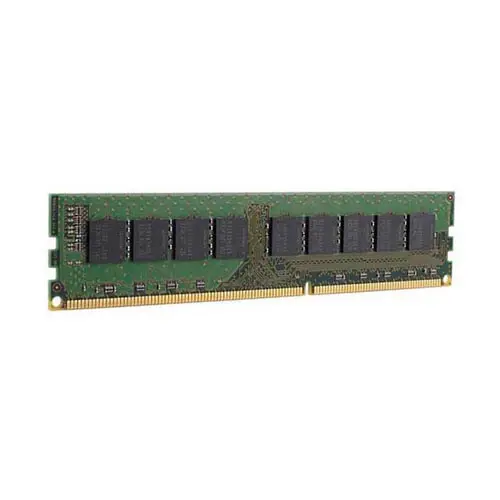
This 4GB DDR3-1600 RDIMM with ECC and registered signaling is a server-grade module purpose-built for virtualization, in-memory databases, and other mission-critical workloads that demand absolute data integrity and stability under sustained 24/7 operation. The single-rank x4 configuration, combined with its registered architecture, minimizes electrical loading on the memory bus and ensures stable signal transmission in dense multi-DIMM server platforms, allowing systems to scale memory capacity efficiently without compromising reliability.
1. Registered DIMM architecture buffers command and address signals to preserve signal integrity across heavily populated server memory channels, enabling reliable scaling without compromising uptime.
2. ECC protection silently detects and corrects single-bit memory errors on the fly, eliminating a major source of silent data corruption in transactional and database workloads.
3. Single Rank x4 organization presents a lighter electrical load per rank, helping maintain stable 1600MT/s timings even when all DIMM slots are filled in dense virtualization nodes.
4. 1600MHz operating speed delivers a peak per‑channel bandwidth of 12.8GB/s, meeting the throughput demands of concurrent virtual machines and in‑memory caching tiers.
5. 4GB capacity serves efficiently in micro‑appliance and light infrastructure roles, keeping power and thermal footprint minimal while covering essential system memory needs.
When deploying a virtualized cluster or running an in-memory database, the M393B5270QB0-CK0 RDIMM transforms technical specifications into tangible business resilience. Its ECC technology actively corrects single-bit errors, meaning the seemingly minor cosmic ray or electrical noise won’t silently flip a bit and crash a hypervisor hosting dozens of critical VMs—this prevents data corruption before it ever reaches your application. The registered signal buffer directly addresses the pain of server memory channel loading. In a fully populated 24-slot server, unbuffered DIMMs would force you to throttle speeds or sacrifice capacity; this registered design stabilizes the electrical load, enabling you to confidently maximize density for dense virtualization or container orchestration without fear of training failures. With DDR3-1600 speed and a single-rank x4 architecture, the module delivers superior bandwidth in parallel access patterns, which is vital when an in-memory analytics platform like a Redis cluster must fetch millions of keys per second with minimal latency. The CAS 11 latency strikes the ideal balance for sustained throughput, ensuring your queries against the dataset stay crisp under load. This combination makes the difference between a system that merely stays online and one that consistently accelerates transactional workloads, protecting your data integrity while scaling up capacity and performance in legacy enterprise racks.
General Virtualization
For a typical hypervisor hosting multiple VMs, populate at least six to twelve modules per server to reach 24–48 GB of total capacity. Deploy the 4 GB RDIMMs in balanced channels—one DIMM per channel—to maintain DDR3-1600 speed while benefiting from registered stability under mixed workloads.
In-Memory Database
In-memory databases demand both capacity and data integrity. Use fully populated memory risers with these 4 GB ECC RDIMMs to achieve 64 GB or more per node, depending on slot count. The single-rank x4 configuration offers low latency, helping sustain high throughput for real-time analytics.
High-Performance Computing
HPC clusters rely on bandwidth and correctness. Install one DIMM per channel across all memory channels to maximize bandwidth at 1600 MT/s, avoiding speed downgrades from multiple DIMMs per channel. A typical dual-socket node with 16 DIMMs delivers 64 GB of registered ECC memory, ideal for error-sensitive simulation and modeling runs.
Rigorously tested for compatibility: fits Dell PowerEdge R720, HPE DL380p Gen8, IBM x3550 M4, and similar server platforms.
Q: Can I mix this M393B5270QB0-CK0 with other memory modules of different brands or speeds?
A: We strongly advise against mixing different brands, speeds, or part numbers in a server. Mismatched Registered ECC DIMMs can cause POST failures, stability issues, or uncorrectable memory errors under load.
Q: Is this memory compatible with my system?
A: Yes, for servers using Intel Xeon E5-2600 v2 series or AMD Opteron 6300 series platforms that require DDR3-1600 Registered ECC RDIMMs. Please verify your motherboard's Qualified Vendor List (QVL) for this specific 4GB module.
Q: What is the recommended DIMM population order for optimal performance?
A: Populate identical DIMMs in matched sets per memory channel, typically starting with the blue slots. For single-rank RDIMMs, follow your server manual's balanced configuration to maximize memory interleaving and bandwidth.
Q: Does this module support overclocking or XMP profiles?
A: No. Server-class Registered ECC memory operates strictly at JEDEC standard DDR3-1600 (PC3-12800) with CL11 timings. It does not support XMP profiles or overclocking, as data integrity and stability take priority over speed.
Q: What warranty and typical failure rate can I expect?
A: This module comes with a one-year warranty. Enterprise-grade Samsung DRAM exhibits an Annualized Failure Rate (AFR) typically well below 1%, ensuring high reliability for 24/7 data-center operations.