











 Secure payments
Standard refund policy
Trade Assurance
Secure payments
Standard refund policy
Trade Assurance
| Model | M393B5273EB0-CMA |
|---|---|
| Product Type | Memory Module |
| Compliance Standards | EU RoHS,FCC |
| Memory Capacity | 4 GB |
| Memory Technology | DDR3 |
| Product Voltage | 1.5V |
| RAM Speed | 1866MHz |
| RAM Standard | DDR3-1866/PC3-14900 |
| Error Identifying | ECC |
| Signal Type | Registered |
| Column Access Strobe (CAS) | CL13 |
| Rank | Dual Rank x8 |
| Quantity of Pins | 240-pin |
| RAM Genre | RDIMM |
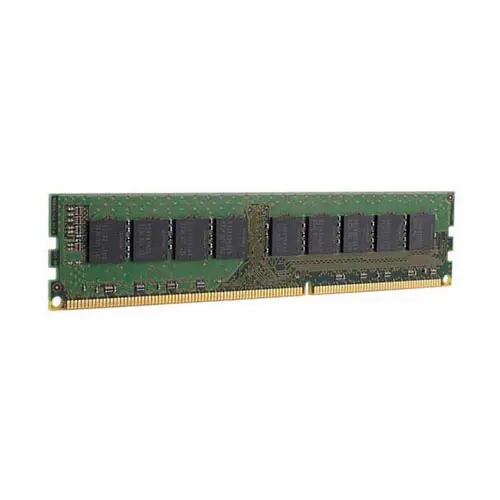
Designed for server platforms, this Samsung M393B5273EB0-CMA 4GB DDR3-1866 Registered DIMM with ECC ensures data integrity in virtualized environments and memory-intensive workloads such as in-memory databases. Its Dual Rank x8 organization and registered signal architecture enhance signal stability and memory channel efficiency, while the low CL13 latency improves responsiveness under sustained load.
1. ECC protection automatically detects and corrects single-bit errors, preserving data integrity for transactional databases and financial systems that cannot tolerate silent corruption.
2. Registered signal buffering stabilizes high-capacity memory configurations, allowing dense virtualization hosts to pack more VMs without sacrificing reliability.
3. Dual Rank x8 interleaving maximizes channel utilization, delivering consistent bandwidth under heavy consolidation when multiple virtual machines contend for memory.
4. 1866 MHz clock speed yields 14.9 GB/s of peak throughput, accelerating in-memory caching, real-time analytics, and large-scale content delivery workloads.
5. CL13 low latency speeds up row-to-column read turnaround, reducing the access gap for latency-sensitive enterprise applications like OLTP databases and high-frequency trading.
When you rely on a virtualized cluster to keep dozens of business-critical applications running, an undetected memory error is more than a technical nuisance—it is a financial risk. The M393B5273EB0-CMA, a 4GB DDR3-1866 Registered ECC RDIMM, is engineered to eliminate that risk and keep your data center predictable. Its four defining characteristics directly translate into real-world resilience: error-correcting code that catches and corrects single-bit flips caused by cosmic radiation or electrical noise, registered signal buffering that stabilizes command and address lines even when you fully populate all 24 DIMM slots in a dual-socket server, a dual-rank x8 organization that enables rank interleaving for higher effective bandwidth under concurrent access patterns, and a tight CAS latency of 13 coupled with 1866MHz speed to feed hungry in-memory databases.
In a VMware farm hosting mixed workloads, ECC is the silent guardian that prevents a flipped bit from silently corrupting a financial transaction or collapsing a guest VM. Registered buffering is what lets you install 192GB or more without chaos on the memory bus—reduced electrical load means the platform can sustain heavy consolidation without signal degradation. Shift to a memory-hungry Redis or SAP HANA instance, and the dual-rank design delivers overlapping data bursts that measurably improve transaction throughput. The 1866 MT/s speed and CL13 latency ensure that when the CPU asks for the next chunk of an in-memory index, the answer arrives fast enough to keep query latency in the microseconds. This RDIMM turns memory from a commodity into a strategic enabler of uptime and performance where it matters most.
Based on the provided specifications — DDR3, ECC, Registered, 240-pin RDIMM — this is server memory. The following capacity planning guidance addresses typical server workload scenarios using these 4GB DDR3-1866 RDIMMs.
General Virtualization
Virtualization hosts thrive on total memory headroom, often measuring capacity per VM. Populate all available channels evenly to maximize memory bandwidth, which benefits many simultaneous guests. A common starting point is six or eight of these 4GB modules per socket, yielding 24GB or 32GB, but scale to 64GB+ for moderate consolidation ratios by using higher-density DIMMs where your platform allows; always keep an identical configuration per NUMA node for balanced performance.
In-Memory Database
In-memory databases such as Redis or SAP HANA demand absolute capacity and data integrity. Use the maximum number of supported RDIMM slots with the largest compatible counterparts to these 4GB sticks, as ECC is non-negotiable here. Employ all memory channels per CPU (typically 3 or 4) with identical DIMMs to preserve low latency and avoid performance cliffs; a dual-rank x8 configuration like this module offers good signal integrity but plan for a minimum of 64–128 GB total, often requiring denser RDIMMs in a pure 4GB-module build.
High-Performance Computing (HPC)
HPC workloads balance bandwidth sensitivity with capacity per core. Populate one DIMM per channel for peak frequency and lowest latency — using a full set of these DDR3-1866 modules on a dual-socket system can saturate memory bandwidth. For capacity-limited simulations, fill a second DIMM per channel, observing that speed may drop to 1600MT/s on some platforms; plan module count to align with job slices so each compute node runs identical memory configurations for predictable scaling.
Rigorously tested for DDR3 registered servers; compatible with Dell PowerEdge R720, HP ProLiant DL380p Gen8, and Lenovo System x3650 M4.
Q: Can I mix this M393B5273EB0-CMA with other memory modules of different brands or speeds?
A: Mixing is not recommended. Server platforms require identical RDIMMs to ensure signal integrity and stability. Different brands or speeds often cause POST failures or memory errors under ECC monitoring.
Q: Is this memory compatible with my system?
A: This is a DDR3-1866 Registered ECC RDIMM. It requires a server board with an Intel Xeon E5-2600 v2/v3 or AMD Opteron 6300 series platform supporting 1.5V, 240-pin RDIMMs. Verify your vendor's qualified list.
Q: What is the recommended DIMM population order for optimal performance?
A: Populate identical DIMMs per channel, starting with slots farthest from the CPU. For dual-socket servers, balance memory evenly across both sockets and follow the motherboard's white-slot-first guideline to retain full ECC and bandwidth.
Q: Does this module support overclocking or XMP profiles?
A: No. As an enterprise-grade Registered ECC DIMM, it strictly adheres to JEDEC DDR3-1866 specifications. Overclocking and XMP are omitted to guarantee 24/7 data integrity and platform-level error correction.
Q: What warranty and typical failure rate can I expect?
A: This module includes a one-year warranty. With Samsung’s rigorous binning and server-grade screening, the annualized failure rate is typically below 0.2%, ensuring exceptional long-term reliability in mission-critical deployments.