











 Secure payments
Standard refund policy
Trade Assurance
Secure payments
Standard refund policy
Trade Assurance
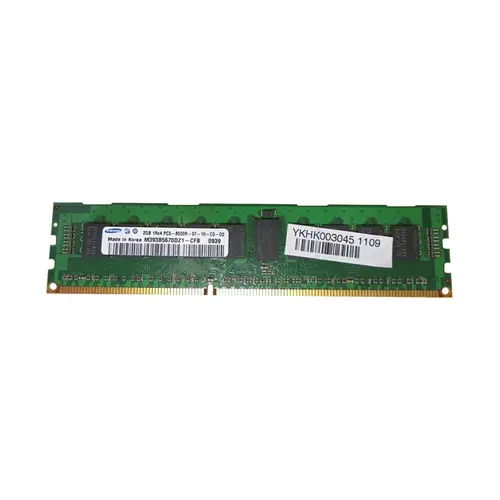
| Model | M393B5670DZ1-CF8 |
|---|---|
| Product Type | Memory Module |
| Compliance Standards | CE,WEEE,RoHS |
| Memory Capacity | 2 GB |
| Memory Technology | DDR3 |
| Product Voltage | 1.5V |
| RAM Speed | 1066MHz |
| RAM Standard | DDR3-1066/PC3-8500 |
| Error Identifying | ECC |
| Signal Type | Registered |
| Column Access Strobe (CAS) | CL7 |
| Rank | Single Rank x4 |
| Quantity of Pins | 240-pin |
| RAM Genre | RDIMM |
This Samsung M393B5670DZ1-CF8 is a server-grade 2GB DDR3-1066 Registered ECC RDIMM, specifically engineered for virtualization and memory-intensive data center workloads where data integrity and system stability are paramount. Its single-rank x4 configuration combined with CL7 low-latency timing and registered signal buffering delivers reliable electrical performance in multi-DIMM per channel deployments, ensuring robust error correction and consistent uptime under 24/7 operation.
1. Error Correction Code actively detects and corrects single-bit memory errors, shielding virtualized databases and transactional systems from silent data corruption.
2. The registered buffer isolates the memory controller from electrical loading on the command and address bus, allowing more DIMMs per channel for memory-dense server deployments without compromising signal integrity.
3. The x4 DRAM organization widens the ECC codeword coverage per access, reinforcing data protection, while single rank keeps the electrical load light to maintain stable latency under mixed-rank population.
4. A consistent 8.5 GB/s per-channel bandwidth delivers predictable throughput for mid-scale application servers and file-serving nodes, balancing performance with lower thermal stress.
5. The CL7 latency shrinks the gap between a read command and data delivery, giving latency-critical services like in-memory caches and lightweight hypervisors a tangible response-time advantage.
When you deploy virtualized clusters or in-memory databases, the M393B5670DZ1-CF8’s four core attributes directly uphold the uptime and data integrity your workloads demand. ECC error correction is non-negotiable: it catches and repairs single-bit flips induced by background radiation, preventing silent corruption that could crash a hypervisor hosting dozens of VMs or poison financial transaction logs. The registered buffer amplifies command and address signals, letting you populate every 240-pin slot without sacrificing stability—so you can scale RAM capacity for massive VM density without compromising signal quality. A CL7 column access strobe latency accelerates data retrieval under the mixed random-access patterns of an in-memory key-value store, trimming response tails and boosting queries per second. Finally, the single-rank x4 configuration presents a lighter electrical load to the memory controller, sustaining consistent 1066MHz bandwidth even when all channels are stressed. In practice, that means your Redis instances maintain state flawlessly during live migrations, your database shards stay consistent, and your server infrastructure delivers the reliability your enterprise runs on.
General Virtualization
Populate all memory channels symmetrically to maximize interleaving and bandwidth. For a dual-socket server using these 2GB RDIMMs, install at least 12 DIMMs per CPU (24 GB) to host a modest number of virtual machines without swapping. Given the small module size, this configuration suits light to moderate virtualization but will constrain VM density; consider upgrading to 8GB or 16GB Registered DIMMs for production consolidation.
In-Memory Database
In-memory databases demand both capacity and low latency. These 2GB modules severely limit dataset size, making them unsuitable for production. If used, fill every slot to reach the platform maximum—e.g., 48 DIMMs for only 96 GB—which may serve small development or test instances. For any real workload, replace them with higher-capacity DDR3 RDIMMs to keep the entire dataset in memory.
High-Performance Computing (HPC)
HPC workloads benefit from balanced memory bandwidth per core. In triple-channel DDR3 architectures, install three identical DIMMs per CPU to enable full channel interleaving, yielding 6 GB per socket. This provides basic throughput for lightweight node tasks, but large-scale simulations will quickly exhaust capacity. Mitigate NUMA effects and increase problem sizes by migrating to larger, higher-density RDIMMs across all memory channels.
Rigorously tested server memory, compatible with Dell PowerEdge R710, HPE ProLiant DL380 G7, Lenovo ThinkServer RD630.
Q: Can I mix this M393B5670DZ1-CF8 with other memory modules of different brands or speeds?
A: Mixing is technically possible but not recommended. All modules will operate at the lowest common speed and must be identical in type (DDR3 Registered ECC). For optimal stability, use identical part numbers.
Q: Is this memory compatible with my server system?
A: This RDIMM is designed for servers with DDR3 Registered ECC support, typically Intel Xeon 5500/5600 series or AMD Opteron 4100/6100 platforms. Verify your board supports DDR3-1066 Registered DIMMs.
Q: What is the recommended DIMM population order for optimal performance?
A: Follow your server motherboard's memory population guide. Generally, populate identical DIMMs per channel starting with the slot farthest from the CPU. Balance across memory channels for best throughput.
Q: Does this module support overclocking or XMP profiles?
A: No. This is a JEDEC-compliant server-grade Registered ECC module running at standard DDR3-1066. It does not support overclocking, XMP profiles, or voltage adjustments. Stability is prioritized over tuning.
Q: What warranty and typical failure rate can I expect?
A: This module carries a 1-year warranty. As an enterprise-class ECC RDIMM built with Samsung components, it delivers a very low annualized failure rate (AFR), typically under 0.5%, ensuring reliable long-term operation.