











 Secure payments
Standard refund policy
Trade Assurance
Secure payments
Standard refund policy
Trade Assurance
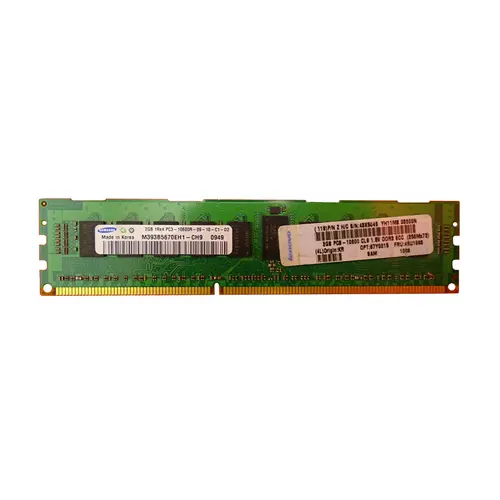
| Model | M393B5670EH1-CH9 |
|---|---|
| Product Type | Memory Module |
| Compliance Standards | CE,WEEE,RoHS |
| Memory Capacity | 2 GB |
| Memory Technology | DDR3 |
| Product Voltage | 1.5V |
| RAM Speed | 1333MHz |
| RAM Standard | DDR3-1333/PC3-10600 |
| Error Identifying | ECC |
| Signal Type | Registered |
| Column Access Strobe (CAS) | CL9 |
| Rank | Single Rank x4 |
| Quantity of Pins | 240-pin |
| RAM Genre | RDIMM |
Designed for legacy server platforms requiring reliable memory subsystems, this 2GB DDR3-1333 RDIMM integrates ECC and a registered signal architecture to maintain data integrity in virtualized environments and memory-intensive database workloads. The single-rank x4 organization at CL9 helps reduce command bus loading, enabling stable operation across multiple DIMMs per channel while ensuring consistent 1.5V power delivery.
1. ECC error correction silently detects and repairs single-bit data corruption, safeguarding financial transactions and database integrity in always-on enterprise environments.
2. Registered buffering isolates the memory controller from heavy signal loads, making large-scale multi-rank deployments stable across fully populated server nodes.
3. Single Rank x4 construction reduces per-channel electrical overhead, enabling predictable high-frequency signaling while lowering overall memory subsystem power.
4. The mainstream DDR3 frequency provides balanced throughput for multiple concurrent virtual machines, avoiding thermal and power stress during sustained operation.
5. Moderate CAS latency optimizes command-to-data turnaround, keeping cache-miss penalties low and response times consistent under dense consolidation workloads.
The Samsung M393B5670EH1-CH9 is a server-grade RDIMM, purpose-built for data centers where uptime and data accuracy are business critical. Its four core attributes directly counter the real risks you face in demanding infrastructure. Error-Correcting Code (ECC) memory is your silent guardian against background radiation-induced bit-flips. For an in-memory database powering real-time financial ledgers, a single undetected bit error can corrupt a transaction record; ECC instantly corrects single-bit faults and detects multi-bit anomalies, preserving the absolute integrity your audit trails demand. The Registered signal buffer acts as a traffic controller on the address bus, re-driving commands cleanly to every DRAM chip. This stabilizes the electrical load so you can fully populate dense virtualization clusters with dozens of VMs without risking instability or sudden host failures from degraded signals. The Single Rank x4 configuration optimizes command rate and bandwidth access, reducing contention when multiple virtual machines compete for I/O, which translates to smoother VM responsiveness during peak consolidation. Finally, the DDR3-1333 speed with a CAS 9 latency provides a balanced throughput profile that sustains steady data flows for your core services, proving that reliable performance doesn’t require chasing maximum frequency but mastering harmonious, error-free operation. This module doesn’t just store data; it fortifies every process that keeps your enterprise online.
General Virtualization
This 2GB DDR3-1333 RDIMM is one of the smallest building blocks for legacy servers. For light virtualization clusters, populate at least six modules per socket to enable triple-channel operation, aiming for a total capacity of 24–48 GB. In multi-node setups, maintain identical Part Numbers to avoid ECC and rank mismatch faults.
In-Memory Database
In-memory workloads demand large capacity and ECC assurance, so this single-rank module is rarely used alone. Build servers with fully populated DIMM slots, often 12 or 18 modules per CPU, to reach 96–144 GB minimum. Because of the low 2GB density, prefer platforms with many memory channels to aggregate sufficient bandwidth and keep databases fully cached in fault-tolerant RAM.
High-Performance Computing
HPC clusters once widely used registered DDR3 modules for scalable throughput. Deploy balanced configurations across all memory channels—typically six or eight identical sticks per node—to maximize interleave and sustained bandwidth. Swap these out for higher-capacity DIMMs if per-node memory exceeds 64 GB, as modern simulation checkpoints often outgrow small-rank modules like this x4 single-rank part.
Rigorously tested server memory, compatible with Dell PowerEdge R710, HP ProLiant DL380 G7, and Lenovo ThinkServer RD230.
Q: Can I mix this M393B5670EH1-CH9 with other memory modules of different brands or speeds?
A: Mixing is not recommended for this registered ECC RDIMM. All modules should match in speed, rank, and timings to ensure server-grade stability and prevent signal integrity issues.
Q: Is this memory compatible with my system? It is a dual-processor server with Intel Xeon E5-2400 series.
A: Yes, this DDR3-1333 RDIMM is compatible with Intel Xeon E5-2400 platforms using the C600 chipset. Verify your server’s qualified vendor list for this Samsung 2GB module.
Q: What is the recommended DIMM population order for optimal performance with this module?
A: Populate identical DIMMs per memory channel, starting farthest from the CPU. Follow your server's manual for balanced configurations. Use equal ranks and capacities across channels for the best interleaving.
Q: Does this module support overclocking or XMP profiles?
A: No. This is an enterprise DDR3 Registered ECC module rated at JEDEC standard 1333MHz with CL9. It does not support overclocking or XMP, as server memory prioritizes data integrity over speed tuning.
Q: What warranty and typical failure rate can I expect for the M393B5670EH1-CH9?
A: This module includes a one-year warranty. As an enterprise-grade Samsung RDIMM, it exhibits a very low annualized failure rate, typically below 0.5%, ensuring reliable long-term operation in mission-critical servers.