











 Secure payments
Standard refund policy
Trade Assurance
Secure payments
Standard refund policy
Trade Assurance
| Model | M393B5670EH1-YH9 |
|---|---|
| Product Type | Memory Module |
| Compliance Standards | EU RoHS,FCC |
| Memory Capacity | 2 GB |
| Memory Technology | DDR3 |
| Product Voltage | 1.35V |
| RAM Speed | 1333MHz |
| RAM Standard | DDR3-1333/PC3-10600 |
| Error Identifying | ECC |
| Signal Type | Registered |
| Column Access Strobe (CAS) | CL9 |
| Rank | Single Rank x4 |
| Quantity of Pins | 240-pin |
| RAM Genre | RDIMM |
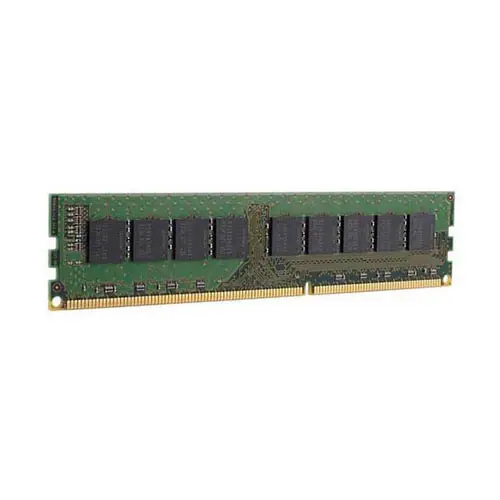
Designed for server platforms requiring uncompromising data integrity, this Samsung M393B5670EH1-YH9 2GB DDR3-1333 RDIMM leverages ECC and registered signal technology to eliminate single-bit errors and stabilize high-capacity memory configurations in virtualization and in-memory database workloads. With a single-rank x4 organization and low 1.35V operation, it delivers consistent CL9 latency while minimizing power draw, making it ideal for dense, efficiency-optimized enterprise deployments.
1. ECC protection corrects single-bit errors and detects multi-bit faults on the fly, preserving data integrity for financial transactions and database logs that cannot tolerate silent corruption.
2. Registered buffering re-drives command and address signals, allowing multiple RDIMMs to populate the same channel without signal degradation—critical for dense virtualization hosts.
3. Operating at 1.35V instead of standard 1.5V significantly cuts per-module energy use and waste heat, directly translating to lower cooling overhead in scale-out data centers.
4. The 1333 MHz clock rate provides a balanced 10.6 GB/s of peak bandwidth per channel, sufficient to keep latency-sensitive web and caching tiers responsive under steady query loads.
5. A Single Rank x4 configuration offloads the memory controller while supplying the extra DRAM width needed for ECC, making it a power-savvy choice for blade servers where every watt matters.
The Samsung M393B5670EH1-YH9 is a DDR3L Registered DIMM purpose-built for demanding server workloads, and its four core attributes directly safeguard your infrastructure. ECC error correction acts as a silent guardian, detecting and fixing single-bit memory errors caused by cosmic radiation or electrical noise. In a virtualization cluster hosting dozens of VMs, uncaught corruption can crash hypervisors or silently poison virtual disks—ECC prevents that disaster, ensuring service continuity. The registered signal buffer stabilizes command and address lines, allowing multiple high-capacity DIMMs to coexist without signal degradation. This means you can densely populate server boards for in-memory databases like Redis, where scale-out reliability is non-negotiable. The module’s low 1.35V operating voltage cuts power draw by approximately 20% versus standard DDR3, slashing both energy bills and thermal stress in packed racks—critical for 24/7 data centers. Finally, the single-rank x4 organization delivers consistent, predictable latency under heavy burst loads, so your cached queries return without jitter even during peak traffic. Together these characteristics turn the M393B5670EH1-YH9 into a foundation of integrity, density, and efficiency for any enterprise deployment.
Server Memory Identified: The Samsung M393B5670EH1-YH9 is a DDR3-1333 Registered ECC DIMM with a capacity of 2 GB per module. Its low voltage (1.35V) and error-correcting features make it suitable for legacy server platforms. Capacity planning must account for the small module density, meaning higher quantities are needed for modern workloads.
General Virtualization
For a general virtualization host, memory is typically the first bottleneck. With 2 GB RDIMMs, you need a high module count to consolidate even a modest number of virtual machines. A dual-socket system with 12 DIMM slots per CPU should be populated with 24 identical modules to reach 48 GB total, enabling around 8-10 light VMs. Always install modules in balanced configurations across memory channels to maintain interleaving and avoid performance penalties.
In-Memory Database
In-memory databases demand substantial capacity and reliability. Using 2 GB modules seriously limits dataset size, so you must maximize all available DIMM slots. For a platform with 24 slots, fully populating with 48 GB (24 modules) can support only very small caching layers or development instances. The ECC error protection is critical here to guard against data corruption, and every slot should be filled with identical registered DIMMs to ensure stable operation under constant load.
High-Performance Computing (HPC)
HPC workloads favor memory bandwidth over sheer capacity. Populate all memory channels with an equal number of modules—typically one or two per channel—to unlock maximum throughput. For example, in a quad-channel platform, installing 8 modules (2 per channel) will yield 16 GB of memory while delivering balanced bandwidth. Given the 1333 MHz speed, latency-sensitive codes will benefit from the CAS 9 timing, and the registered buffer helps maintain signal integrity at scale.
Rigorously tested, compatible with Dell PowerEdge R720, HP ProLiant DL380p Gen8, IBM System x3650 M4.
Q: Can I mix this M393B5670EH1-YH9 with other memory modules of different brands or speeds?
A: Mixing this registered ECC RDIMM with unbuffered or non-ECC modules is unsupported and will likely prevent boot. For stable server operation, all installed DIMMs must share identical specifications, including voltage, rank, and timings.
Q: Is this memory compatible with my server platform? (Intel/AMD)
A: This DDR3-1333 registered ECC DIMM is compatible with servers using Intel Xeon 5500/5600 series or AMD Opteron 6100/6200 series processors. Please verify your motherboard specifically supports 1.35V low-voltage RDIMMs and 240-pin DDR3 slots.
Q: What is the recommended DIMM population order for optimal performance?
A: For dual-processor servers, populate identical DIMMs per memory channel starting with the slots farthest from the CPU. Follow the platform’s memory population guide to enable balanced interleaving and full memory bandwidth across all installed processors.
Q: Does this module support overclocking or XMP profiles?
A: No, this is an enterprise-grade server memory module operating at fixed JEDEC-standard DDR3-1333 timings. It does not include XMP profiles and has no overclocking capabilities, prioritizing data integrity and 24/7 reliability.
Q: What warranty and typical failure rate can I expect?
A: This module includes a one-year warranty covering manufacturing defects. As a rigorously tested enterprise component with ECC protection, the annualized failure rate is extremely low under standard server operating conditions and proper cooling.